
Photo Credit: thecambridger.wordpress.com
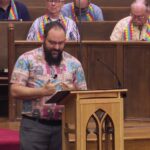
Moral autonomy, the reigning doctrine of our age, is seriously inhibiting both truth and freedom for the gospel. The reasons why this is so was discussed in some detail by Jim Tonkowich, past president of the Institute on Religion and Democracy, at a Faith and Law presentation on February 21 on Capitol Hill. Tonkowich asserted that by making untrammeled freedom the supreme consideration, relativism is profoundly hostile to the Christian commitment to the lordship of Jesus.
Tonkowich noted the confession that “Jesus is Lord,” has always been the basic Christian confession, and it has always been disputed. While the Magi “understood the look and feel of majesty,” a more common reaction is that of bystanders at Jesus’ Passion, popularized as “Jesus, you don’t look like much of a king to me.” However, Tonkowich claimed that Jesus kingship, “while disputed today, will one day be beyond dispute … we are early adapters of the age to come.” In the present age, Christians struggle to realize Jesus’ lordship in a world that does not acknowledge him, but are driven forward in faithfulness to Christ. This commitment was presented with Dutch Calvinist Abraham Kuyper’s famous words “There is not one square inch of the entire creation about which Jesus Christ does not cry out, ‘This is mine! This belongs to me!’”
It is “because Jesus is King we believe there is true and false,” Tonkowich said, but when his kingship is rejected, truth “is rejected outright.” Another way of saying this is that “truth is democratized.” In the contemporary world, Gnostic ideas are very influential, and they are part of this same issue, since for Gnostics, truth is “intrinsic” (i.e., inside a person), not “extrinsic” (something coming from outside ourselves that we have to accept whether we like it or not). Similarly, sociologist Christian Smith found that among American young people, the most basic belief was belief in “myself.” Tonkowich noted that Facebook now lists 58 “genders” from which its users can pick, not just two sexes. Biological sex is now viewed as “an assault on human dignity,” and dignity is understood to be based on a self-defined essence, not on external reality. “Rational argument is viewed as aggression and even hatred.” In this radically different understanding of truth and morality, the “imperatives of morality come from within.” “The rejection of all authority as demeaning or degrading” has ominous implications, reducing all human interaction to a power struggle. Our contemporary, relativistic “culture views God as a competitor in a zero-sum game.”
The power struggle of blind will is seen especially in the “culture war” Supreme Court decisions which have excluded consideration of Judeo-Christian morality from the formulation of law. The famous “mystery clause” of the 1992 Casey decision, upholding legal abortion, declared that each individual has the “right to define one’s own concept of existence, of meaning, of the universe, and of the mystery of human life.” Similarly, the Romer, Lawrence, and Windsor decisions legalizing and normalizing homosexuality declare that law against sodomy expresses “impermissible animus,” is “demeaning” to “homosexual persons,” and therefore cannot be rationally justified.
While the doctrine of moral autonomy “makes God the great tyrant,” Jesus Christ reveals a God whose “very being is love,” Tonkowich said. He noted a statement from the Colson Center which said we seek “not to impose our beliefs … what we can do is propose … the Kingdom of God,” because “we are early adaptors of the Kingdom of God.” We should “reflect to others” Jesus’ kingship in our lives and all our activities. “Restless angry lonely selves can find peace and joy” under the lordship of Jesus.
Tonkowich then asked, how sustainable is relativism? He noted that Robert Nisbet’s Quest for Community maintains that “we are hardwired to connect.” As traditional social forms (family, church, etc.) dissolve, the state is left as the only flourishing human institution left to join. This would seem to portend a totalitarian future, in which the state is involved in and regulates all aspects of life. In a concluding question and answer session it was noted that the late Judge Robert Bork held that relativism does not lead to chaos, but a “portfolio change” in values, replacing one set of values with another. The pressing question for Christians in this cultural environment is how we help institutions choose correctly in their corporate lives. Assorted groups defend marriage and religious liberty, but “we have no good offense.” Because the relativist challenge to truth and morality is so wide ranging, a successful strategy has to be on many fronts. It has to affect the “core of what people believe.”
No comments yet



Leave a Reply