
American conservatives have long been at economic odds with conservatives elsewhere, including in Europe. There conservative movements grew to defend ancient feudal orders. In contrast, U.S. conservatives were generally classical liberals, who promoted and celebrated the rise of a commercial society.
Today America’s conservative movement increasingly has been infected by antediluvian currents, including from Vice President JD Vance, who curiously targeted Milton Friedman, the Nobel Prize winner who did much to revive liberal thought in the U.S. amid President Lyndon Johnson’s faux “Great Society” and Richard Nixon’s statist economic tergiversations. While there is much to life beyond the market, modern conservatives increasingly embrace a diminished future about which Lord Acton long ago warned when he intoned that “power tends to corrupt and absolute power corrupts absolutely.” Sometimes the well-intentioned can be the most dangerous for the rest of us.
The West prospered because it protected liberty and promoted virtue. Both were important. A major aspect of that liberty reflected economics, the opportunity, indeed, right, of people to decide their own futures and make choices for themselves based on their perceived interests. Modern presidents are no more able than ancient kings to intelligently or justly engineer economic systems and enforce social outcomes.
Of course, the result of untrammeled markets often feels unsatisfying. And, in fact, the process should be unsatisfying for Christians. Market operations reflect practicality rather than morality. Imperfect human beings make imperfect decisions which generate imperfect outcomes. However, results do not improve when wannabe social engineers grab control of flawed state institutions to impose their self-serving solutions. Markets are the best means for regulating economic relations among sinful human beings.
Still, market outcomes do not define a good society. Thus, Western liberalism’s unique strength always was its commitment to choice and opportunity beyond the marketplace. Yes, expansive and vibrant markets are necessary for a free society. The idea of truly democratic socialism worthy of the label is an oxymoron. However, a free society is much more than a free market, no matter how wide-ranging and active.
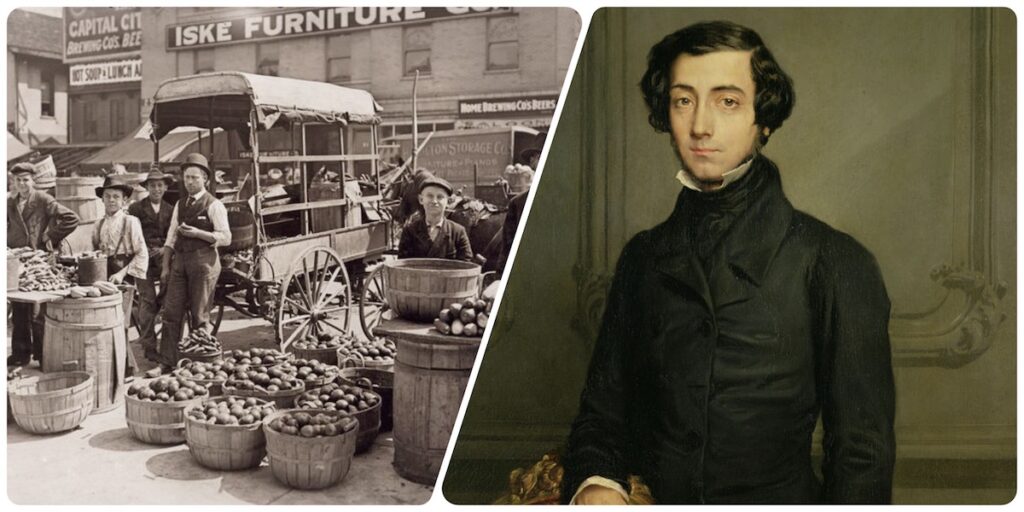
Two centuries ago the French liberal Alexis de Tocqueville wrote Democracy in America, in which he famously celebrated the willingness of Americans to organize for social purposes. That commitment to voluntary action continues to this day. Much of American life, indeed, much of the nation’s most important activities, occur outside of the marketplace.
Ironically, some forms of socialism are pervasive in America. Virtually every person begins life in an irredeemably collectivist enterprise, the family. Even fervent Friedmanites do not typically send their children out to work for their keep. This very personal form of socialism continues to life’s end for most people.
The U.S. boasts an enormous independent sector, beginning with churches, which also represents entirely different visions, objectives, and behaviors. Foundations, universities, and hospitals choose to operate without seeking that essential capitalist end, profit. Perhaps even more important are the plethora of other often small and decentralized institutions—clubs, teams, associations, leagues, and much more—to which so many people are dedicated.
Similar institutions sometimes exist in socialist lands, but unfree societies inevitably view with suspicion any organization competing for people’s loyalty and support. Everyone and everything are expected to demonstrate loyalty to the central political ideals and authorities. For instance, the great and powerful Chinese Communist Party fears larping: “The government is worried, for several reasons. One is that no formal mechanism exists for censoring the scripts. They are circulated in samizdat form, without going through the normal publishing process.” Horrors!
Just as no nominally socialist society operates without markets—China has created a mixed economy while even the Soviet Union traded internationally with capitalist states—no nominally market society leaves social life to market institutions. Different peoples develop different orders. There is no single correct outcome for the diverse humanity that overspreads the planet. Rather, free people in free societies can and do make different choices, generating varying results. The critical difference is that a free society allows people to choose more restrictive institutions. In contrast, an unfree society rarely allows people to choose fewer controls, whether economic or other.
Hundreds, indeed, thousands of years of human practice demonstrate that the best human society protects individual freedom and limits state authority. That means much more than just free markets, as independent institutions, particularly churches, constantly remind us. And there is no single liberal template for a good society. However, free markets are essential for any nation that claims to be free.
Doug Bandow is a Senior Fellow at the Cato Institute. A former Special Assistant to President Ronald Reagan, he is author of Foreign Follies: America’s New Global Empire.
More from IRD:
America’s Faux Socialists Know Not What They Claim to Be
Vice President JD Vance’s Economic Confusion about Milton Friedman
No comments yet




Leave a Reply