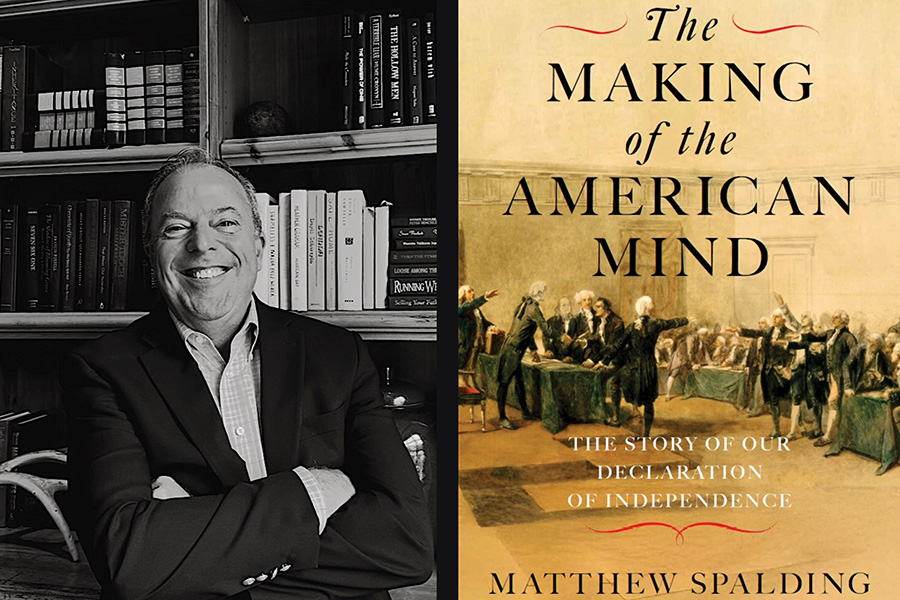

The Making of the American Mind: The Story of our Declaration of Independence
By Matthew Spalding
Encounter Books, 2025. 344 pages.
America’s Declaration of Independence was not just rhetoric or the position of one person, committee, or Congress. It was and remains, as author Matthew Spalding writes, “an expression of the American mind.”
In The Making of the American Mind: The Story of Our Own Declaration of Independence, released on the eve of America’s 250th anniversary, Spalding encourages Americans to reengage with our history, to rediscover the timeless principles embedded within the Declaration of Independence, and to fall in love with America, again.
Spalding, who serves as Kirby Professor in Constitutional Government and Dean of the Van Andel Graduate School of Government at Hillsdale College, dedicates the first chapter to the opening phrase of the Declaration: “When in the course of human events.” Though the American Founders understood English history to be their history, they viewed the American experiment as “part of the course of human events, stretching back well before the Declaration” and even well before the Magna Carta.
England’s rule of law, development of the common law under substantial Judeo-Christian influence, and parliamentary supremacy resulting from the Glorious Revolution directly shaped the American mind. But the American Founders understood the influence of Rome, Athens, and Jerusalem to be just as foundational.
Alongside John Locke and Algernon Sidney, two prominent English political philosophers in the 18th Century, Thomas Jefferson named Aristotle and Cicero within “the elementary books of public right.” Aristotle and the Greek philosophers developed the very idea that objective reality exists and that the human mind can pursue truth, as opposed to merely reacting and forming opinions based on experiences. Then in Rome, Cicero integrated Aristotle’s concept of justice with the law and argued that all have a moral duty to strive for virtue.
In looking beyond their immediate circumstances, the American Founders claimed authority to declare independence from a much higher and more foundational source. The Declaration begins and ends with references to the divine. According to Spalding, this not merely for gravitas but presents a “theology of the Declaration.”
Immediately in the Declaration’s paragraph-long first sentence, the “one people” dissolving their ties with Great Britain say they are “entitled” to do so by “the Laws of Nature and Nature’s God.” As the document moves toward its close, the references to the divine become more personal and particular.
At first, as Spalding argues, God appears “by virtue of man’s unaided reason” in his ability to discern the laws of nature. Then, God appears as the Creator “not just of nature in general but of man in particular.” It is the divine, and not culture or government, that endows man with his certain, unalienable rights.
Next, God appears as the “Supreme Judge of the world,” but specifically the supreme judge of man. In this role, God knows the deepest intentions of both parties and reigns at all times. In the Founders’ view, after suffering “a long train of abuses,” submitting the “[f]acts… to a candid world,” and petitioning the King without receiving relief, the divine was the only court left.
Importantly, the Declaration could have appealed to history or the previously mentioned “opinions of mankind” as its supreme judge, but it does not. The Framers wrote not to justify their current preferences or momentary whims. They genuinely believed their cause was just and informed by enduring, self-evident truths.
Lastly, in pledging their lives, fortunes, and “sacred honor” to support the Declaration, the signers state their “firm reliance on the protection of divine Providence.” This final expression of God is an active one. To the signers, God did not create the laws of nature, endow man with inalienable rights, and then walk away. He remains present and as Spalding notes “sometimes changes the course of human events.”
The Declaration’s references to God, self-evident truths, and enduring principles aren’t lofty rhetoric that the Founders did not truly believe, as the 1619 Project or other revisionist history projects attempt to convince us. In the epilogue, “Iron Men,” Spalding recounts story after story of the Declaration’s signers who sacrificed their personal fortunes for independence, risked their lives, and even suffered torture without recanting their signatures from the Declaration of Independence. Yet, as Spalding wrote, “None forfeited his sacred honor.”
For those wishing to reengage with our history, our timeless principles, and the classical tradition that gives America its strength, read The Making of the American Mind. The ideas are timeless but the content is timely.
Davison Drumm is a Research Assistant at Advancing American Freedom. He studied at The King’s College and is a graduate of Fordham University with a Bachelor of Arts in Political Science. Drumm interned at the IRD from 2024 to 2025 as a Falls Church Fellow.
More from IRD:
American Liberty’s Ancient Pedigree




Comment by David on August 7, 2026 at 7:43 am
Karl Marx held that wars were started primarily for economic reasons. We see that in the American Revolution. Following major expenditures for the French and Indian Wars, which protected the Americans, taxes were imposed on the colonies. While taxation varied by colony, New Englanders paid only about 5% of the tax that was imposed on persons in England. Americans have been whining about taxes ever since.
Southern planters, such as Washington and Jefferson, were very heavily in debt to banks in England and Scotland. The Revolution conveniently ended this indebtedness. Indeed, the total American debt exceeded the value of all the money in circulation here.
As the only form of government to emerge from the Judeo-Christian tradition was divine-right monarchy, it is no wonder that the Founders turned to pagan sources, namely the Roman Republic and Greek democracy.
Then there was the fear that England would abolish slavery in the colonies. A court case in 1772 found no basis for slavery in English Common Law. This was not imposed on the colonies at the time, but concern arose.
Comment by Wilson R. on August 7, 2026 at 3:10 pm
I have a graduate degree in American History, with a focus on the history of slavery in America, and like many historians, I had significant problems with the initial version of the 1619 Project, which underwent a lot of revisions in light of the criticism it received from experts. Too many sweeping conclusions and not enough nuance.
But I also have serious problems with Hillsdale College’s way of narrating US history. If the 1619 Project was too polemical, Hillsdale’s 1776 curriculum is too hagiographic, and their sugar-coated shortcomings are distorting the way history is being taught, in the name of “anti-wokeness.”
For example, the Nicole Hannah-Jones (1619 Project) was wrong to say that the nation was founded in slavery. Slavery was introduced 150 years before 1776 and had been the dominant form of labor in the Southern colonies for a century before the Revolution. More accurate to say that America was like a crack baby, born with an addiction to slavery passed down from the mother country. Hillsdale underplays this.
Hannah-Jones went too far in claiming that the Revolution was about slavery. But she’s not wrong that it was an issue. As David notes above, the Somerset case in 1772, which ruled that slaves brought from the Colonies were free when they were on English soil, convinced many Virginians and Carolinians that the only way to protect slavery was independence from Britain. The Hillsdale project won’t tell you any of this.
The Revolutionaries were heroic and risked everything, as the author notes, and they truly believed in self-evident truths about their rights. But it’s also true that there were obvious limits to their belief that all men are created equal. They didn’t believe it about slaves or Native Americans.
There is a tendency among both Hillsdale types and advocates of the 1619 Project to take an all-or-nothing approach to our history. History like the 1619 Project gets accused of teaching only the negatives (e.g., “America was always racist”) and none of the positive. Hillsdale is justifiably accused of sugar-coating our history and leaving out anything that might not reflect well on us. (I get their newsletters every week and have a pretty good picture of what they teach, and it’s more propaganda than history.)
The truth is that our complex history involves contradictory through-lines that co-exist uneasily alongside each other. Ours was the only nation founded on an idea, and the world has admired us for it ever since. But any honest telling of our history recognizes racism as the other through-line that not only stands against the natural rights our founders proclaimed but also has affected how life has been lived for people here from before the Revolution to the present day.
Both of these through-lines need to be taught.