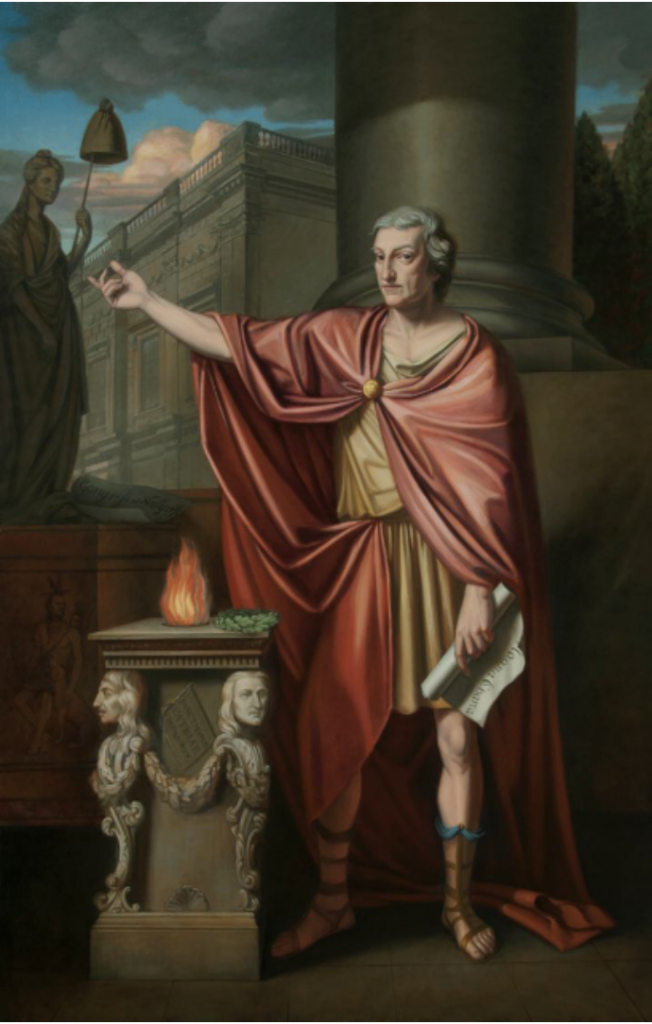
As July 4 approached, I came upon a stunning Whiggish artwork illustrating early America’s understanding of liberty, as valid now as then. It’s in the parlor of Stratford Hall, built nearly 300 years ago, seat of the famous Lee family of Virginia. Two Declaration of Independence signers were born here, the brothers Francis Lightfoot Lee and Richard Henry Lee, who made the original motion at the Continental Congress for American independence. Robert E. Lee was born here much later.
The 1768 painting (whose original is in the nearby Westmoreland Museum, Stratford Hall having made a copy in 2016) by famed early American portraitist Charles Wilson Peale shows British Prime Minister William Pitt the Elder, Earl of Chatham. It was commissioned by Richard Henry Lee, who was sometimes called the Cicero of the American Revolution, on behalf of the Westmoreland [County, Virginia] Association of Patriots, to honor Pitt for opposing the 1766 British Stamp Act against the colonies. Lee had organized the Westmoreland Resolves against the Stamp Act, opposing taxation without representation and trial without juries of peers. The Stamp Act had been the start of a “long train of abuses and usurpations” later cited by the Declaration of Independence to justify the American Revolution. Lee was told by his London contact: “…the Honest Cause of America hath been supported by the true Liberallity [sic] of that great man, Lord Chatham. I could wish that his Merits were not forgot.”
In the spirit of British liberty, Pitt opposed the Stamp Act in 1766, as he would later defend America in its struggle against Britain: “I rejoice that America has resisted,” adding, “Three million of people so dead to all feelings of liberty, as voluntarily to submit to be slaves, would have been fit instruments to make slaves of the rest.”
Wilson did another copy of his Pitt painting for the Maryland legislature, which still hangs in the Maryland Capitol, and then marketed an engraving of it, titled “Worthy of Liberty, Mr. Pitt scorns to invade the Liberties of other People.” He did not portray Pitt as simply a contemporary British politician. Instead shown as a “universalized symbol of heroic resistance to tyranny,” as described by J. Patrick Mullins, Pitt wears the robe of a Roman magistrate from the ancient republic, clutching the Magna Carta, Britain’s original charter of freedom. He points to a female incarnation of liberty, at whose feet are the tragically ignored 1765 appeals of the protesting Stamp Act Congress vainly appealing to Parliament. She stands atop a column, with Peale later explaining: “The Pillar at the Back of Mr. Pitt signifies Stability in the Patriot and his principles.” The Indian brave carved into the column, with his quiver full of arrows, signifies according to Wilson “the natural Faithfulness and Firmness of AMERICA.” He describes America as loyal but “erect,” “attentive,” “watchful.”
Engraved into the altar are the busts of martyrs for English liberty Algernon Sidney and John Hampden. The later refused to pay unjust taxes to King Charles I and died fighting in the English Civil War. The former resisted both Oliver Cromwell and King Charles II, advocating popular governance against despotism. Peale said both “with undaunted Courage, spoke, wrote, and died in Defence of the true Principles of Liberty, and of those Rights and Blessings which GREAT-BRITAIN now enjoys.” The building behind Pitt is Whitehall’s Banqueting House before which King Charles I was beheaded by Parliament in 1649. Sidney originally opposed the king’s execution but later defended it.
Sidney was himself executed during the time of King Charles II chiefly for having written his 1680 Discourses Concerning Government, against royal absolutism. In 1820 when writing to Henry Lee, the last Lee owner of Stratford Hall, Thomas Jefferson cited Sidney as a key inspiration for the Declaration of Independence. Jefferson wrote:
Neither aiming at originality of principle or sentiment, nor yet copied from any particular and previous writing, it was intended to be an expression of the American mind, and to give to that expression the proper tone and spirit called for by the occasion…All its authority rests then on the harmonizing sentiments of the day, whether expressed in conversation, in letters, printed essays, or in the elementary books of public right, as Aristotle, Cicero, Locke, Sidney, &c. …
Six years later, in one of his final communications, Jefferson declined to honor July 4 in Washington, DC due to ill health (in fact dying on that day), but celebrating the “palpable truth, that the mass of mankind has not been born with saddles on their backs, nor a favored few booted and spurred, ready to ride them legitimately, by the grace of god.” He was echoing Sidney, who had written in his Discourses:
The Liberty of a People is the gift of God and Nature [and that] God only who confers this right upon us, can deprive us of it …. [Such deprivation could occur only if God] had so declared by express Revelation, or had set some distinguishing marks of Dominion and Subjection upon men; and, as an ingenious Person not long since said, caused some to be born with Crowns upon their heads, and all others with Saddles upon their backs.
Sidney’s spirit infuses Peale’s idealized portrait of Pitt. This spirit insists that no human is born with a saddle on their back. The portrait magnificently illustrates how Americans even before the Revolution prioritized God-ordained liberty against despotism, a heritage they saw as having an ancient pedigree. This July 4, may we remember and perpetuate that legacy.


Comment by David on July 6, 2025 at 8:38 am
But hear, ye sons and daughters of liberty, the sounds which the winds are wafting from the western continent. The Americans are telling one another, what, if we may judge from their noisy triumph, they have but lately discovered, and what yet is a very important truth: “That they are entitled to life, liberty, and property; and that they have never ceded to any sovereign power whatever a right to dispose of either without their consent.”
We are told, that the subjection of Americans may tend to the diminution of our own liberties; an event, which none but very perspicacious politicians are able to foresee. If slavery be thus fatally contagious, how is it that we hear the loudest yelps for liberty among the drivers of negroes?—Samuel Johnson 1775
Comment by Wilson R. on July 7, 2025 at 12:33 pm
That’s a great quote from Dr. Johnson, and it gets right to the heart of the contradiction that was always there in our nation’s founding–that a nation founded in 1776 on the idea that all men are created equal could maintain a 150-year-old addiction to human slavery.
The contradiction does not diminish the nobility of the founding ideal, but it should be acknowledged and taught as part of our national story. Acknowledging the fuller truth of our story does not mean our students shouldn’t learn about the theories of Locke or the (under-emphasized) ideals of the Glorious Revolution of 1688, which had a profound effect on the thinking of our founding generation.
What our students were not traditionally taught is that even the slaveholders among the Framers regarded slavery as a sin and a moral stain for which the nation would eventually pay (you need only read their own writings on the subject).
Jesus said the truth will set you free, but most state textbook committees don’t believe it when it comes to the teaching of history.
Comment by Dan W on July 7, 2025 at 10:54 pm
Dr. Johnson was British. The British were second only to the Portuguese, in the number of enslaved Africans shipped to the Americas. The British and others made a lot of money off the slave trade, then blamed the agrarian societies that depended on the very slaves they sold. The U.S. banned the importation of slaves 1 January, 1808. The British Parliament banned it in 1807, but they continued to import products produced with slave labor. I’d call that hypocrisy!
Comment by Wilson R. on July 8, 2025 at 10:46 am
All good points. As someone trained as a historian, one of my complaints about the controversial “1619 Project” was the contention in the original version that the US was founded in slavery in 1619. That’s obviously bunk. There was no United States for another century-and-a-half. What would be accurate to say is that the United States was like a baby born with fetal alcohol syndrome or a drug addiction because of the mother’s substance abuse. By the time our nation was born, it was addicted to slavery because the mother country had made it so.
But it is also worth pointing out that the British were moving away from slavery even before 1807, and this was a factor in moving some of the American colonists to revolution. In 1772, Britain’s highest court ruled in the Somerset case that any slaves brought to England from the Colonies were free while they were on British soil. (If they returned with their masters to the Colonies, they reverted to slave status.) News of this decision electrified the Southern colonies; planters recognized that, if slavery wasn’t protected on British soil, then it might not be protected in British colonies either. Many, therefore, concluded that the only way to ensure the future of slavery in America was to gain independence from Britain.
In the 1619 Project, Nicole Hannah-Jones was wrong to claim that the American Revolution was about defending slavery (not an issue for Massachusetts). But she would have been correct in amending her statement to claim that the Revolution, in part, was about slavery. It was.