
Many have covered the terrain of Anglican patriots during America’s revolutionary period. For those, like me, who live in Washington, D.C., we hear these stories regularly. So many of the Founding Fathers were Anglicans, born and bred. George Washington served on the vestries of Truro parish and Fairfax parish and he contributed to the building of Christ Church, Alexandria, part of latter parish. George Mason served on the Truro vestry alongside Washington. Thomas Jefferson was nominally Anglican, despite his Sweeney Todd approach to the Bible. Hamilton is buried in the churchyard at his parish, Trinity Church, New York. Benjamin Franklin, while a freethinker in many respects, had a stellar Anglican pedigree. The first governor of Virginia, Patrick Henry, can also be included in this number.
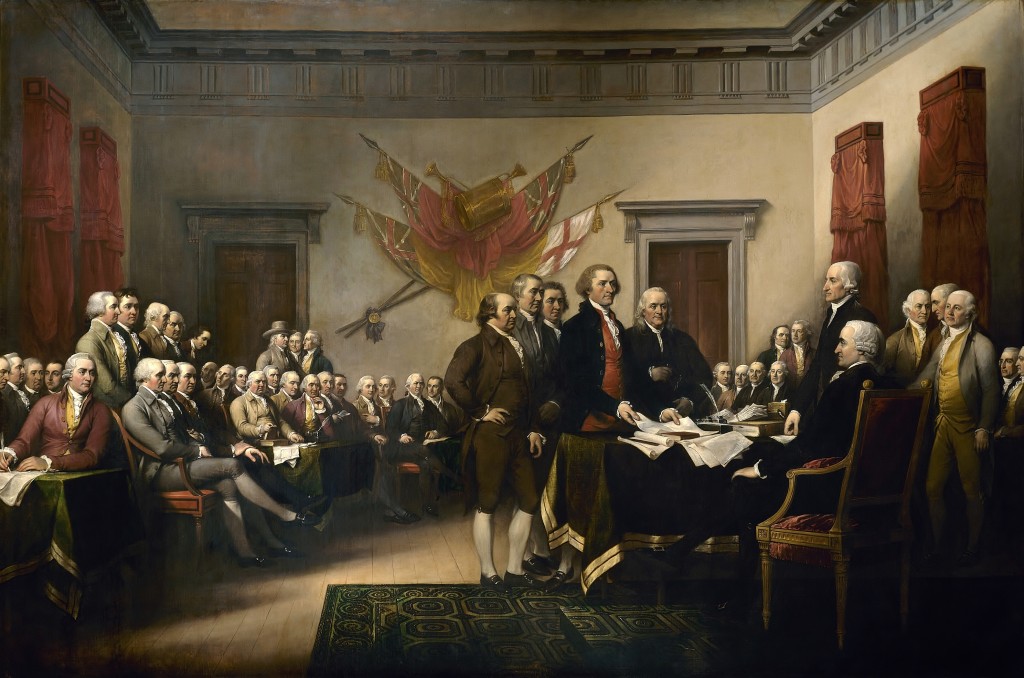
Of the 56 signers of the Declaration of Independence, 34 were Anglicans (roughly 60%). This includes some notable figures such as Robert Morris, Benjamin Rush, and Franklin from Pennsylvania, Richard Henry Lee, Jefferson, Benjamin Harrison, and Francis Lightfoot Lee from Virginia, William Hooper from North Carolina, and Edward Rutledge and Arthur Middleton from South Carolina among them.
During the Constitutional Convention of 1789 in Philadelphia, a who’s who of America’s founders attended Christ Church, where the convention often met for worship. There they engaged with the emerging leaders of what would become the Protestant Episcopal Church in the United States of America, including the first presiding bishop, William White. The numbers, again, speak for themselves. The convention included 27 Anglicans out of a total of 55 delegates (49%). These were predominantly lay people, leaders in their communities, yet shaped and formed by an Anglican ethos.
The question that begs attention here is this: How did that Anglican formation shape the emerging republic within a revolutionary period? Revolutions and Anglicanism do not historically go together. While Anglicanism in the colonies did not hold the hegemonic cultural, historical, and political power that it did in England, it can be argued that Anglican precedent, alongside English culture, played an impressive role in the formation of the new republic, even providing continuity beyond revolution. J.C.D. Clark in his English Society 1660-1832 rightly argues that Anglicanism and English society went hand in glove. The same cannot be said for the colonies on the whole, but the influence of church and society was still evident.
Continue reading at Covenant here.
No comments yet


Leave a Reply