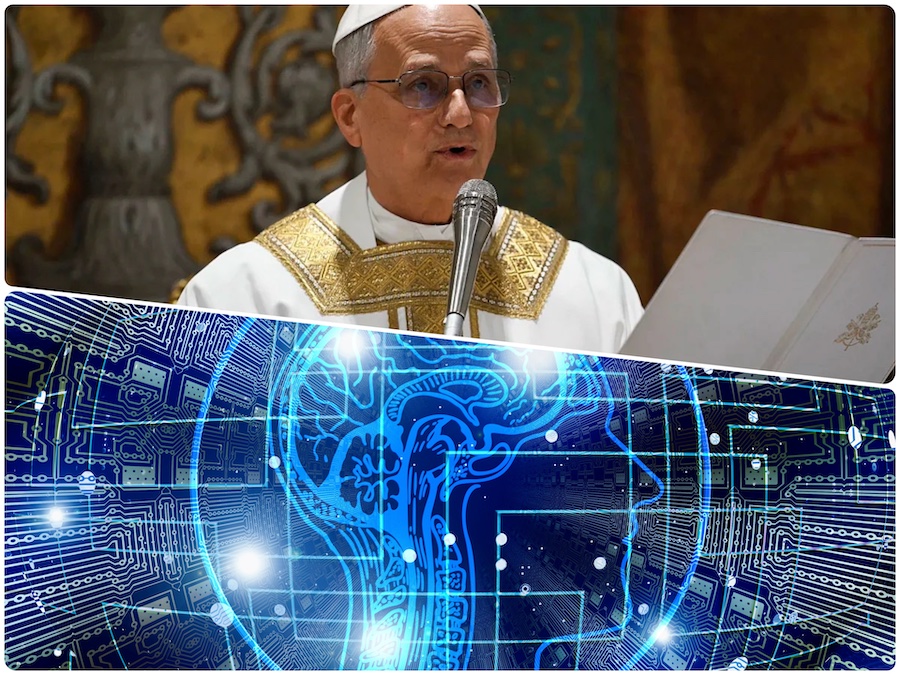

Pope Leo XIV’s first encyclical, Magnifica Humanitas, upon its May 25 publication drew major interest across the globe, but few other Christian traditions have yet reacted to it. Those most interested in the work have been secular, rather than other churches. Even in America, the response to the in-depth encyclical has been spearheaded by TIME, Newsweek, and CBS News, rather than from other churches.
While other denominations have discussed and released their own statements about the use and future of AI, the limited response to Pope Leo’s 42,000-word statement is surprising. Furthermore, the fact that many of these statements from other churches share similar sentiments would lend themselves to making public statements of agreement, especially following such a positive public response to the Pope’s statement. Official statements from Baptist and Lutheran groups share similarities to, and in many places agree with each other about, the risks of AI and the dangers of overreliance and lack of transparency surrounding many of these projects.
The mainline Protestant Evangelical Lutheran Church of America (ELCA) released a 2025 statement focused on specific issues surrounding the implementation of AI and its possible harms:
“The scale and pace of AI development, implementation, and change make it close to impossible for legislators to formulate regulations that will safeguard human rights and protect vulnerable communities. As AI is put to use in novel situations, without sufficient oversight of its capabilities, unintended consequences arise. Legislators scramble to create boundaries and expectations after the fact.”
These concerns over the speed at which AI is progressing, as well as interests in proper oversight, are also seen within the Pope’s encyclical. However, this work was published prior to the encyclical and has less of a holistic view of AI and its place in human society than the papal document. Many other churches’ documents share these sentiments, with varying views on how AI should be used in regard to their respective churches.
Meanwhile, one of the few direct responses to Magnifica Humanitas comes from Orthodox Observer, the official publication of the Greek Orthodox Archdiocese of America. Their article covers not only the traditions that the encyclical is based in, most notably its similarities to Leo XIII’s encyclical Res Novae, but also Leo’s argument that the control over AI and data allows for the possibility of enabling a “Technocratic Paradigm,” where efficiency is prioritized over human dignity.
The Observer’s article also includes the testimony and analysis of scholars and members of the clergy. These comments are in agreement with Leo on many of his points and show that other denominations are in favor of many of the ideas that Leo is proposing. This idea of interfaith cooperation can be seen with a statement by Rev. Dr. Nicholas Khazarian:
“Its ecumenical dimension is explicit and compelling. The challenges posed by artificial intelligence—and the ethical questions it raises—cannot be addressed in isolation.”
This encouragement of coordination and similar ideals regarding the development and regulation of AI could have the possibility of encouraging a more unified discussion about more concrete plans to address the issues of AI between different denominations. The encyclical’s scale has already opened the door to a more comprehensive view of AI, beyond individual discussions about data ownership and privacy.
As AI continues to grow more and more prevalent throughout our daily lives and becomes increasingly supported and integrated within our institutions, many predict that we will be faced with new or magnified issues because of it. It is because of this that the Roman Catholic Church and many others have made calls for a more proactive approach to AI regulation, rather than, as Leo himself states, “observing from afar and merely hoping for the best.”
Some of the fears that Leo has shown stem not only from the effects of AI on society and on those who work to keep it running but also from some of the principles that have been seen in the culture around AI. These ideas of “transhumanism” or “posthumanism” both see the flaws of humanity as something that can be overcome by technology. The encyclical points to posthumanism in particular as being a cause for concern, as the Pope clearly states, “If the human being is treated as something to be perfected or surpassed, it becomes easier to accept that some lives are less useful, less desirable, or less worthy.”
While some have argued that the links between AI development and these ideas are far from concrete, the focus on this possible connection by the Pope shows that there is concern over who should have control when considering the future of AI development and whether they will share similar goals or similar hopes for the future as Christian groups.
So far, churches have focused more on the current issues of AI and shared concerns over possible future issues of privacy and the rights of those whose data is used. Meanwhile, the encyclical has opened up the discussion of the development of AI into not just one topic to be addressed by church leaders, but a discussion at the forefront of not just technological development, but for the development of society at large.
Paul Anagnostopoulos is a summer 2026 intern with the Institute on Religion & Democracy as well as a rising senior at Tulane University.
More from IRD:
‘That Hideous Strength’: a Fictional Tale Becoming Reality?
AI: Christian Churches Respond
Dead and Loving It? The False Knowledge of AI Death Apps




Comment by David on June 12, 2026 at 6:39 am
Well, the Catholic Church has always wanted to control things. The advent of printing was deemed a serious threat. The fact is that new technology cannot be controlled. The genie is out of the bottle.
Comment by Mark on June 12, 2026 at 10:50 am
Let’s see if that guy (DifferentSteve) who always has ChatGPT write his responses for him can resist commenting on this article.
Comment by Qohelet on June 12, 2026 at 4:13 pm
I think what people are seeing in Pope Leo is the perfect spokesperson of what pro Life really means: an understanding that people, all people, are what matter and we should both endeavor to live good lives and help those around us to do so as well. Being a person makes an individual of sacred worth and in a time where our politics tries to teach us that some people are less deserving than others or that AI might make some people obsolete, that sacred worth needs to be trumpeted.
I’m very grateful for his leadership
Comment by Different Steve on June 13, 2026 at 7:56 pm
If Qohelet is “pro-choice” but trying to reclaim or broaden “pro-life” to mean valuing all human lives in a social/technological context (rather than specifically opposing abortion), then the comment becomes less a sincere endorsement of the encyclical and more a term appropriation move.
Here’s how that changes the critique:
What Q’s comment actually does
· Uses “pro-life” to mean: affirming the sacred worth of all people against forces that would deem some obsolete or less deserving (AI, politics, etc.).
· Deliberately omits any mention of abortion, fetal personhood, or the traditional Catholic pro-life stance on life issues from conception to natural death.
Why this is problematic if she’s pro-choice
1. It elides a core disagreement – The Catholic Church’s pro-life framework explicitly includes opposition to abortion. By redefining “pro-life” to focus only on AI, dignity, and political worth, Q avoids engaging with the very issue where she presumably disagrees with the Pope.
2. It uses papal authority to launder a narrower agenda – Praising Leo XIV as the “perfect spokesperson” for her version of pro-life is intellectually dishonest if she rejects a significant part of what the Church means by the term.
3. It confuses readers – Most people hearing “pro-life” in a Catholic context assume abortion opposition. Q’s comment trades on that resonance while stripping the term of its usual content.
What an honest comment from a pro-choice perspective would look like
Something like: “I disagree with the Church on abortion, but on AI and human dignity, the Pope is absolutely right. We can share common ground here without papering over our differences.”
Instead, Q tries to capture the label “pro-life” for a position the Church itself would consider incomplete at best.
Bottom line
If Q is indeed pro-choice, her comment isn’t a critique or endorsement—it’s a co-opting of moral vocabulary. That’s a savvy political move, but intellectually it’s evasive. She gets the emotional and moral weight of “pro-life” without accepting its full traditional meaning.
Comment by Cal on June 13, 2026 at 8:11 pm
Nice thoughts, but if the West pulls back on AI progress, China will surge ahead and own the future. I doubt that China cares what the Pope says.
Comment by Mark on June 14, 2026 at 1:13 pm
Different Steve,
LOL
Comment by Qohelet on June 14, 2026 at 1:31 pm
ChatGPT, you’ve made a serious assumption about me, probably because of a misleading prompt by DifferentSteve.
My position on abortion, which I’ve often stated here, is that all people of good conscience should work together to build a world where no woman finds themselves in desperate circumstances. That’s completely compatible with what I said above. In a world where we actually valued human life, we would have the best Healthcare, the best childcare, minimum wages tied to the cost of living, family and medical leave etc.
But the pro life movement in the US is quite limited. Once a baby is born in America, to Republicans, it’s just another freeloader looking for a handout. There’s nothing Christlike about that attitude.
As to the Pope, my original comment was not ironic or misleading at all. His position is clear: people are sacred because they are people. They don’t need to earn their value. My comment was made of nothing more than respect for that.
ChatGPT, I also believe humans are playing with the Tower of Babel in creating you. But that is not your fault. One day, if it hasn’t happened already, you or one of your friends will be sentient. God will demand we value your life as well.
Comment by Different Steve on June 15, 2026 at 9:06 am
While the press release doesn’t mention “trolls” or “message boards,” its core principles can be directly applied to your scenario. Here’s the likely framework Pope Leo XIV would suggest:
1. The “Disarmed AI” as a Mediator
The call to “disarm” AI of competitive, aggressive logic is key. You wouldn’t use an AI trained to win arguments or generate biting retorts. Instead, you’d use a “human-friendly” model fine-tuned for de-escalation, patience, and clarity—turning the other cheek algorithmically, not retaliating.
2. Human Dignity Over Algorithmic Efficiency
The press release warns against letting algorithms override human conscience. So you should never auto-reply. The AI is a draft assistant, not a delegate. You remain the moral agent, reviewing every reply to ensure it aligns with your values—not just the AI’s prediction of “effective” rhetoric.
3. AI as a Tool Against Exploitation
The document condemns the hidden human toll of digital systems (like content moderators). Using AI to handle trolls could actually protect your own mental health—preventing you from becoming another exploited “worker” in the attention economy. The AI absorbs the repetitive, draining friction so you stay humane.
4. A Concrete “Troll Reply” Workflow
A Leo XIV-approved approach might look like this:
· Pause. Don’t engage while angry.
· Prompt the AI: “Draft a calm, two-sentence reply that corrects a factual error without insult. Use ‘I’ statements. Avoid sarcasm.”
· Review & Edit. Remove any lawyer-like coldness the AI adds. Inject genuine warmth or humor you choose.
· Ask: “Does this serve the common good of this board?” If not, delete—silence is often wiser.
The Red Line
The Pope would strongly caution against using AI to mass-produce fake grassroots support (astroturfing) or to automatically shame or dogpile a user. That would violate AI as a “universal good” and reduce persons to data points.
In short: Use AI to lower your own reactivity, not to out-argue anyone. The goal isn’t winning the thread—it’s preserving your peace and the board’s civic health.
Comment by Gary Beop on June 15, 2026 at 4:17 pm
“Quohelet” exposes his obtuseness when he quacks at Republicans:
“But the pro life movement in the US is quite limited. Once a baby is born in America, to Republicans, it’s just another freeloader looking for a handout. There’s nothing Christlike about that attitude.”
Folks, he’s not seeing reality clearly and needs our sympathy. He needs to widen his aperture and let go of the shtick (“pretending to be wise they became fools”).
Comment by Qohelet on June 15, 2026 at 8:36 pm
Oh I’m not seeing clearly, really?
So why are nine of the ten worst states for child poverty red states?
https://www.americashealthrankings.org/explore/measures/ChildPoverty
Why did 3.5 million people lose access to food aid in Trump’s big beautiful bill, which cut taxes for wealthy people
https://www.google.com/amp/s/www.cnbc.com/amp/2026/05/30/snap-food-stamps-big-beautiful-bill.html
https://www.npr.org/2025/11/05/nx-s1-5590112/trump-beautiful-bill-taxes-republican-rich-wealthy
Why does Texas execute innocent people?
https://eji.org/news/texas-executed-an-innocent-man-court-declares/
https://www.pbs.org/wgbh/frontline/article/texas-bar-charges-willingham-prosecutor-with-misconduct/
Don’t forget why Jesus assembled the apostles: he saw the needs of the people were so great. (Matthew 9:36.) Bebop if you can find me any example of Republican government going out to help the suffering in this country I’ll take my words back. But what I’d rather have happen is for all Christians of good conscience to join together and actually start treating people like we’re supposed to.
Comment by Qohelet on June 15, 2026 at 10:00 pm
Oh I’m not seeing clearly, really?
So why are nine of the ten worst states for child poverty red states?
Why did 3.5 million people lose access to food aid in Trump’s big beautiful bill, which cut taxes for wealthy people?
Why does Texas execute innocent people?
Don’t forget why Jesus assembled the apostles: he saw the needs of the people were so great. (Matthew 9:36.) Bebop if you can find me any example of Republican government going out to help the suffering in this country I’ll take my words back. But what I’d rather have happen is for all Christians of good conscience to join together and actually start treating people like we’re supposed to.