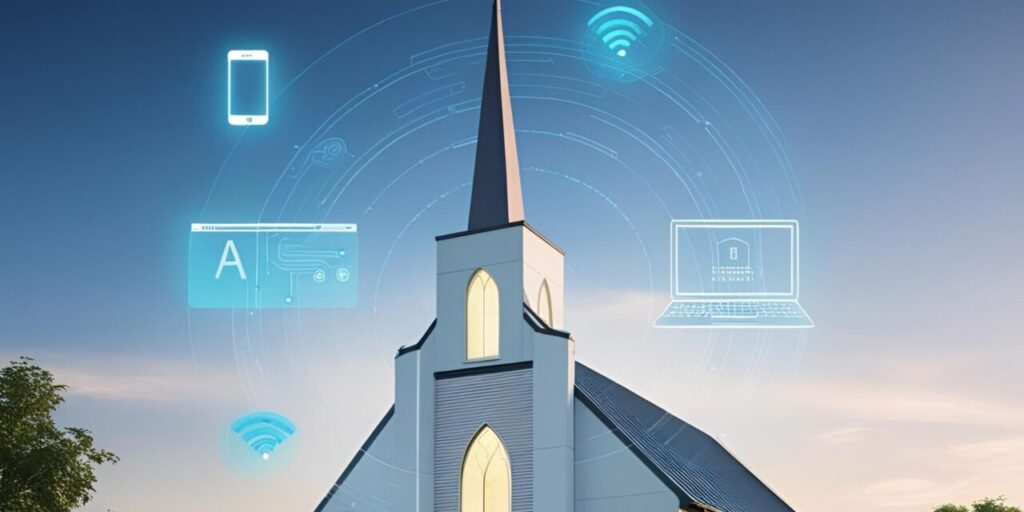

With Artificial Intelligence (AI) rapidly encroaching on even spiritual aspects of society, some Christian churches are seeking to respond. Chatbots now claim to imitate Jesus, while AI-generated worship music tops iTunes and Billboard charts. Churches’ response has been varied: some denominations are authoring reports seeking to guide their flocks while others do not directly address the topic.
The Roman Catholic Church’s Antiqua et nova is currently the most comprehensive and extensive document of any Christian group. Published in January 2025 during the papacy of the late Pope Francis, it differentiates between human intelligence and artificial “intelligence” as well as offers guidelines concerning the usage of AI.
Antiqua et nova claims that AI’s “‘intelligence’ is understood functionally” and measured by its “ability to produce appropriate responses.” In contrast, human intelligence encompasses the entirety of a person, pertaining to how “the whole person engages with reality” by “the full scope of one’s being: spiritual, cognitive, embodied, and relational.”
Additionally, the document suggests moral guidelines on interacting with AI in the many sectors that it affects. These include the workforce, the environment, healthcare, education, human relationality, spirituality, and war. The Church sees potential for great good through the use of AI as well as great risks, warning of specific boons and dangers in each sector. Interested readers may access it here.
Eastern Orthodox Ecumenical Patriarch Bartholomew has made several statements on AI. Similarly to the Catholic Church, Bartholomew holds AI as both high-risk and high-reward.
“…artificial intelligence has immense potential for positive transformation in environmental protection, education, and healthcare,” the Patriarch notes. “However, it also contains massive risks, from “invasions of privacy to rising inequalities and possible compromise of institutions.”
The Episcopal Church has convened a Task Force on Artificial Intelligence and Intellectual Property. Its mandate resolves to explore the relationship between the Episcopal Church, AI, and intellectual property rights in its processes and practices.
The Evangelical Lutheran Church of America (ELCA) published its most recent report on AI on December 5, emphasizing concerns on the difficulties of properly regulating rapidly developing technology. It primarily looks to potential advances in science, healthcare, and defense, as well as automating tedious processes.
More space is dedicated to potential risks inherent in AI. Misuses and abuses of AI are cited, among them Cigna Healthcare’s automated denial of more than 300,000 claims without legally obligated physician review. It raises concerns about bias and discrimination, as seen in Science, Technology, Engineering, and Mathematics (STEM) workplaces, where AI preferred men to women in the hiring process because of a historical gender skew towards males. The Lutheran report also decries a lack of transparency in AI, from training to resource and energy allocation by large corporations in AI development.
The Lutheran Witness, the Lutheran Church Missouri Synod’s (LCMS) denominational magazine, published a six-part series titled “The Digital Age.” The series discusses technology and suggests guidelines for how the church, laypeople, children, and parents should interact with technology.
Officials with the Presbyterian Church (USA) published their own report on technology in 2024, though it only briefly touches on AI. It spends most of its time discussing what it terms the precautionary principle and how it relates to modern technology in general. The PCUSA website has a page dedicated discussing AI’s role in the church, complete with an infographic showing how AI will “augment” church leaders. The official blog also has several articles written by clergy, with one article pushing back against the culture of optimization by saying that “God is not an optimizer.”
The United Methodist Church displays an overall positive view of AI through its podcasts, website, and teachings. The UMC-sponsored Compass Podcast has an episode discussing the app “Text with Jesus,” an AI app that features a chatbot meant to represent Jesus. The discussion surrounding the app – which was itself pre-scripted by a different AI – viewed the app positively, despite concerns by podcast hosts about pulling verses out of context. The UMC’s discipleship website offers an AI-edited resource titled “AI for Ministry” with training on “harnessing AI for good.”
The Southern Baptist Convention passed a resolution on AI and technology in 2023. Minimal compared with more recent statements from other denominations, the resolution resolves that “human dignity must be central to any ethical principles, guidelines, or regulations for any and all uses of these powerful emerging technologies” and calls for people to use AI in ways that are “honest, transparent, and Christlike.”
Denominations including the Anglican Church in North America (ACNA) and Presbyterian Church of America (PCA) have not released public statements on AI.
More from IRD:
Artificial Intelligence and Christian Faith and Life
‘That Hideous Strength’: a Fictional Tale Becoming Reality?




Comment by Dan W on December 12, 2025 at 11:56 am
Is “A.I.” the new click-bait, boogieman for journalists?
I use A.I. every day, mostly for turn-by-turn directions to project locations. 5-6 years ago I was on the Interstate, about 45 miles into a 90 mile trip. The mapping app I was using suddenly announced “Exit now!” I ignored it, convinced it was a mistake, and spent 45 minutes sitting in snarled traffic caused by a collision at a road construction site. (No one was injured.) Google and Apple maps have taken me on thousands of trips. I hope this technology will be used for traffic lights. There is an intersection near my office, where the left turn signal allows 2-3 cars to turn left each cycle. There are two large shopping centers at this intersection and sometimes there are 15-20 cars trying to turn left. It could use a little A.I.
I have had A.I. screw up dozens of times when I’m trying to order parts, or find technical information online. For example, I’ll search for information on a part that has been out of production for 20 years, and the A.I. thinks I have entered a typo. It fetches reams of documents on some unrelated item. A.I. does a lot of things well, but it’s far from perfect.
As handy as it is, I prefer to keep A.I. out of the spiritual.
Comment by David on December 12, 2025 at 9:31 pm
The day may come when someone makes a virtual Jesus. Based on red letter Bibles, this avatar might be able to give sermons and answer questions.
Comment by Dan W on December 13, 2025 at 8:36 am
I was mistaken. I thought “A.I.” was the newest click-bait trigger. David has convinced me it’s actually “Virtual Jesus.”
Comment by Qohelet on December 13, 2025 at 2:10 pm
Thank you for this comprehensive review.