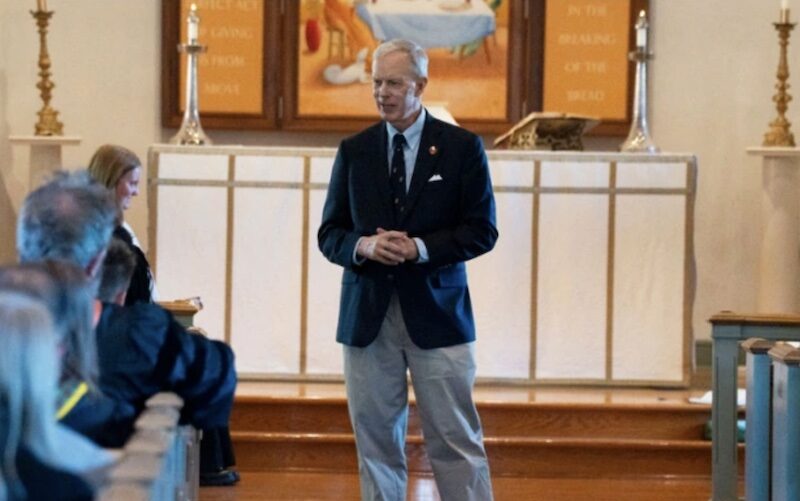
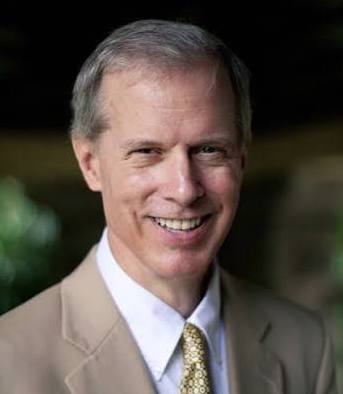
The following is the 2026 Baccalaureate Sermon given by Dr. David Hein at Saint James School in Hagerstown, Maryland. It is posted here with permission.
In the name of God: Father, Son, and Holy Spirit. Amen.
Well, good evening!
We’ve had a wonderful year of chapel speakers, haven’t we? I am particularly grateful to the students and teachers who took up the challenge of offering their reflections on our theme of teaching the virtues.
For example, do you remember Logan getting us off to a splendid start early in the fall? Talking about making it through the harsh Canadian winter and being patient during his physical rehabilitation? He spoke on the virtue of perseverance—so crucial for both students and teachers during the long academic year. And what about Father Dunnan? He faced some notable trials this year—but he persisted, functioning at a high level. An exemplar of perseverance!
And then my favorite talk by a faculty member was by a fellow who took a bit of a risk. Remember Dr. Weibel’s homily back in early December? Dr. Weibel was concerned that students were scarfing up too many chocolate-chip cookies and pieces of fried chicken in the Refectory. So he thought students would benefit from a good old-fashioned, fire-and-brimstone sermon on the virtue of temperance: self-discipline, self-control.
That morning, I was sitting in the back pew, next to F.D. himself, and I was thinking, “Wow, I don’t know. Dr. Weibel is doing a fine job. He’s really bringing the heat. But what if students turn sullen, resentful, and angry? What if they stage a mutiny?” I needn’t have worried. Students recognized that of course Dr. Weibel had their best interests at heart. He was only looking out for their own good. Grateful, they rewarded his remarks with a big round of applause.
These chapel talks and all the other ones were very good—just as good of their kind as they could have been. But they were not good enough. They were not good enough because now we need to pivot from direct instruction to active participation. That’s how we learn anything, whether it’s lacrosse or writing or learning to play a musical instrument or biology or math or sailing a boat—anything.
Which is why I gave you a homework assignment last May and again this past September. Who remembers that homework assignment? [Logan Cohn:] “Noticing and naming the virtues.” That’s exactly right; thanks, Logan! The virtues are practices, and the more we recognize how they function in our daily lives, the more we shall appreciate their true worth both for us and for our community.
Here’s an example, from an important area of school life: our honor system. Which virtues do you see at work in our honor system? [Students:] “Honesty.” “Justice.” Yes, very good!
Prudence means at least the capacity to look ahead and see the big trouble you’ll get into if you lie to a teacher.
Justice means maintaining a level playing field, treating others fairly. That means not tilting the board in your favor by cheating.
Courage means at least the moral courage necessary to choose the hard right over the easy wrong.
Temperance means self-mastery: at least sufficient self-discipline to keep from stealing a look at your neighbor’s multiple-choice answers or turning to A.I. to complete your paper outline for you.
These cardinal virtues were easy to identify. Let’s ramp things up a bit with the theological virtues.
Love does not mean that students will love every aspect of school life. Students won’t love every athletic practice outside under a hot sun or every test or every homework assignment or having to learn the French subjunctive (sorry, Ms. Flanary!). They won’t love every teacher or every fellow student. But by the time that graduating sixth formers walk up those historic stone steps on the front of Claggett Hall (and if you want to know why they’re historic, ask Mr. Camp), most will have come to love the history, the character, the grounds, the purposes of this place. They will love at least some of their teachers and some of their fellow students. And as a reflection of that love, just as in their families, they will want to hold themselves to a high standard. They will want to do nothing that would bring shame or dishonor on themselves or on their school.
Faith we talked about last year. The active side of faith is loyalty—in this case, loyalty to the community of trust, loyalty to the community of honor.
Hope is more difficult. So to help me I’ve brought along the program from the fall play: Bethel Park Falls. Who was in that play or worked on it? [many hands go up] One scene really caught my attention. Gaia, played quite expertly by Ariana Daly, had cheated. She talks about how high parental expectations bore down on her.
And she talks about why she cheated. In fact, the night of the play, I wrote down the exact line she speaks. It’s a commonplace set of words. Probably no one else paid much attention to them. Gaia says, “I didn’t know what else to do.” I sat up in my seat when I heard those words because they represent just what we were talking about last year in respect of the virtue of hope. When people feel desperate, they sometimes cheat. Why? Because hope is particularly dependent on the imagination. We have to be able to imagine fresh possibilities, a way out of our difficulties. But sometimes the well of our imagination runs dry. We can’t think of any good options. That’s what Gaia means when she says, “I didn’t know what else to do.”
But hope, as we also learned last year, not only imagines; it imagines with. If we turn to a friend or teacher or coach or parent, we can put on that person’s imagination and see possibilities we hadn’t thought of. So, in this play, what happens? Gaia meets Ash, played by Jack Regan. Now Ariana (in real life) is quite a different person from Gaia (in the play). But Ash and Jack seem like pretty much the same person to me. Like Jack, the character Ash is exactly the kind of stalwart, true, reliable friend that anyone would want to have in a crisis. (Am I going too far with this praise, Jack? [Jack, from the back of the Chapel:] “No, not at all!” [laughter]) And we can tell that Ash will help to reduce Gaia’s despair. He will help her to find a good way forward.
Now you can see what we’ve done in this example of our honor system:
First, we noticed the robust relationship between virtue and honor. We raised to the surface the virtues ingredient in honor that lay just below the horizon of our conscious awareness. We rendered the implicit explicit.
Second, we didn’t just notice the virtues. We named the ancient virtues associated with Plato and Aristotle which were picked up in the Christian tradition by St. Augustine and St. Thomas Aquinas, and we named the theological virtues that St. Paul talks about in 1 Corinthians 13 and which are strongly represented all through both the Old Testament and the New Testament.
These seven virtues are not watered-down, generic values like “citizenship” and “responsibility” that you might encounter in most public schools. You won’t gain much traction with those values. They are untethered, free-floating norms.
That vague, watery approach is not how we teach the virtues at Saint James School. Here the virtues are embedded in a living tradition. Here we are formed and fortified in a particular community.
Last year we talked about how, when you enter the chapel, you can see right away that this place is different from other buildings on campus. Our eyes are drawn first to the altar and to all that it signifies. And, as you look up, you don’t encounter a ceiling nine feet above your head. You can see all the way to the beams supporting the roof. This physical framework reminds us that this space offers a framework of meaning for the virtues. This structure is essential. It’s here that the virtues come in with you and get squared away. Here in the chapel they receive their orientation. Then they leave with you—as your good habits—to go out into the world.
Here in the chapel the virtues work together with the means of grace. “Grace” refers, first of all, to the power and presence of our Lord for us and with us.
What are the means of grace? They are our praying and our attending to the preaching of the gospel and our listening to the readings from scripture. Also, our participation in the sacrament of Holy Communion, where, through grace, our selfish and often misguided wills come more and more to be aligned with the sovereign, holy will of God, revealed by Jesus Christ.
And our singing. How many of you were present for my debut performance with the Filthy Animals (Peter, Paul, and James) last month? Well, if you endured that painful experience, then you know that my singing needs all the help it can get.
And each Sunday I receive the help I need from the magnificent Saint James choir. So I’d like to thank Fatou and Sabrina and through them all their fellow choristers for lifting up my worship experience every Sunday. In fact, I think that when you take your show on the road and sing at other schools and churches, you should call yourselves The Means of Grace, because that’s what you are.
To be clear: the virtues work together with the means of grace to pull all of us up a little higher than where we were.
In concluding, let’s take a moment to focus on that word higher.
When Mrs. Espy and Mr. Tucker travel all around the globe and tell the great story of Saint James School, they are constrained by their circumstances to use standard categories that everyone—prospective applicants, their parents, and other admissions officers—will understand. So they describe Saint James using such key terms as grades 8 through 12, coed, rural location, church-related, and of course college-preparatory. College-preparatory, as all of you know, means that Saint James is an academic institution that prepares its graduates for higher education.
But what is even more basic, what is even more essential, about our identity is that Saint James is a school of virtue that prepares its graduates for higher life.
Not only that but, as Father Montgomery pointed out in his very fine Alumni Weekend sermon, Saint James School has always been in the business of teaching the virtues. It runs like a golden thread right through our school’s history. It goes all the way back to our pre-history. In his writings on education, one of our great founders, William Augustus Muhlenberg, affirms that teaching the Christian virtues should be at the center of the work of church schools.
In other words, we are a school of virtue. We have always been a school of virtue. And I don’t care who the next headmaster is, Saint James will continue to be a school that teaches and lives the traditional virtues.
Now, on behalf of the trustees, of the remarkable Saint James faculty, of your noble parents, and of the Headmaster himself, I am authorized to tell you:
You are ready.
You are prepared.
Friends, go up higher!
Live bravely!
Lead for good!
Amen.
Professor David Hein, PhD, FRHistS, is Distinguished Teaching Fellow at the Russell Kirk Center for Cultural Renewal (Michigan) and the author, most recently, of Teaching the Virtues: An Essay in Practical Philosophy, 2nd ed. (James Clarke/Boydell & Brewer). A member of the Saint James board of trustees since 2019, he chairs the Enrollment Committee.
The above address may be viewed on the St. James School YouTube channel here.



Comment by Wat on August 10, 2026 at 1:09 pm
So glad this fine sermon was printed here. For all the right reasons, SJS is one of the best boarding school in America.