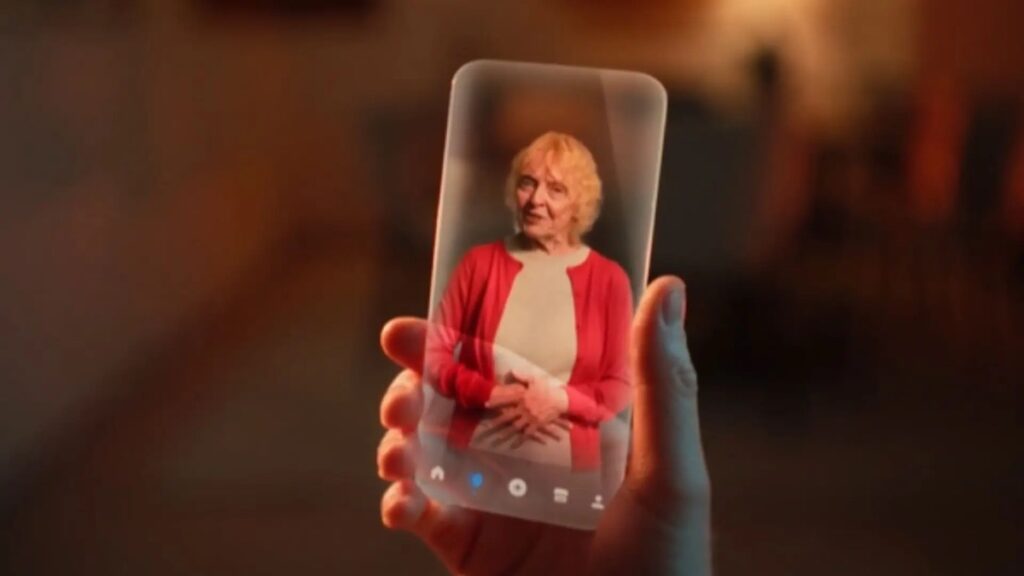

In an age of Artificial Intelligence (AI), what are the ethical ramifications of avatars of deceased loved ones? Apps offering the ability to hear from and relate to those who have passed on now include 2wai, HereAfter AI, and StoryFile. All appeal to an urge to connect with those we have lost.
This technology comes at a price.
British author and scholar C.S. Lewis’ reflections on his own grief offer us an understanding of just how great the cost will be. He published A Grief Observed after his wife Joy died. In it, he reflects on his desire to see her again and his struggle with suffering and faith after her passing.
The desire to interact with the dead is not new. The Old Testament books of Leviticus and Isaiah prescribed strict punishments for mediums and those who sought their services. Famously, Spiritualism took hold following the first World War. Christianity and Judaism have always been at odds with such practices. While this new AI does not rely on the demonic to interact with the dead, it too is at odds with the Christian understanding of how we should view death.
HereAfter AI proudly shares a review that it is the “Next step in the quest for immortality.” But this is not true. The person represented by the AI chatbot is no more alive than a person whose likeness is preserved in a photograph or recorded on video. If anything, it is less so. After all, the person in the photo really posed that way, made that facial expression; the video recording is a person’s voice with their real inflection, but the AI chatbot is an imitation of those things.
Lewis was suspicious of even the photo for its ability and attempt to preserve the memory of the deceased. He writes:
“What pitiable cant to say, ‘She will live forever in my memory!’ Live? That is exactly what she won’t do. You might as well think like the old Egyptians that you can keep the dead by embalming them. Will nothing persuade us that they are gone? What’s left? A corpse, a memory, and (in some versions) a ghost. All mockeries or horrors. Three more ways of spelling the word dead. It was H. I loved. As if I wanted to fall in love with my memory of her, an image in my own mind! It would be a sort of incest.”
In the end, the AI chatbot will be more damaging than a photo or a video. Photos and videos are static. They make no pretense to be the real object or give the illusion that the person is still present. This is not the case with the chatbot, there to interact with the deceased’s loved ones. Those who interact with it sense that they are experiencing a novel interaction with their loved one. And that interaction gives a false sense of knowing, the person comes away feeling that they interacted with their grandparent or spouse when they didn’t. Without realizing it, they have taken in false knowledge.
They did not see or hear the person represented by the chatbot; it’s a kind of facsimile. And the more they go to the facsimile, the less knowledge they will have of the real person. The love that grows will not actually be directed toward the deceased but to the AI. It will, in a sense, steal affections away from the true and redirect them toward the false.
But Lewis has another concern: it’s not just that the memory or, in this case, the chatbot will receive the affection that should be due to another person, but that these interactions actually damage our ability to love.
“…the image has the added disadvantage that it will do whatever you want. It will smile or frown, be tender, gay, ribald, or argumentative just as your mood demands. It is a puppet of which you hold the strings,” Lewis explains. He writes similarly of pornography and sexual fantasy in Mere Christianity. An image or, in this case, an algorithm will never displease you. It will only be what you want, what you design. And if you happen to become bored or displeased, you can put it away until it is pleasing again. But this is not the case with human beings.
To love people, we have to want their good, and that is difficult with fallible persons. People, even those we dearly love, place real demands upon us, the AI will not. But as Lewis writes, “The most precious gift that marriage gave me was this constant impact of something very close and intimate yet all the time unmistakably other, resistant — in a word, real.”
We need what is real.
This isn’t theoretical, I have been suffering through a personal matter, and there is one person I have desperately wanted to discuss it with, my father. At times I find myself craving his opinion and advice, and no one else’s thoughts will substitute. I want his opinion in part because I think we might disagree on the course of action. It’s his opinion, given in his voice, with his inflections, and founded on his life experience that I want.
An AI that resembles him, one that simply encourages me, is a cheap substitute. And the AI cannot will my good. The thing that distinguishes it the most is that my father loves me. The AI has an algorithm that seeks to please me; nothing could be farther from true love. I don’t want to rely on my memory, and I certainly don’t want an avatar, I want my father.
But there is hope, the same hope that Lewis comes to at the end of A Grief Observed, the resurrection. I will see my father again, and our relationship will be even more real, true, and good than it was on this earth. We will know and love each other perfectly. In the meantime, my father, like all the saints lives, and as members of the body of Christ, we have true communion with one another. He makes intercessions for me, actually willing my good. While I cannot ask for his advice, I can ask for his prayers, and in the end, that is far more valuable.
And Lewis leaves us with the final words of A Grief Observed, “How wicked it would be, if we could, to call the dead back! She said not to me but to the chaplain, ‘I am at peace with God.’ She smiled, but not at me. Poi si tornò all’ eterna fontana.”
More from IRD:
Better Stories, Stronger Spells: Anglicans Consider C.S. Lewis
AI: Christian Churches Respond




Comment by David on January 15, 2026 at 8:33 am
A virtual Jesus will be next along with a Mary for Catholics. A virtual Satan might be amusing by telling dirty jokes. Some ill-disposed person might hack this app and depict the loved one burning in hell.
Comment by John on January 15, 2026 at 10:47 am
Yikes!
Comment by Qohelet on January 15, 2026 at 3:58 pm
I am sorry you are going through something, and I am sorry for the loss of your father.
I agree with you completely on the idea of an AI avatar of a person being grotesque. I’d add that an extra danger is that even if a survivor could completely translate their experience of a person into an AI algorithm, that still wouldn’t be enough. My cousins’ version of who my grandfather was was very different than my version. I knew my wife’s grandmother as a very old woman when she’d grown quite a bit as a person; my wife’s uncle recalls a time when she wasn’t as kind. Who gets to be the programmer? In any case, none of us could build the complete person.