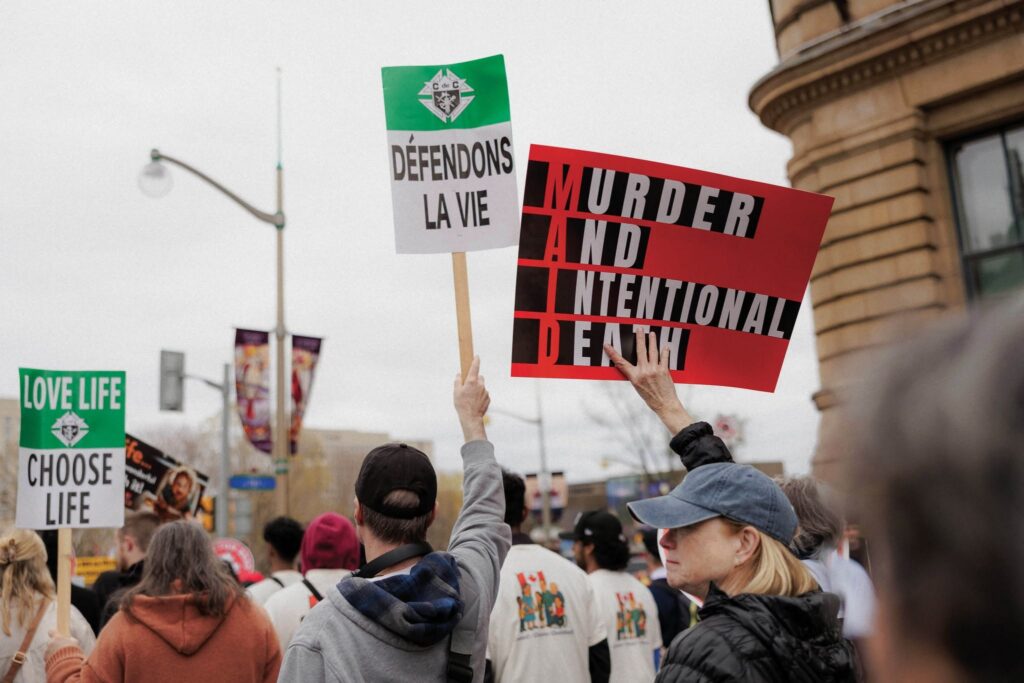
This summer, courts in British Columbia will decide whether faith-based healthcare institutions may keep their current exemption from providing euthanasia services, euphemistically known as medical aid in dying (MAiD). Under current rules, Canadian religious hospitals, most of them Catholic, are not obligated to euthanize patients on-site but must arrange referrals and transfers for patients.
The legal issue was ignited in 2023, when Samantha O’Neill, who had Stage 4 cervical cancer, died shortly after being transferred from St. Paul’s in Vancouver, a Catholic hospital, to a facility willing to provide MAiD. Her mother, along with Dr. Jyothi Jayaraman, a palliative care physician formerly employed by Providence Health Care, the hospital’s parent company, and Death with Dignity Canada, sued St. Paul’s, alleging a violation of O’Neill’s constitutional right to die. This constitutional challenge derives from the Supreme Court of Canada’s 2015 decision in Carter v. Canada, which held that the ban on assisted suicide violated the Canadian Charter of Rights and Freedoms, Canada’s equivalent of the American Bill of Rights.
Since 2023, the Church in British Columbia has come to something of a rapprochement with the death-cult progressives in charge of Canada’s healthcare system. Vancouver Coastal Health Authority, the government body in charge of providing healthcare, has opened MAiD centers adjacent to St. Paul’s Hospital, along with two Catholic-owned hospices in the province. When St. Paul’s relocates next year, its new Catholic site is expected to include a MAiD facility operated by the public authority.
The Church has remained steadfast in her opposition to the killing of the infirm. In 2023, the Canadian Conference of Catholic Bishops wrote that the bishops “unanimously and unequivocally oppose the performance of either euthanasia or assisted suicide (MAiD) within health organizations with a Catholic identity.” Yet this case provides a critical test of how far the Church in Canada and beyond will go to defend her witness to life. In Nova Scotia, the province’s only Catholic hospital, St. Martha’s, run by the Vincentian Sisters of Saint Martha, will disaffiliate from its Catholic sponsorship this year because of provincial efforts to compel it to provide MAiD and abortion services. Similar stirrings have begun in Quebec and elsewhere.
The decisions facing the Church in light of these proceedings will be incredibly challenging. In British Columbia, half of hospice beds are provided by the Church, and hundreds of thousands of people receive treatment in her facilities. Yet, as John Paul II wrote in Evangelium Vitae, his definitive 1995 encyclical on life issues, “[euthanasia] involves the malice proper to suicide or murder.” The Church cannot and must not accommodate herself to a grave violation of the divine and natural law. If that means the closure of Catholic hospitals or a significant reduction of services, then that is what the Gospel of Life demands.
It is easy for American readers to dismiss this as the sort of occurrence possible only in an extreme element of the post-Christian West like Canada. Yet a similar process is already underway in fourteen American jurisdictions, thirteen states and Washington, DC, that permit MAiD. Last week, the New York Medical Aid in Dying Act took effect, mandating that healthcare facilities counsel patients about assisted suicide. The Carmelite Sisters of the Aged and Infirm, along with several other Catholic organizations, won a temporary federal court order exempting their facilities from providing MAiD services. At the same time, their lawsuit against New York Attorney General Letitia James continues.
American protections for religious freedom are certainly stronger than elsewhere in the West. Still, the plight of the Catholic Church in Canada should serve as a canary in the coal mine for the Church universal. As attacks on the sanctity of life intensify around us, our ability to continue our historic ministries to the sick, the infirm, and the dying may face monumental challenges. In this time, it is important to keep the Canadian Church in prayer and recall the long Christian history of resisting assaults on human life. From the early Christian refusal to participate in infant exposure, going as far as to rescue exposed children from human dumping grounds, to the brave witness of Dietrich Bonhoeffer in refusing to subordinate the German Protestant Church to Nazi rule, our shared history is not lacking in bold acts of resistance to the culture of death. Perhaps the struggle over MAiD will provide us with new entries in this venerable tradition.
More from IRD:
Religious Sisters’ Lawsuit Alleges Compulsion in Doctor-Assisted Suicide




Comment by David on August 12, 2026 at 7:30 am
“Everyone wants to go to heaven, but no one wants to die.”
Well, attitudes have changed since the early 20th century. Prolonged suffering is a byproduct of improved medical treatments. Sick people last longer today. While withdrawal of feeding tubes and ventilators is often allowed, this can become complicated once these have been provided. People are advised to have medical instructions such as do not intubate or do not revive. I intend to die only once.
There is no longer any need for religious groups to operate secular businesses such as hospitals when health insurance is available, especially in Canada compared to the US. Also, there is no longer ethnic discrimination in hospital admissions, as Jews, Blacks, etc., were not welcome.
Comment by Wilson R. on August 12, 2026 at 10:03 am
I stopped reading when I got to the inflammatory phrase “death-cult progressives.” I am concerned about slippery slopes when euthanasia is allowed. I don’t think Catholic hospitals should be required to perform assisted suicides even when that is the patient’s wish. But those who want to help terminally or incurably ill people end their suffering have a reasonable point as well. Calling them death-cult progressives makes you come off as though you’re incapable of an informed debate. Do better next time.
Comment by Mike on August 12, 2026 at 4:35 pm
Wilson,
You and your kind forget that it is God who decides when we die, not ourselves. If we commit suicide, we are guilty of murder-it simply is murder of ourselves.
Also, you don’t end your suffering when you end your own life. if you are not one of Christ’s, your suffering will be increased, as you face the eternal torments of hell and everlasting punishment.
Comment by Wilson R. on August 14, 2026 at 1:05 pm
Mike:
I’m not condoning suicide, and I thought I made it clear I have mixed feelings about assisted suicide. But to your comment about God’s judgment: A lot of people who are not terminally ill or in unbearable physical pain commit suicide because they experience emotional suffering that hinders them from being in their right minds. The Jesus I know looks upon such people with compassion. It sounds like the Jesus you know is more about judgment and hell.