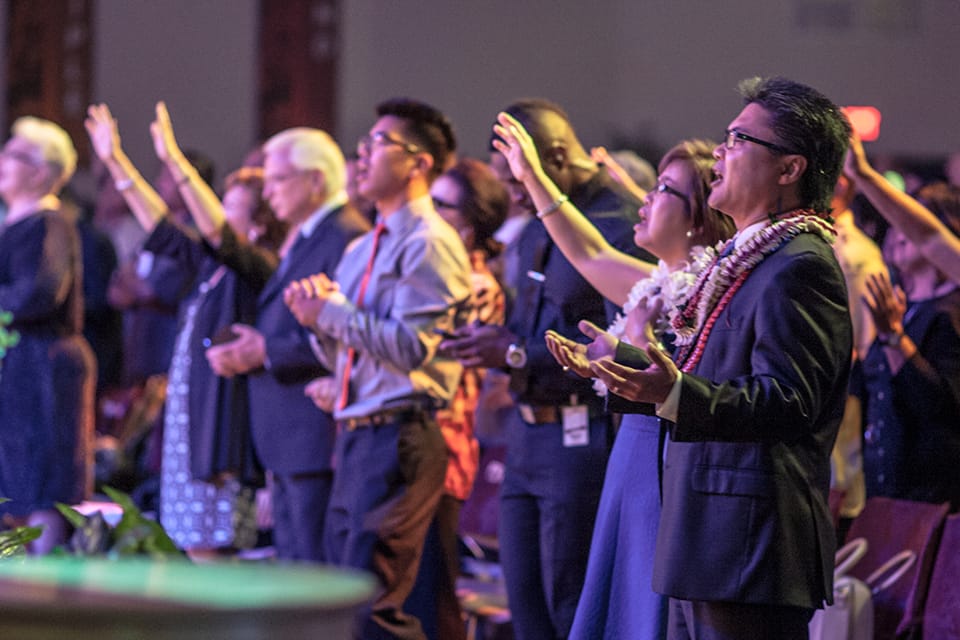

Statistician Ryan Burge recently authored a piece on healthy statistical trends in the Assemblies of God (AG), probably the only large denomination in the United States that is showing long-term growth. Writing on his indispensable Graphs About Religion substack (find that here) Burge notes that characteristics of charismatic worship and non-denominationalism are commonplace in churches that are growing.
The AG is “one major denomination that manages to buck that trend,” Burge notes. “They have one big advantage—charismatic worship—but they’re also still a coherent denomination. Despite being fairly ‘institutional,’ they’ve managed to post nearly continuous growth over the last five decades. That’s something almost no other major denomination in the United States can say.”
I found this updated information on the AG to be of great interest. It partly buttresses and partly complicates some of the conclusions we’ve drawn ourselves here at IRD. In short: aside from a one-time COVID-era attendance drop (from 3.3 million in 2019 down to 2.93 million in 2021 and a subsequent rebound since to 3.06 million in 2024 – but not quite to pre-pandemic size) the AG seemingly hasn’t plateaued (yet) and their networks seem healthy with what Burge notes is a “slow, consistent climb of about 2–3 percent per year.”
Here at IRD we’ve noted that larger local churches tend to minimize their denominational ties to the AG, if not obfuscate them outright, one part of a consistent trend that points to denominational ties being less valued across various Protestant traditions in the United States. As an example, National Community Church (among the most-attended Protestant churches in Washington, DC) appears on the AG website. But, good luck trying to find a reference to the AG on the NCC website. I even recall meeting a young couple at a party once who were surprised to learn that NCC was not actually a non-denominational church as they had assumed across nearly a year of attendance there.
Do the people in the pews (or stadium seats) care about an AG affiliation? Maybe not, but the denomination has institutions (seminaries, church planting networks, mission sending organizations) that facilitate continued growth, and I propose that is an important contribution beyond the conscious denominational identity of church members.
The AG’s Pentecostal-but-not-weird-about-it brand is being well-received. The denomination is more diverse in both the age and race/ethnicity of its membership than most other churches of its size (according to the AG’s Annual Church Ministries Report, ethnic minorities comprised about 43 percent of AG U.S. adherents as of 2019, a figure that has steadily increased). That’s something to celebrate, especially for those of us coming from Mainline Protestant traditions that have rapidly aged and remained overwhelmingly white, even as the overall U.S. population has ethnically diversified.
An outworking of the denominational institutions matter more than perceived identity. If these institutions assist in planting churches that people attend, and their seminaries train those who pastor them, that matters more than if there is a coherent denominational identity. Most in American Protestantism think that they are merely following what the Bible plainly teaches, unaware that they make interpretive choices shepherded by institutional gatekeepers.
I do agree with IRD President Mark Tooley’s “big picture” that denominationalism is obviously in decline, and 20 percent of American Protestants in nondenominational churches is a substantial – and unprecedented – increase across the past generation (Burge notes that in 1972 less than 3 percent of U.S. Christians were nondenominational, and that the number didn’t really take off until the late 1990s).
That said, denominations do still matter, and I’m not just referring to relatively modest examples catering to a subset of elites like the Anglican Church in North America (130,111 members) or the Presbyterian Church in America (400,751 members). There’s a lot of nuance here, and the much larger Southern Baptist Convention or AG’s effect reaches far beyond their church walls, even as people in the pews have little direct interest in the connection. Few of these people, for example, could articulate a coherent eschatology, but I could identify threads of shared belief that trace themselves back to institutions that those in the pews themselves could not name.
When I was young I had little idea what the Episcopal Church really even was, aside from that there was a bishop in Denver and we prayed for someone named “Edmond” each week. What mattered was the outworking of the institution in the lives of those who surrounded me – things like Episcopal Cursillo, Dinner for Eight, that my rector was a graduate of Virginia Theological Seminary, programs and institutions that shaped people. Both the AG and the SBC have their equivalents (Awana, International Missions Board, Southern Seminary etc).
Overt “care” doesn’t matter as much as what actually influences. Denominations still facilitate some theological transmission even if relatively few know what they are. The AG still matters, and its fingerprints are around us, even those of us who don’t consciously know it.




Comment by Curtis Nester on December 2, 2025 at 12:20 pm
Southern Baptists have six Seminaries:
Gateway Seminary of the Southern Baptist Convention in Ontario, California
Midwestern Baptist Theological Seminary in Kansas City, Missouri
New Orleans Baptist Theological Seminary in New Orleans, Louisiana
The Southeastern Baptist Theological Seminary in Wake Forest, North Carolina
The Southern Baptist Theological Seminary in Louisville, Kentucky
The Southwestern Baptist Theological Seminary in Fort Worth, Texas
And we support over 3,500 Missionaries.
Comment by Curtis Nesster on December 2, 2025 at 12:24 pm
Southern Baptists have Six Seminaries:
Gateway Seminary of the Southern Baptist Convention in Ontario, California
Midwestern Baptist Theological Seminary in Kansas City, Missouri
New Orleans Baptist Theological Seminary in New Orleans, Louisiana
The Southeastern Baptist Theological Seminary in Wake Forest, North Carolina
The Southern Baptist Theological Seminary in Louisville, Kentucky
The Southwestern Baptist Theological Seminary in Fort Worth, Texas
And we support over 3,500 Missionaries
Comment by jeff on December 2, 2025 at 12:41 pm
the dirty little secret is that almost all AG growth is from immigrants. Either outright joining or forming their own affiliated networks (such as Slavic churches forming their own AG-affiliated Slavic network).
Comment by April User on December 2, 2025 at 12:48 pm
Thank you for this report. My husband and I both grew up in the AG (where he was ordained), migrated into the UMC, and finally into the ACNA twelve years ago where he now serves as rector. We have family locally that worships in a growing AG congregation. Just this week we learned that, after a four-year study regarding women elders/deacons, the decision is not to appoint women to that role. As a denomination, the AG ordained women from early in their history but this local leadership board is electing to not to include women. Unfortunately, that decision has drawn battle lines that will most likely split their church. Because the AG is congregational in governance, they are free to differ from the denomination. We shared with them that our own beloved ACNA is facing the same decision but at a provincial level. Thankfully our district has put a moratorium on the ordination of women. Lord have mercy.
Comment by Gary Bebop on December 2, 2025 at 1:03 pm
Denominational labels matter to academics, to list makers, to journalists, but the people who fill the seats don’t cotton to “legacy identity” but only the ethos or culture of their local church. One won’t get many sales promoting denominational identity; it’s one of those details that seldom surfaces in conversation. When people discuss churches, they focus on details they recognize and value, not denominational memes, statistics, and symbols, which they regard as opaque, obscure, or obfuscating.
Comment by Glenn Wheeler on December 2, 2025 at 11:09 pm
The denominations are important only to those who make their living from them.
Comment by Patrick on December 3, 2025 at 9:10 am
To Glen Wheeler:
Denominations are important if they have systems of accountability, and do not allow predators to move from congregation to congregation. I would say that importance is more than to those who make their living from them.
My heart breaks on this issue, because unworthy leaders are found in both non-denominational and denominational churches.
(This is my short reply to a subject worth a long discussion, which comments sections do not always make the best place for.)
Comment by Qohelet on December 3, 2025 at 6:13 pm
Denominations do matter, and the role of women in leadership is one of the chief examples of why.
I won’t look at a church that doesn’t allow women preachers. Firstly, we believe preachers are called by God. We do not control God, and the idea that we would block a woman from the pulpit who God has called is an unbelievable amount of arrogance before the Lord.
Secondly, we’ve seen all too well in the US Catholic Church and the Southern Baptist Convention what happens when you don’t have diversity in your leadership. Women priests and preachers might not have stopped the abuse, but they would have made the systematic cover up impossible. The reason corporate America embraced DEI is that diverse groups of people collectively make better decisions. They have more experiences to draw on and any divisions the diversity causes requires professionalism and introspection to solve.
Comment by Jason on December 4, 2025 at 10:57 am
To Qohelet,
You’re making a significant logical fallacy here. There is no logical principle that states:
For some x, P(x).
For some x, Q(x).
Therefore, for some x, P(x) and Q(x).
In a nutshell you’re saying:
Most abuse/cover up occurs in Catholic & SBC churches.
Most Catholic & SBC leadership is male. (remember Nuns can hold leadership roles)
Therefore, most abuse/cover up is caused by males.
This is akin to saying:
Most animals in this zoo are birds.
Most birds can fly.
Therefore, most animals in this zoo can fly.
Both arguments are fallacious.
A zoo could have mostly penguins & ostriches.
An organization could have all male leadership and no maligning record of abuse.
Judaism, Buddhism, Eastern Orthodox, and Oriental Orthodox are such examples.
Conversely, public school teachers are almost entirely female and you can’t turn on the news without hearing about some teacher caught in an abuse scandal.
Comment by Mark on December 4, 2025 at 11:58 am
Jason,
Abuse does and sadly likely will continue to happen in all religious traditions. What matters is how those instutites address it. Do they have policies in place to protect women and children from abuse happening in the first place? Do they have clear systems for filing and reviewing complaints against clergy and other leaders? Is their first instinct to investigate the matter and protect the alleged victims, or is to try cover things up and spare the perpetrator embarassment? Research does show that churches (as well as businesses and others institutions) in which all the power and decision-making is in the hands of men do tend to take instances of abuse against women less seriously as those that are more egaliterian and transparent in their leadership. It’s not that Catholic priests or Southern Baptist preachers are more prone to sexual misconduct than other clergy, it’s that when it does happen the systems in place tend to protect and benefit the perpetrator over the victim.
Comment by Different Steve on December 4, 2025 at 12:55 pm
The Episcopal Church has had women clergy (Heather Cook being a singularly appalling example) since the 70s but theres been no dearth of abuse and coverup (much of it commited by women) since so there goes your theory. This webpage may be instructive:
https://www.anglicanwatch.com/
Comment by Qohelet on December 4, 2025 at 3:14 pm
@ Jason
That’s not remotely what I said. I said that those two churches, who exclude women from leadership, have had far reaching and shocking sexual abuse scandals. This is not an opinion but a historical fact.
What I said was that if their leadership was more diverse and included women and their experiences, those churches might not have bungled their response so terribly. Gender isn’t the issue, groupthink is. I’m inherently suspicious of decisions not made by anyone but the good ol’ boys. We’re not good at policing ourselves.