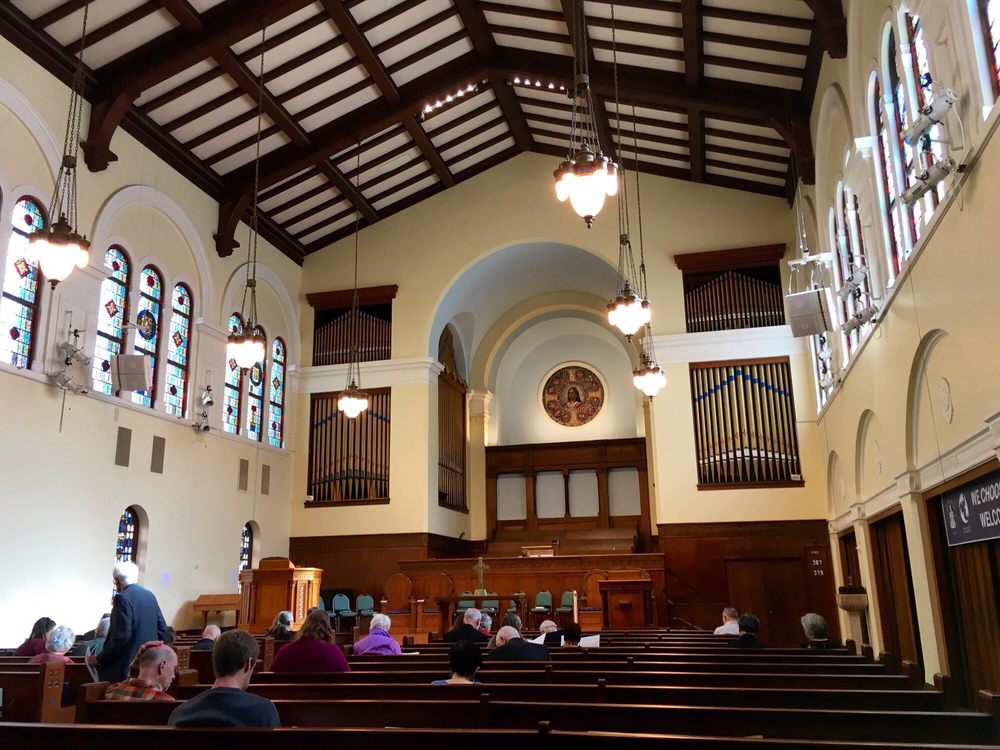

The Presbyterian Church (USA) is gradually shifting into a new role as a shrunken denomination of mostly tiny churches, according to statistics released this week by the mainline Protestant denomination.
In 2024 the PC(USA) shrank by 48,885 members, down to 1,045,848 (4.5%). The steady decline of about 4.5 percent per year is mostly consistent across the past decade after accelerating earlier. Presbyterians also saw 140 local churches either dissolved or dismissed to other denominations, still counting 8,432 total. Across the entire denomination, only four churches were planted in 2024, the lowest number in memory (the average had been nearly 30 new churches planted each year between 1995-2005).
On track to drop below one million members sometime this year, the PC(USA) will have less than one-third of the 3.1 million members that it counted when formed in reunion of two predecessor bodies in 1983. Peak membership was in 1965, with 4.25 million members in the two denominations that later merged.
Large churches have declined in number precipitously. In 2021, 919 PC(USA) local churches had more than 800 members, in 2024 that was only 367. Two-thirds of congregations have fewer than 100 members, while 22.7% have 25 or less.
While more than a third of Presbyterians are age 71 or older, and nearly 60 percent are age 56 or higher (significantly older than the U.S. population), deaths don’t explain the majority of membership loss: only 20,420 deaths were recorded in 2024, far less than the total membership drop of 48,885. The total number of deaths recorded in the denomination has actually decreased each year.
The PC(USA) did report 181 additional members (a nearly 12% increase) identifying as nonbinary or genderqueer to a total of 1,728 comprising 0.2% of the denomination. There were also minor increases in Asian, Native American/Indigenous, and Hispanic/“Latinx” members, while the number of Black, Middle Eastern and multiracial members declined. The PC(USA) membership is 87.6% White.
Membership decline has had a significant budgetary consequence for the denomination, which saw the Presbyterian Mission Agency undergo a series of reductions in total annual giving towards supporting missionaries, peaking at $16 million in 2000 and declining to about $6 million by 2023. It was recently eliminated and merged alongside the Office of the General Assembly into a new entity, the Interim Unified Agency. In February, 54 mission “co-workers,” nearly the entire number of foreign missionaries, were notified that they would be laid off and offered severance packages.
Not every Reformed denomination is in decline. The medium-sized Presbyterian Church in America (PCA) reported in April a 1.84% increase in 2024 membership, bringing the denomination up to 400,751 members, or a gain of 7,223. The theologically conservative denomination also added a net 22 churches, rising to a total of 1,667. The PCA in 2024 reported a 16.56% increase in adult baptisms and a 2.4% increase in infant baptisms.
More:
PC(USA) Comparative Summaries of Statistics 2024
Presbyterian Church (USA) Notes More ‘Genderqueer’ Members Amid Overall Decline
Presbyterian Church (USA) Shutters Foreign Missions



Comment by David D Wilson on May 23, 2025 at 4:26 pm
Only 4 churches planted nationwise in 2024! Turn out the lights and lock the doors on your way out, The PCUSA is doomed. As is the UMC and TEC!
Comment by Larry Jackson on May 24, 2025 at 4:10 am
It is unseemly to gloat. But it must be said: “We told you so.” These denominations once actually focused on (in my opinion erroneous) religious doctrines. Now they focus almost solely on social and political concerns. They are mere NGOs and are and will continue to be increasingly irrelevant.
Comment by Mark Siegman on May 24, 2025 at 12:19 pm
A sad but expected continuation of decline. The PCUSA website gloats that despite these declining numbers, 3,000 more people transferred into PCUSA churches than transferred out – but the total dropped by over 48,000 and there were just over 20,000 deaths. The numbers don’t add up, but it doesn’t matter, this is a dying institution. Looking at the big picture, how is the PCUSA fulfilling the Great Commission? They’re eliminating all foreign missionaries, closing churches, and reading headlines under “PCUSA News” on their website, are indistinguishable from what you’d see on media from left wing NGO’s and the Democratic Party. Most consist of left-wing virtue signaling overlaid with sanctimony and dubious references to Scripture.
As noted, the more conservative PCA has continued growing. The combined total membership in the PCA; the Evangelical Presbyterian Church; the Covenant Order of Evangelical Presbyterians; the Orthodox Presbyterian Church; and Associate Reformed Presbyterian Church is approaching that of the PCUSA, and these smaller, more theologically conservative Presbyterian denominations are growing, planting churches by ministering to people today as the body of Christ – not as an NGO.
Comment by Tim Ware on May 24, 2025 at 11:46 pm
The 2/3 of congregations with fewer than 100 members provide no significant support to the denominational structure. What that denomination is becoming is an urban, boutique denomination, supported by a relative handful of urban congregations. And that’s ok with them. Ironically, the more people they lose and the more insignificant they become, the more they are convinced they are doing “God’s will.”
Comment by Mark S on May 25, 2025 at 7:40 am
Don’t forget another conservative/traditional spinoff, the Evangelical Covenant Order (ECO) of Presbyterians, which is also growing.
Comment by Jeffrey Walton on May 27, 2025 at 10:48 am
Yes, I’m aware of ECO, the OPC, and the EPC as well. It has been more difficult to locate 2024 membership numbers for these, although I was able to find that ECO reported 121,058 members and 629 churches in 2023. in 2018 ECO had 383 congregations and 129,765 members, so they appear to be growing in number of congregations but not in membership. If you can direct me to 2024 numbers, that would be most helpful.
Comment by Cal on May 25, 2025 at 9:46 am
It’s the Joe Biden of denominations: aging, declining, and in thrall to the progressives.
Comment by Gary Bebop on May 25, 2025 at 12:32 pm
“An urban, boutique denomination” may be goldilocks for PCUSA. This likely defines the chosen future of United Methodism as well. There’s a whiff of resignation in such a choice. But if you are part of such a church culture, the haze of corrupted and confused thinking is thick about you.
Comment by Nathan on May 25, 2025 at 11:15 pm
Only 4 churches organized is hardly surprising. Those four are likely mostly ethnic churches with Korean or Latino pastors too. PC(USA) is losing pastors even faster than churches (net loss of 236 ministers and 140 churches) so it struggles to fill the pulpits at the shrinking, dwindling, aging churches that remain.
Comment by Tim Ware on May 26, 2025 at 12:07 am
A couple of years ago, rode by a First Presbyterian Church in a town near here, a church that used to be the flagship church of the local Presbytery. Impressive brick building on a hill. But definitely past its glory days. Sanctuary probably seats 600 but has maybe 75 on an average Sunday. Impressive from a distance, but when you get close to it, you see that it’s no longer maintained. Paint old and crumbling, everything looks like it needs a good sprucing up. Stuff around the outside needs picking up, everything looks weathered and worn. A sad, crumbling, deteriorating remnant of what used to be.
A good example of what the PCUSA has become.
Comment by Tim Mc on May 26, 2025 at 8:32 am
Romans 1:22 Claiming to be wise, they became fools.
Comment by Tim Wohlford on May 26, 2025 at 6:35 pm
After I left UMC in 1991, I went to PCUSA, where I stayed thru 2022. In that time, I lived in Louisville, with PCUSA staffers and General Moderator in my Sunday School class. I married an ex staffer as well. While doing long out of town gigs, I went to two marquee “seminary” PCUSA churches.
PCUSA, like UMC, had its headquarters turned into a refuge for closeted gays. It never met a cause popular with university faculty that it disagree with, and it comes as a surprise that Jesus might not agree with those stances. Competency for successive leadership teams was at a minimum, with emphasis put on hiring DEI compliant activists (when not downsizing). While I was already leaving my (beloved) Louisville church, I left with a BANG when the PCUSA’s staff declared Jesus’ support for gender affirming care for kids.
YOU FORGOT that PCUSA just shut down its foreign mission support. That doesn’t bode well either
Comment by Jeffrey Walton on May 27, 2025 at 10:43 am
Tim, I did not forget. Please see the second to last paragraph.
Comment by James W. on May 26, 2025 at 6:40 pm
There are still biblically faithful churches in the PCUSA. Some advertise on their websites that they view their denomination as a mission field. I’ve been told that some of these churches are larger than their presbyteries would be without them, so they are largely allowed to be orthodox without repercussions. This was true for one large PCUSA congregation in suburban St. Louis until recently. It is now about to vote on whether to join ECO.
Comment by Mary Lou Longworth on May 26, 2025 at 6:51 pm
Such sad news of a once booming culturally-significant church. People want to hear the good news of redemption, eternal life, and how to walk with God according to the Holy Spirit’s leading. People want to learn of a sovereign God and the holy God-breathed inerrant scriptures. Instead, hearing political and gender issues is not what brings people to church. God is still at work–just not at the Presbyterian Church (USA).
Comment by Rev Robert H Tanzie on May 26, 2025 at 6:53 pm
In 1968, was under care on my way to ordination in the Upper Ohio Valley Presbytery of the PCUSA – if I correctly recall the name. A fellow under care a few years ahead of me was heading to Princeton. The presbytery sent him back his doctrinal paper for a rewrite as he was told his treatment was “too narrow in concept”. His topic? The doctrine of the Trinity. After a serious season of prayer, I changed denominations – OPC then, PCA. I was honorably retired in 2022 with no regrets but much thankfulness for my earlier decision.
Comment by Patrick on May 27, 2025 at 9:17 am
Well, well well.
Back in 1998 Houston Hodges predicted that the PC (USA) would be below one million members by 2020. He also said the PCA would by that time surpass the PC(USA).
Was he a false prophet? He did not say these things “in the name of the Lord”. Maybe he was just mistaken.
Comment by Loren J Golden on May 29, 2025 at 12:21 am
In the years following the Civil War, a handful of scholars in the (northern) PCUSA’s seminaries, followed about a quarter century later by scholars in the (southern) PCUS’s seminaries, bought into the lie that the Bible was full of errors, that treating and trusting it as the inerrant Word of God was intellectually untenable, that there was no future for a church that held to the supernatural teachings of Scripture as if they were indispensable to the Christian faith, and that the church ought to put her entire emphasis on finding cures for social ills—such as poverty, drunkenness, and armed conflict between nations. They found in some of their students itching ears, eager to hear something new.
Thus, unbelief spread like a cancer through the two denominations until, by the end of the 1920s, it became clear that both denominations were dominated, not only in their seminaries, but in their presbyteries and churches as well, by Theological Liberalism, which J. Gresham Machen famously said, “is not Christianity at all, but a religion which is so entirely different from Christianity as to belong in a distinct category.” (Christianity & Liberalism [1923; reprinted Grand Rapids: Eerdmans, 1997], pp. 6-7)
To be certain, there were stalwart Presbyterians who opposed the Theological Liberal hegemony (Machen being a case in point), but they were never able to uproot it from its seats of influence. Thus the 1958 union of the PCUSA and the UPCNA that produced the UPCUSA and the 1983 union of the UPCUSA and the PCUS that produced the current PC(USA) have been overshadowed by the divisions in 1936 that produced the OPC, in 1973 that produced the PCA, in 1981 that produced the EPC, and in 2012 that produced the ECO. Membership in the UPCUSA crested at an all time high of 3,308,622 in 1965, and in the PCUS at 961,767 just three years later; since then, they—and since 1983 the PC(USA)—have experienced net membership losses every year (for full disclosure, the PCUS experienced a net gain of 626 in 1970, but that was more than offset by a net loss that same year in the UPCUSA of 76,969), and in the past fifteen years alone, the PC(USA) has experienced a net loss of just over one million members (including yours truly).
Sadly, there is no end in sight for the PC(USA)’s annual membership losses. At the current rate of decline, the PC(USA) will lose the rest of its members sometime in the mid- to late-2040s. More likely, the membership loss will gradually lessen, and I would not be surprised if there were a merger between the PC(USA) and the RCA (which also has a Presbyterian form of government, is also dominated by Theological Liberalism, and has lost half its membership within the past five years) sometime in the next ten to twenty years. Other mergers (such as with Methodists, Lutherans, Congregationalists, or Episcopalians) seem unlikely, considering that each of these denominations has its identity in its polity, and a merger between any two or more of them means that at least one of them would lose their identity.
It should go without saying that the PC(USA) is not hopelessly lost. God is omniscient, omnipotent, merciful, and gracious. If He so chooses to act, His Spirit can work in a denomination as dead as the PC(USA), so as to breathe new life into it and resurrect it from the dead, causing the Gospel message of Jesus Christ to once again be proclaimed from the pulpits of the PC(USA), with men and women putting their trust in the Biblical Jesus (and not the pitiful mascot Theological Liberalism has made of Him), engendering new life where currently there is none.
Three thousand souls were added to the Church on the day of Pentecost (Acts 2.41); five thousand men joined the Church when Peter and John preached in Solomon’s Portico after the pair had healed a lame beggar (Acts 4.4); after the incident of Ananias and Sapphira, the Apostles regularly preached and performed signs and wonders in Solomon’s Portico, “and more than ever believers were added to the Lord, multitudes of both men and women” (Acts 5.14); and after the first deacons were commissioned, “the number of disciples multiplied greatly in Jerusalem, and a great many of the priests became obedient to the faith.” (Acts 6.7). This is what happens when the Lord works in a church—men and women hear the Gospel preached, believe in the Lord Jesus, and thus are saved from sin and death.
And this is precisely not what is happening in the PC(USA). The PC(USA) as it stands today is moribund and has been languishing for the past sixty years. The Gospel message of Jesus Christ is not preached from her pulpits—indeed, it is anathema to many who do preach from her pulpits—and until it is, she will continue to languish, until either she repents and believes, or until she dies an ignominious death.
As for me, I pray for the former, but I fear the latter will be her end.
Comment by Felix on April 12, 2026 at 6:10 pm
This article makes the mistake of taking bogus PCUSA statistics at face value. It says: “Large churches have declined in number precipitously. In 2021, 919 PC(USA) local churches had more than 800 members, in 2024 that was only 367.” However, in 2021 the number of local churches with 800+ members was 176, not 919. see: https://pcusa.org/sites/default/files/2025-01/2023_Comparative_Summaries_Statistics.pdf
The number in 2024 was 151, not 367. see https://church-trends.pcusa.org/churches-by-size/search/
Comment by James Weldon on May 14, 2026 at 11:52 am
Waiting on the “Official” numbers for 25 to see if they fall below 1,000,000 this year.
Comment by Felix on June 14, 2026 at 10:20 pm
> Waiting on the “Official” numbers for 25 to see if they fall below 1,000,000 this year.
The official 2025 statistical report appears to exist. It is cited in
[PLEN-INFO-01] Report of Allegations and Charges of Sexual Misconduct
https://www.pc-biz.org/search/3001587
But it hasn’t been released to the public. Maybe that will happen soon after the General Assembly is over. In any case, it will be old news when it is released. Membership is dropping at a rather steady rate of about 4.5% per year, and the 2027 and 2028 proposed budgets are based on that continuing. So by June 30, 2026 there will be about 22500 fewer than 1M members.
Comment by James Weldon on June 30, 2026 at 9:06 am
Waiting on Jeff or someone to dig into the latest numbers. I haven’t looked at anything but headline that said shrinking slowed which I don’t believe for one instant. The few PC USA churches I see look like a nursing home.
Comment by Felix on June 30, 2026 at 1:37 pm
No need to wait. Take a look at Wikipedia PCUSA. It shows that membership for the Presbytery of Southern New Jersey was arrived at by adding its 2024 and 2025 membership together. This shows up in the statistics as a “Misc” entry of 5923. There is no apparent reason to be summing 2024 and 2025 membership figures.