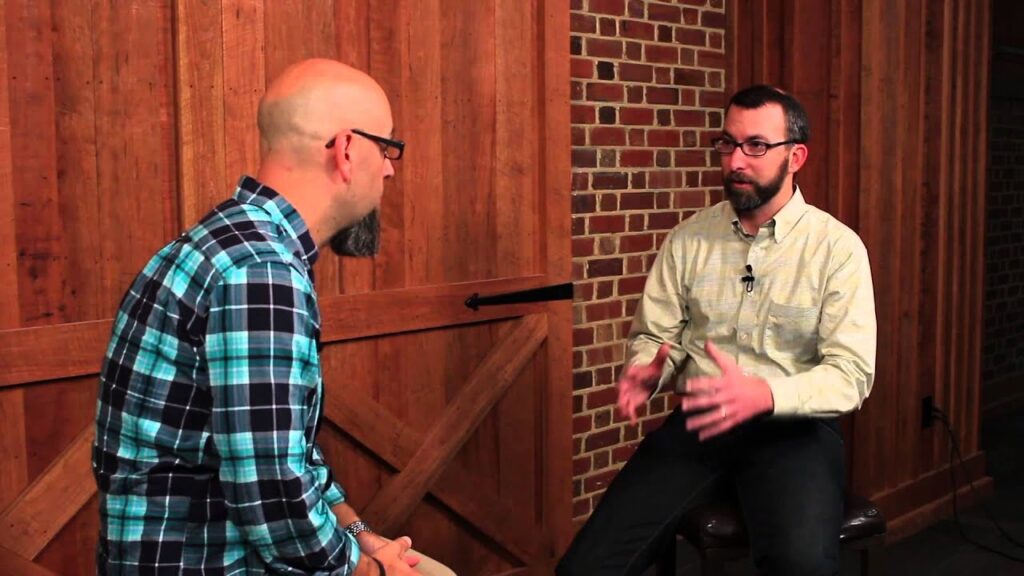

Matt Schmidt, founder and CEO of Engage 360, a ministry aimed at helping Christians “share their faith in everyday conversation,” spoke at the Southern Evangelical Seminary’s Apologetics Conference on October 12 regarding how ordinary Christians can engage in conversational evangelism, particularly with persons who have left the Christian faith. Earlier articles (here and here) dealt with engaging with persons who “deconstructed” their faith.
The Engage 360 ministry sees apologetics as coming on the “back end” of evangelism. Apologetics should “be serving either evangelism or discipleship.” Schmidt said that he “came to faith from atheism.” He did, however, come from a churchgoing home but found that no one could answer his questions. Through a “long path” he came to faith, but “without much help from Christians.” This has given him a “passion” to help others who are struggling with doubt or unbelief. However, most people in churches are not interested in apologetics, he said. There are those who endeavor to “beat people over the head” with apologetic arguments, but more commonly Christians prefer to avoid people with serious doubt or unbelief. He believes that if a Christian can be put on a path in which they will “create or take advantage of opportunities to talk about their faith with non-Christians, they will become more interested in apologetics over time.”
Schmidt defined “deconstruction” as the experience of “someone having had certain Christian beliefs or views, and then changed.” He or she “walked away or significantly shifted those views even if they remained in some sense under a banner of Christianity.” A common story of the loss of faith is the story of an individual who accepted much of Biblical faith but found some aspect of the faith unacceptable and then rejected much or all of the faith.
Schmidt asked what reasons people give for deconstructing the Christian faith. “Hurt in church” was the first reason given. Other reasons were doubt in Biblical authority, whether in its factual claims or moral precepts, hypocrisy on the part of believers, God’s command to annihilate various peoples in the Old Testament, experiencing condemnation for one’s doubt, and the problem of evil. Schmidt said, however, that people who reject Christianity do not do so after a though investigation of the evidence, but rather for some specific reason (such as those above), and then find evidence and arguments to support their unbelief. “The overwhelming majority” of people he has spoken with apostatize because of either “a misunderstanding” of Christian faith, or “a faith grounded in the wrong foundation.” People can even have correct beliefs, wrongly grounded. Faith that is “wrongly grounded” is “perilous,” he said.
Schmidt said that he specifically focuses on “discipleship and evangelism.” The first includes training the church, and especially youth, in correct and defensible doctrine, the second involves preparing Christians for objections or problems they will encounter in outreach to the world.
Wrong Foundations for Faith
Three “wrong foundations” for Christian faith include “self,” “church,” (including parachurch organizations), and (said with caution) “the Bible.” Schmidt defined faith as “a belief, based on authority, in which we actively trust.” If one is “functionally trusting” in any one of the three as the basis of Christian faith, there is a danger of loss of faith.
Uncertainty about the faulty foundation, or conflict between the trusted foundation and the true foundation can lead to a loss of faith. Schmidt did say that people who trust in a wrong foundation are not necessarily unsaved. They trust Christ through the foundation, but faith should have a true grounding. The correct basis is instead “the person and work of Christ.” He cited the Roman centurion (Matt. 8:5-13 and Lk. 7:1-10) the Canaanite woman (Matt. 15:21-28) and the Samaritan woman (Jn. 4:19-29) as examples of faith. All three recognized Jesus’s authority. The apostles in their writings continually pointed back to Jesus. But, he said, we must beware of having knowledge about Jesus without commitment to Jesus.
Regarding the use of self as a foundation, here the self is made “the arbiter of truth.” One builds beliefs based on what seems plausible to oneself. Christian faith then become simply a set of ideas on par with other ideas, to be modified or rejected if they don’t seem to fit the accepted secular ideas. Choosing to follow Christ on the presentation on the gospel does not make one the foundation of truth. But there may be those who profess Christ who are in fact basing their commitment on their own power to determine truth. It is not wrong to have reasons for faith in Jesus, but one must trust him for “those things that can only be known by faith,” particularly for forgiveness of sins. Included as well are Jesus’s moral teachings.
Regarding the second wrong foundation, Schmidt said that some theologies place their true faith in an ecclesiastical system. It is this system which “makes available the benefits that Jesus provides.” Mormonism was given as an example. Trusting Joseph Smith’s claims to revelation, the current doctrines of the church, and doing what the church prescribes gives “access to the benefits” Jesus provides. Also the sacramental/sacerdotal systems of the pre-Reformation churches are claims to have necessary requirements for access to Jesus.
But Schmidt also said that trust primarily in the church can be found in Evangelical churches, where a favorite pastor or a “celebrity pastor” is practically the final authority in defining the Christian faith. One may have correct “beliefs about Jesus” in this situation, but they depend on the pastor or the church. People who leave Christianity entirely due to a sex scandal involving the pastor or a trusted institution were given as examples of a wrong foundation for faith. Here faith has been placed in a corporate Christian body. He said it may be emotionally hard to continue to follow Christ after such a crisis, but our real faith must be in Christ, whom we know through Scripture, not our immediate circumstances.
Finally, the Bible itself cannot be the ground of our faith. He said that the Bible is indeed “our surest epistemic … way to get to the teaching of Jesus and the apostles.” But the things recorded in the Bible “didn’t become true when they were written down in the books that we call the Bible.” As far as the New Testament is concerned, the gospel of Jesus had been taught orally for fifteen to twenty years before it began to be written down. While affirming Biblical inerrancy, Schmidt said that the importance of the Bible “is that it’s true.”
Young people from conservative Christian homes may be taught Biblical infallibility from a young age and be very enthusiastic about it. Then in college they find just one difficulty, and their entire faith is shaken. Schmidt observed that while the apostles would argue to Jesus’s messiahship from the Hebrew Scriptures when talking to Jews, with Gentiles, they would “build to Christianity” from what the pagans already believed. He observed as well that Paul’s statement in Romans chapter 10 that “faith comes by hearing, and hearing by the Word of God” actually is written in the context of a reference to Jesus’s death and resurrection. The true object of faith is Jesus. He is “solid foundation … [of] whatever storms come in life.”
Engaging a Secular Culture
In response to a question about inerrancy, Schmidt says that “if we have good reason, and especially from the teaching of Jesus to believe that the Bible is from God, [and] including [the] New Testament … gets the overwhelming benefit of the doubt and I trust that it is somehow without error … it’s not a historical claim, it’s a faith claim with historical implications, versus a historical claim with faith implications.”
In response to another question, Schmidt said that Engage 360 does significant work in New England, which is to a considerable degree de-Christianized. Therefore common ground must be found, and from that Engage 360 endeavors to build to the truth of the gospel.
Another questioner asked about the most common reason for leaving a church, Schmidt identified the most common reason as “hurt or confusion from the church.” And often it’s “some combination of the church and the church’s understanding of the Bible … [or] a failing in the church.” Although faith cannot be grounded in family or church “there is a valid time period … where it’s legitimate for a child to have faith grounded in their family and their church, but the hand off has to happen to where they eventually personally have [faith] grounded in Christ.” He suggested that high school age would be the time when this should happen.
The homeschool curriculum that Engage 360 is developing challenges students “to go out and actually have conversations with people.” Even students with a good grasp of their faith are likely to not be well able to share their faith unless they have experience doing so. And well-grounded students who have not shared their faith with others do not, in Schmidt’s experience, show a large “difference in drop-off rate when they go to college.” What does make a great difference is having actually shared their faith with people holding different ideas. They must consider how to explain their faith to others. Thus, “there is something in that wrestling process.” It seems that “we have to wrestle with some doubts to come to a well-grounded faith.”



Comment by Colin Ross on November 29, 2024 at 12:30 am
Wow three paragraphs in and this guy couldn’t be more wrong about most people I met who have left the faith. Apologetics was such a pathetic pastime that when I turned to it save my faith I ended up leaving in disgust. This guy has no shot at reaching the vast majority of people who have left this silly religion
Comment by David Gingrich on November 30, 2024 at 7:20 am
Collin Ross, you are commended to have left ‘silly religion’. I pray you will now follow Jesus.