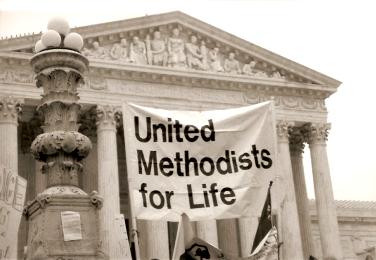
Recently a newly appointed official with the United Methodist General Board of Church and Society explained on her agency’s website that “we are a church that is pro-life, not pro-birth.”
Interesting explanation. What does it mean to be “pro-life, not pro-birth?” She describes United Methodism’s stance:
“We do not believe that abortion should be used as birth control or as a means of gender selection. We ‘call all Christians to a searching and prayerful inquiry into the sorts of conditions that may cause them to consider abortion,’ and we take consideration of the mother’s health. Also, we affirm ministries to both women who do and do not terminate a pregnancy. Unlike pro-birth proponents, we don’t believe in forgoing the life and safety of the mother.”
She further explained that “like Jesus, our denomination doesn’t seek to treat any person — male or female — as simply a means to an end.” So “to emphasize birth at any cost means treating a woman as if she were worth nothing more than her reproductive utility.” She also boasted that United Methodists “don’t believe that the church’s commitment begins and ends with the act of birth,” supporting “prenatal, postnatal and a lifetime of social and spiritual supports for all of God’s children is central to the work of the body of Christ.” She lamented that “current discussion on reproductive health has attempted to cut this conversation short, focusing only upon the act of birth and not the journey of life.”
It’s not clear who these morally numb people are who care only about the “act of birth” but lose interest in the child minutes later. Here’s one question for this “pro-life, not pro-birth” official with our church’s official lobby office: If pre-born children have no intrinsic value, dignity or protection, then how or why should society invest so much in the children after birth? If the value of human life is so fluid, then inevitably much of society will look at all children, and all vulnerable persons, through a utilitarian lens.
As I recount in my new book Methodism & Politics in the Twentieth Century, United Methodism shunned almost 2000 years of Christian tradition by endorsing unqualified abortion rights at the 1970 General Conference. An earlier draft of the legislation crafted by the Board of Social Concerns, predecessor to the current Board of Church and Society, even declared the “fetus is not a person, but rather tissue, with the potentiality in most cases for becoming a person.” The final draft didn’t go this far, but it opposed legal restrictions on abortion, which it asserted should be available “request.”
Fiercely opposing this stance at General Conference and later was perhaps United Methodism’s greatest theologian of the 20th century, Albert Outler. He afterwards helped organize a statement from United Methodist academics asking: “How long can we meaningfully say that all men are created equal while the innocent unborn are sacrificed to personal whim, convenience, or that new test of Americanism in our increasingly technologic and impersonal age: The qualification of being perfect, or being wanted, or being viable?”
In 1973, the U.S. Supreme Court decreed what the United Methodist Church had requested three years earlier when “Roe versus Wade” overturned all state legal restrictions on abortion. Fifty million abortions have followed, and there’s little that’s “pro-life” or ennobling about this grizzly result. The abortion rights culture has coarsened America and degraded our humanity. Like the nation, United Methodism has slowly been stepping back in recent years from the earlier enthusiasm for abortion rights. This year’s General Conference was almost certainly prepared to withdraw from the Religious Coalition for Reproductive Choice had it been allowed to vote. It will happen next time in 2016. And hopefully, as our church becomes more global, United Methodism will once again reflect the historic Christian consensus that is both pro-life and pro-birth.



Comment by Donnie on September 26, 2012 at 9:47 am
I long for the day the UMC is free of both the GBCS and the RCRC.
Comment by Mark on September 30, 2012 at 10:53 am
AMEN!
Comment by John Leek on October 21, 2012 at 5:19 pm
I pray for a day when the GBCS unites Methodists behind causes with little grey area. United Methodism worldwide should be working with local churches and international voices to end modern day slavery, generational poverty and child hunger. We’d be better served not to focus our attention on those areas where we disagree. United Methodism has always been political and sought to better society through public action. That needn’t stop, but our priorities should reflect our global points of agreement and the clear biblical witness.
Comment by spectre3218 on September 26, 2012 at 11:11 am
Rev. Paparella ( a provisonal elder) claims that we’re pro-life, but not pro-life? How is that consistent with the Book of Discipline? How is that even logical? What nonsense. You cannot be pro-life and not pro-birth. It’s like being pro breathing but not pro air. How does she expect to have anyone in her congregation, assuming we make the error of ordaining her, if we’re not pro birth? She, like Jim Winkler, presumes to speak on behalf of the faltering number of United Methodists without our acquiescence or approval. It’s time for both, along with the total waste of money and effort that GBCS is, to leave.
Comment by gayrette on October 21, 2012 at 7:20 am
Oh, do I ever agree with you! I am close to leaving the church over GBCS, Jim Winkler, and those mis-fitted to the congregational values like Paparella.
Pingback by Mere Links 09.28.12 - Mere Comments on September 28, 2012 at 11:00 am
[…] United Methodists Are “Pro-Life” but “Not Pro-Birth?” Mark Tooley, Juicy Ecumenism Recently a newly appointed official with the United Methodist General Board of Church and Society explained on her agency’s website that “we are a church that is pro-life, not pro-birth.” […]
Comment by Beth on September 29, 2012 at 7:31 pm
I wish United Methodists were pro-life. That is the only thing keeping me from joining my husband in that church.
Comment by Ben Welliver on September 30, 2012 at 1:29 pm
Beth, lots of individual UMs are pro-life, but the national bureaucracy is firmly in the hands of very pro-abortion feminists, so don’t look for the denomination to ever change. The Upper Room doesn’t even allow the use of “Father” in its devotionals.
My suggestion to your husband: do what I did years ago, bail out and find a church that is genuinely Christian.
Comment by gayrette on October 21, 2012 at 7:23 am
Join the church and get others like you to join and together we will rid ourselves of those left leaning who have taken the church to politics instead of worship. I truly believe that we will split off the left wing of UMC and become a new church.
Comment by Clemster on September 30, 2012 at 3:36 pm
Only liberals could craft such a contradictory, illogical position.
Comment by John Leek on October 21, 2012 at 5:22 pm
Sadly as fallen people I haven’t met many of any political persuasion who miss obvious things here or there. The “liberal” counterexample would be to point out how little “pro-life” politicians often seem to care about those same babies on the other side of the birth canal. Most of us at times, myself included, have been guilty of putting political ideology before the Kingdom of God.
Pingback by October 1, 2012 | Another Slow News Day on October 1, 2012 at 12:26 am
[…] http://juicyecumenism.com/2012/09/26/united-methodists-are-pro-life-but-not-pro-birth/ […]
Pingback by Pro-life without being pro-birth on October 2, 2012 at 6:01 am
[…] via United Methodists Are “Pro-Life” but “Not Pro-Birth?” « Juicy Ecumenism. […]