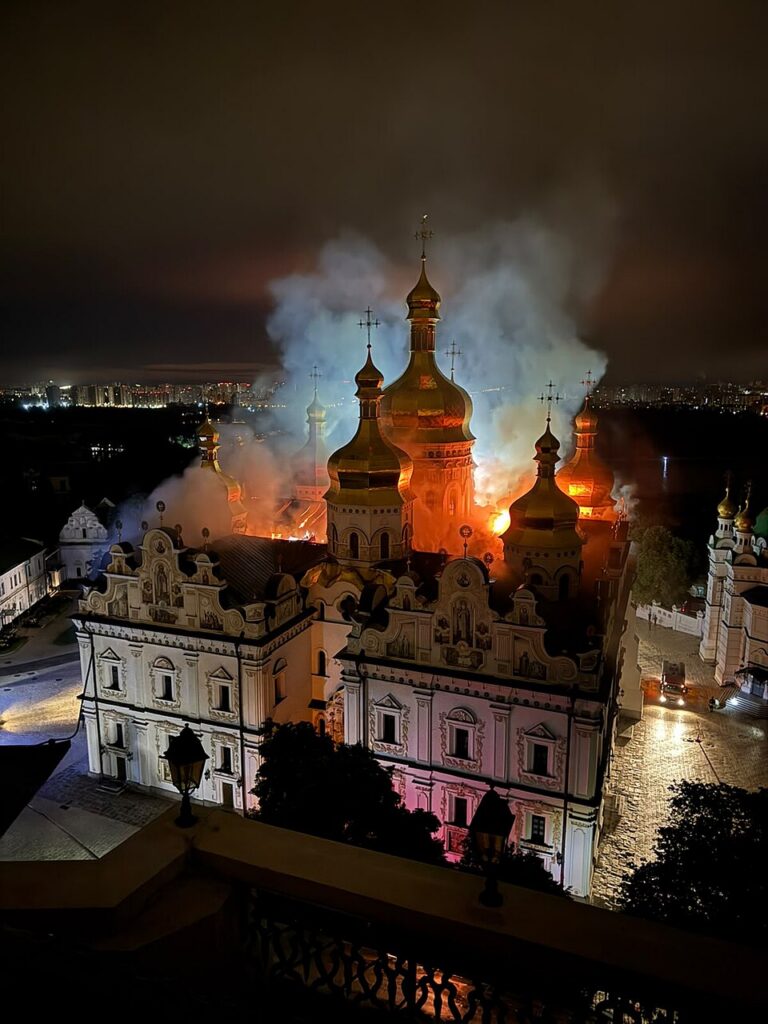

On June 15, the historically significant “Monastery of the Caves,” in Kyiv was damaged during a large-scale Russian bombing campaign of the Ukrainian capital. The monastery has a long history, and has, in recent years, been one of many sites of struggle between Russia and Ukraine’s conflicts over history, national identity, and culture.
Originally built in the 11th century, the monastery survived attacks by warring nations ranging from the Mongols to the Russian Empire. In the Soviet era, the complex was turned into a museum, 8 years after it was the site of a murder of the Metropolitan. The monastery’s Dormition Cathedral would be destroyed during the Second World War by retreating Soviet forces in the 1941 Battle of Kiev. Only in 2000 was the cathedral rebuilt by an independent Ukraine. In 1992 the monastery was given to the Orthodox Church of Ukraine (OCU), under the Moscow Patriarchate. It would remain under their jurisdiction until 2023 when the OCU (Moscow Patriarchate) lost its lease on the complex, and the monastery was handed over to the Ukrainian Orthodox Church (UOC) under the Kyiv Patriarchate.
This exchange of control, from one church to another, was just one example of the conflict over influence that both Kyiv and Moscow have been engaged in since 2014. Following the ousting of now-former President Viktor Yanukovich in the Revolution of Dignity, Ukraine has attempted to separate its institutions from Kremlin influence. One way that they have tried this, has been to achieve an autocephalous church, headquartered in Kyiv, instead of under the Moscow Patriarchate. These efforts met with success, but have caused Russia to respond to challenges to its influence with increased ideological and physical aggression. Hostilities flared following Russia’s 2022 invasion of Ukraine and Russian occupation of Ukrainian territory.
Within these Russian-occupied territories, trends emerged showing that Moscow potentially views this conflict with Ukraine not only as political and ideological, but also spiritual. Wheaton, Illinois-based Evangelical organization Mission Eurasia has released multiple reports describing Russia’s hostility towards faiths it deems as “unloyal” or “unreliable.” The most recent report shows how Russia’s campaign is being waged not only against the Ukrainian Orthodox Church, but against other religious minorities within the occupied regions, including Muslims and Protestants. The methods used by the occupying governments vary from displacement, threats of violence, and a series of laws and regulations meant to deplatform and delegitimize religious groups that the Kremlin sees as a threat to their authority.
Russia’s seeming lack of reverence for religious sites extends within Ukrainian-controlled territory as well. Russia has, whether due to deliberate targeting or a lack of oversight in target selection, destroyed or damaged hundreds of different churches. Some of these are well within the interior of the country, far from the front line. Russia’s continuous attacks on the religious culture of Ukraine, and in the structures that support this culture has been well-documented and reported upon.
In addition, priests and parishioners have been targeted by the Russian military and occupation forces. Priests have been arrested, transferred, and in some cases, outright killed. Among those targeted by Russia are clergy of the Kiev Patriarchate Ukrainian Orthodox Church, Baptists, Pentecostals, Adventists, and even members of the Moscow Patriarchate Orthodox Church of Ukraine itself.
The nature of the cathedral strike is contested by Russia, which has called accusations of a deliberate strike a “crude fake.” Ukrainian security services claim two Iranian-designed Shahed-style drones hit the structure deliberately. Russian officials countered that it was hit by an interceptor from a patriot missile battery that malfunctioned or missed its target, leading to accidental damage of the holy site. This Russian narrative, however, seems unlikely: a drone was tracked traveling in the direction of the monastery for many minutes leading up to the explosion. This claim, from the Ukrainian organisation Terrecon, refutes the claims by Russia that faulty Ukrainian air defence was to blame for the damage.
Even if the Russian claim is to be believed, the damage only occurred due to Russia’s continuous bombing of Kyiv, and the targeting of city infrastructure. This damage to an important Ukrainian historical and spiritual site is just another instance of many that has occurred during this war, and to have a site of this size and importance be damaged sets a dangerous precedent.
More from IRD:
Ukrainian War and the Churches
Church of England Priest Denounces Putin’s False ‘Christian Orthodox’ Faith
How Should Christians Think About the War in Ukraine?




Comment by Thomas on July 16, 2026 at 7:49 pm
Russia is now once again an empire of evil, and unfortunately United States don`t have a President like Ronald Reagan anymore, and Vladimir Putin is way more evil than Mikhail Gorbachev ever was. Pray for peace and for the Russian and the Ukrainian peoples.
Comment by Patrick on July 17, 2026 at 9:50 am
During the Soviet era, Russian troops commandeered Reformed Church buildings in Ukraine and Hungary, for military uses. After the end of the Soviet Union and the return of troops to Russian, the buildings were given back to the previous owners. The buildings had been misused, abused, neglected, and not maintained. This too was a deliberate attempt to wipe out physical evidence and architectural witness to the Savior Jesus. So, it is not just the Orthodox buildings that were/are targeted.