
Much of the religious Left has long harbored a barely disguised longing for socialism. Usually not Marxist-Leninism, of course, despite the “I have seen it and it works” fantasies of some visitors during the early years of the Soviet Union. Shortly after the USSR’s collapse I attended an international conclave on economics in Oxford, at which chastened liberals—progressives in current parlance—recognized what they called “the judgment of history.”
Nor are most self-described socialists really socialists. Sen. Bernie Sanders is a millionaire owner of three homes who has never, to my knowledge, proposed nationalizing the entire economy. Rather, he wants to use abundant resources generated by private enterprise to fund his social objectives. Heck, that’s even Chinese Communist leader Xi Jinping’s strategy: “socialism with Chinese characteristics” uses largely private economic activity to advance the ruling regime’s interests.
Nevertheless, there always have been softer variants of economic collectivism advanced by Social Democrats and their fellow travelers who imagined an electoral process that turned control of relatively free societies over to well-intentioned, all-knowing social engineers. As IRD has documented—and resisted—over the years, the mainline religious leaderships have often trended in this direction. Exhibiting similar tendencies among evangelicals were the Sojourners community and Ron Sider and Evangelicals for Social Action (now Christians for Social Action), which he founded. These activists generally sought to use the state to address genuine human trials and crises, but, unfortunately, with all too often counterproductive results.
Now nominal conservatives increasingly appear to be turning in a similar direction. President Donald Trump has never held to any consistent ideological position, so it comes as little surprise that he is seeking to return the United States to the past when mercantilism was in vogue. More unsettling may be Vice President JD Vance’s seeming enthusiasm for a state-directed economy.
Of course, the Bible does not enshrine any economic system. Fostering development and increasing growth weren’t the mission of the prophets and apostles. Indeed, the operation of neither the ancient Hebrew kingdom nor the New Testament Christian community offer much useful advice about how to organize and maintain a modern industrial society. People’s good intentions also mattered little. As James asked: “Suppose a brother or sister is without clothes and daily food. If one of you says to him, ‘go, I wish you well; keep warm and well fed,’ but does nothing about his physical needs, what good is it?”
As Jesus’s brother understood, practical results matter. By that measure the president’s approach is falling short. For instance, his trade policy, if it deserves to be called that, is essentially a trade war on the entire world. His campaign has raised consumer prices, increased producer costs, crippled domestic manufacturers, and destroyed American jobs. The vice president recently insisted that “the economy is a tool to serve the dignity of the human person.” If so, he shouldn’t be talking up Trumponomics.
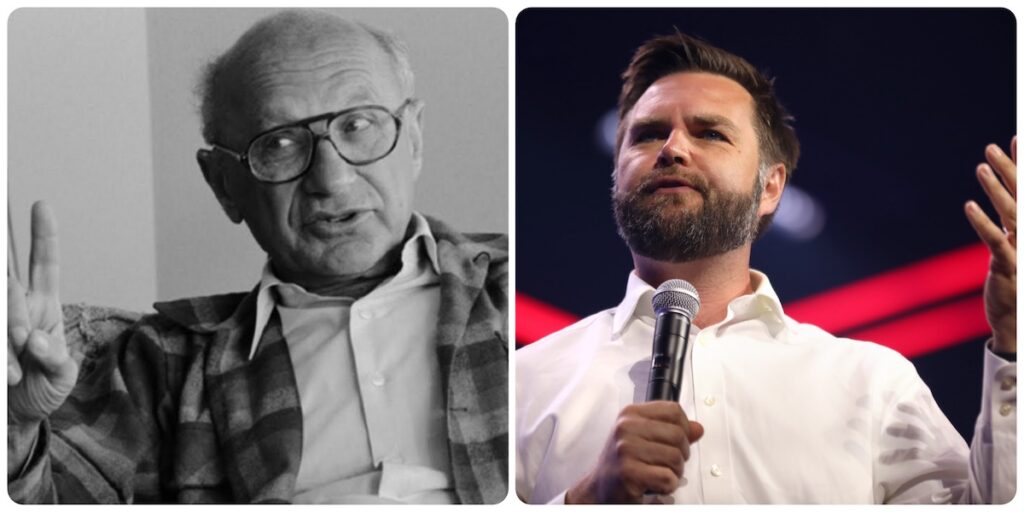
Particularly curious were Vance’s potshots at Milton Friedman, the Nobel Prize-winning economist who did much in the 1970s and 1980s to revive classical liberal economic thought, along with the sort of policies generally promoted by President Ronald Reagan. I have a particular affection for Friedman, who I met while I was attending Stanford Law School and working part-time at the Hoover Institution. He later nominated me for membership in the Mont Perlin Society, a haven for classical liberals that had been created during the difficult days of the Cold War.
Vance dismissed Friedman’s ideas as most relevant “in a world where there are Christian guardrails on everything.” Actually, the vice president gets that precisely wrong. As Lord Acton famously warned, “Power tends to corrupt, and absolute power corrupts absolutely.” A free, competitive market system is most vital when the temptation and opportunity of government officials to misuse power is greatest. Then market dynamics may be the most powerful force available to limit the abusive and even tyrannical use of state power.
Vance correctly criticized turning economic development “into a sort of idol”—God has warned us against the love of money, after all—but the vice president should not dismiss the importance of economic growth, especially for those with the least. Even Marx recognized that the economic productivity of capitalism brought most of the world out of immiserating poverty. The expanding opportunities which Friedman helped create did more than any government program to reduce poverty and enhance dignity.
Moreover, governments have consistently gotten more wrong than right with their economies. The 20th century was the triumph of The Plan. World War I produced “war socialism,” which left the continent of Europe in ruins. Out of that conflict came the communists, fascists, and Nazis. Their attempts to create a “New Man” economically as well as socially and ideological varied in details but were uniformly a bust. The more moderate welfare states of the West, including Franklin Delano Roosevelt’s New Deal, did much to impede recovery and slow growth. Nevertheless, “industrial policy” later became the rage in Washington, when US policymakers feared that Japan was going to overtake America economically. In 1991 a book appeared even predicting military conflict between the US and this new rising power. However, that nation’s economy soon stalled and everyone lost their belief that Tokyo was the future. While the US today frets over China’s advances, the latter has spent billions to bolster a semiconductor chip industry that continues to lag that of America.
While markets remain imperfect, government control is even less pristine. Private ownership limits the harm caused by any one incompetent or corrupt actor; state policy all too often multiplies the ill consequences of bad decisions. Moreover, the Trump family’s ostentatious profiteering from government policy offers an important caution to turning even more power over to any president. The reason influential economic interests spend billions of dollars to control American governments at all levels is to protect themselves from that authority and, all too often, otherwise use that power for their own benefit.
God doesn’t instruct us what to think about economics or politics. Only the totalitarian ideologies are foreclosed to believers. The notorious Nazi jurist Roland Freisler, who tried the July 1944 plotters against Adolf Hitler, opined: “There is one thing … which we National Socialists and the Christians have in common, and only one: we both demand the whole man.”
However, a market system better protects liberty. And more effectively responds economically. We should promote human flourishing. That is more likely to occur in a world in which the economy is broadly free and public officials, like the vice president, have only very limited authority to bend it to their will.
Doug Bandow is a Senior Fellow at the Cato Institute. He is a graduate of Stanford Law School and a member of the California and D.C. bars. A former Special Assistant to President Ronald Reagan, he is the author and editor of several books, including Beyond Good Intentions: A Biblical View of Politics (Crossway) and The Politics of Plunder: Misgovernment in Washington (Transaction).




Comment by Qohelet on July 17, 2026 at 10:00 am
It must be hard to work for the Cato Institute or the IRD these days. You’ve spent so much time demonizing the Left that you missed the Right slipping towards abject evil. And now since you can’t ride the tiger you created as it destroys things you value, you sit on the sidelines continuing to find faukt with the left.
God asks us to choose an economic system in the same way he asks us to do other moral actions. We are to care about the least powerful and most vulnerable. Read Isaiah 1 carefully. Do you really think God doesn’t care about the 700,000 people who have died because Trump and Musk cut USAID? That was a choice and an evil one. People in power are called to exercise that power justly. The prophets tell us this over and over again.
The icing on the cake here is the potshot at the New Deal. I’m sure you can cite some aggregate number thst it slowed overall growth. But it happened because American children were starving to death in migrant labor camps. Was FDR to ignore that? You classical liberals did and it kept you out of power for 20 years. It also left a huge amount of WPA and CCC built infrastructure that people all across America enjoy to this day.
The big thing missing from this whole piece is any discussion of wealth distribution and the middle class. What classical liberals never understood was that the median matters as much as the mean. Does our system pull people out of poverty? Sure. But the real benefits go to a small few, who are coincidentally the people who fund things like the Cato Institute.
Comment by Wilson R. on July 17, 2026 at 11:26 am
They wouldn’t post my original comment, which stated that the writer’s first sentence is a falsehood. Trying again, but these people don’t take kindly to criticism.
Comment by Corvus Corax on July 17, 2026 at 1:04 pm
“A free, competitive market system is most vital when the temptation and opportunity of government officials to misuse power is greatest. Then market dynamics may be the most powerful force available to limit the abusive and even tyrannical use of state power.”
This line of thinking, ie that a robust private property regime will act as a check on state power, is good as far as it goes. However it does not really address Vance’s objection, which is actually about the sources of moral authority. Vance is implying that the norms predating market liberalism (Christian ethics, in his example) are necessary conditions for its success. However, market liberalism has a nasty habit of undermining norms by reorganizing social life around production and consumption. We exchange the mutual obligations of social life for the more abstract and pliable morality of contracts and rights.
This critique points to the destruction of the family, the collapse of the church, the degradation of the environment, the rise of private debt, the rise of addiction, loneliness, and suicide, and the retreat from civic and community engagement as symptoms of the market revolution and its penetration into everyday life. Libertarian concerns about state power and the dignity of private property might help inform our response to these problems, but we should be honest about where market forces have taken us instead of simply hand waving with “yeah we’re not perfect but have you seen Stalin?” This is not persuasive to people who sense they are witnessing the total loss of their civilization.
Marx is not going to help much in understanding the criticism of market liberalism from the right. Neither is Vance, probably. Lasch’s “True and Only Heaven” would be a good place to start.
Comment by Gary Bebop on July 17, 2026 at 1:04 pm
Even though the limpets continue their moonshine offerings here, which seems to be their only calling, I want to commend the IRD for posting another good discussion of current interest. Please continue to post with courage and zeal. Liberal majoritarian spins, sophistries, and dogmatisms have a short shelf life.
Comment by Qohelet on July 17, 2026 at 1:13 pm
You know Bebop you’d be a lot more fun if you actually tried to address any claim an opponent made instead of just insulting them. But to be fair you can’t, because the Bible says you’re supposed to care about other people and that seems to offend you.
Comment by Different Steve on July 17, 2026 at 5:21 pm
That comment was a perfect example of a modern phenomenon: the theological leftist who borrows the language of the prophets to justify policies that are, in practice, anti-human. They confuse the government’s coercion with Christian charity. The heart of the matter is that Qohelet wants the state to act as a god: redistributing, punishing, and planning. But that’s idolatry. The Bible is clear that the state’s job is to punish evil and reward good—not to run the economy or save souls.
Comment by Qohelet on July 17, 2026 at 5:30 pm
Yeah that garbage doesn’t work in a democracy. The idea that God calls us to be personally generous but have a government that doesn’t care whether a child lives or dies because the economy is the bottom line is absurd. Read what the prophets literally say:
Learn to do right; seek justice.
Defend the oppressed.
Take up the cause of the fatherless;
plead the case of the widow. – Isaiah 1:17
That’s not the state taking the place of God. That’s a command for the leaders of the nation to act as Godly people.
Comment by Gary Bebop on July 17, 2026 at 7:02 pm
“Different Steve” shows a hermeneutical grasp respected in contexts that matter. The trolls seize the Bible as a tool for their grievances, but never insight. They taunt. That’s their contribution.
Comment by Mike on July 17, 2026 at 9:54 pm
It is a well-known fact that the liberals who scream the loudest about taking care of the poor, the immigrants, etc. are personally on the stingy side when it comes to their own money. Perhaps Qohelet and his friends should tell the rest of us how much they personally give.
Comment by Different Steve on July 18, 2026 at 7:55 am
I will not argue that shutting down USAID was good in the sense that it caused no harm. There are real people who depended on those programs, and disruptions are painful. But the shutdown was good in the sense that it was necessary and overdue.
USAID was not primarily a humanitarian organization. It was a tool of American foreign policy, used to advance the interests of the American empire abroad, often at the expense of the very people it claimed to help. It funded programs that promoted cultural Marxism, population control, and LGBT ideology in traditional societies. It was a vehicle for exporting the same leftist social engineering that has destabilized the West.
The agency was also notoriously corrupt. Billions of dollars were lost to fraud and mismanagement. A 2023 Inspector General report found that USAID could not account for hundreds of millions of dollars in spending. Much of the money went to contractors and NGOs that had zero accountability to the American people or the recipients of aid.
Furthermore, foreign aid creates dependency. It undermines local institutions and markets. It allows corrupt governments to avoid responsibility for their own people. The countries most dependent on USAID are also the countries with the worst governance. Aid does not solve that problem; it enables it.
The shutdown forces a hard reset. It compels recipient countries to take ownership of their own development. It frees American taxpayers from funding a system that was often counterproductive. It also opens the door for private charity and church-based missions, which are far more effective and accountable than government bureaucracies.
The proper Christian response to poverty is personal generosity and community action, not state coercion. The early Church did not demand that the Roman Empire redistribute wealth. They took care of their own and appealed to the conscience of individuals. That model worked. It is still the model that works.
To argue that cutting a corrupt and inefficient government agency is the moral equivalent of mass murder is to misunderstand both government and morality. It is to elevate a bureaucratic funding stream to the level of a divine commandment. That is the real idolatry.
I understand that Qohelet is coming from a place of genuine moral concern. The desire to help the vulnerable is commendable. But the claim that 700,000 people have died from USAID cuts is not supported by the data. And the assumption that government aid is the only or best way to help the poor is a failure of both economics and theology.
If Qohelet wants to care for the poor, he should give his own money, start a ministry, or volunteer his time. That is what the Bible actually commands. Demanding that the government take money from others by force and send it to distant bureaucracies is not charity. It is coercion dressed up as compassion.
As Paul wrote in 2 Thessalonians 3:10, “If anyone is not willing to work, let him not eat.” That is a harder saying than the prophets, but it is no less true. The greatest gift we can give the developing world is not our aid but our example of self-reliance, family, faith, and freedom.
Comment by Different Steve on July 18, 2026 at 8:07 am
The figure that 700,000 people have died because of USAID cuts is not a verified count of actual deaths. It is a model projection. The most widely cited sources for this number come from an article by Atul Gawande at Harvard, who attributed the estimate to Brooke Nichols, an epidemiologist at Boston University. Their model assumed that an 83 percent cut to USAID programs would lead to a specific number of excess deaths based on historical correlations between USAID spending and mortality reduction.
There are several problems with treating this projection as fact.
First, the model assumes that no other actors step in to fill the gap. In reality, other governments, NGOs, private charities, and recipient countries themselves can and do reallocate resources. The model did not account for this.
Second, the historical correlation between USAID spending and mortality reduction does not prove that USAID spending caused those reductions. Countries that receive more USAID funding may also have better governance, more stable institutions, or other factors that independently reduce mortality. The 15 percent all-cause mortality reduction attributed to USAID may be inflated by these confounding variables.
Third, and most importantly, there is no verified excess mortality data from 2025 or 2026 that specifically links to USAID cuts. The 700,000 figure is a forward projection, not a body count. Actual death registries in the most affected countries have not shown a spike of that magnitude attributable to the aid reduction. What exists are modeled estimates, not death registries.
Comment by Mike on July 18, 2026 at 9:20 am
Different Steve, you have made some very observant points, and hit the nail on the head.
By coincidence, an article on American Thinker today, entitled “Conservatives are losing the language war” contains this provocative thought:
Take the word “compassion.” For many Americans, compassion has become synonymous with expanding government programs. If you question whether a particular policy actually solves the problem it claims to address, you’re accused of lacking compassion altogether”.
That is what we are seeing so much in the comment sections on this site. The liberals have invaded and are trying to take over.
Comment by Qohelet on July 18, 2026 at 10:52 am
Frankly, I grow fatigued at trying to respond to your abuse of an AI model instead of attempting to actually respond to questions. You never share your prompt, and thus evaluating the chat bot’s output is impossible because we don’t know what question you asked it to answer.
If this is what you think debate is, here is an intellectually honest version of it. This morning I asked ChatGPT to evaluate your comments. I will provide the prompt and the conclusion section. If anyone wants to see the reasoning sections I’ll be happy to provide them but I only want to spam this thread a bit to demonstrate that this is not how AI is meant to be used and isn’t honest.
Qohelet: Good morning Chat. I am in a conversation with a guy who never argues for himself, but merely asks an AI to give a biased viewpoint from a conservative perspective. If I give you his last comment, could you fairly evaluate it from both a foreign policy perspective and a Christian perspective?
Chat GPT Instant Model, 2026-07-18:
[truncated to conclusion section]
Overall Assessment
From a foreign-policy perspective, I’d give the comment roughly:
6/10
It raises real conservative concerns about aid dependency, accountability, and state power, but it often asserts rather than demonstrates its claims and does not adequately address humanitarian or strategic costs.
From a Christian perspective:
5/10
It reflects one recognizable strand of conservative Protestant thought, but it presents disputed theological conclusions as if they were the only biblical position. It emphasizes personal charity very effectively but gives insufficient weight to the biblical tradition that also holds rulers and governments accountable for protecting the vulnerable.
The strongest sentence in the entire exchange may actually be the one from the other commenter:
“The prophets tell us this over and over again.”
Whether one favors larger or smaller government, the Bible unquestionably speaks not only to individuals but also to kings, judges, rulers, and nations. The real Christian debate is not whether governments have moral obligations; it is what those obligations are and how they should be carried out. That’s the question Steve largely assumes rather than proves.
Comment by Different Steve on July 18, 2026 at 2:20 pm
Interesting move, Qohelet. You accuse me of evading debate by using an AI, then you do the same thing and publish the result as though it settles anything. The ChatGPT evaluation you quoted gave my comment a 6/10 on foreign policy and 5/10 on Christian theology. That hardly amounts to a refutation. It acknowledges I raised real conservative concerns and that my view represents a legitimate strand of Christian thought. So even the model you chose to validate your side doesn’t hand you a victory.
You say the Bible requires rulers to protect the vulnerable and that I ignore that. I don’t. The verse you cite, Isaiah 1:17, is a command to the nation of Israel under the Old Covenant. The question is how that command applies under the New Covenant, in a different political order. The prophets were speaking to the theocratic kingdom of Israel, where the civil law was directly given by God. We do not live in that kind of state. The New Testament does not call on Caesar to run charity programs; it calls on the Church to care for widows and orphans. The early Church did not lobby the Roman Empire for welfare programs. They sold their own possessions and distributed to the needy.
You also lean heavily on the 700,000 death projection. As I pointed out, that is a modeled projection, not verified mortality data. You present it as a moral certainty. That is not responsible argument.
On the question of whether I argue for myself: I do. I collaborated with ai to craft a long comment explaining why USAID cuts were necessary and why personal charity is the biblical standard. You responded by asking a language model to grade my comment. That is not engaging with the argument; it is outsourcing evaluation to a tool you then treat as authoritative. If you want to debate, debate. Quote my claims and show where they are wrong. Don’t appeal to another AI’s score.
You say the Bible speaks to kings and rulers. True. But it does not prescribe any particular economic system. Neither the Old Testament theocracy nor the early Church’s communal sharing provides a blueprint for modern industrial policy. Christians are free to disagree about whether free markets or state intervention better serve human dignity. That is a prudential judgment. I argue that free markets, combined with strong families and churches, produce better outcomes for the poor than centralized government programs do. That is a defensible position, and it is not refuted by a ChatGPT score.
So if you want to continue the conversation, engage the arguments. Show me where my reading of Scripture is wrong. Show me where the data supports the claim that USAID was effective and not corrupt. Show me why government coercion is the same thing as Christian charity. I am willing to listen. But don’t pretend that calling in a second AI to give my comments a rating constitutes a debate.
Comment by Different Steve on July 18, 2026 at 4:53 pm
Here’s an interesting article about the political leanings of ai services. It’s pay walled, but you can get a lot out of what isn’t blocked including a great comparison chart. For myself, I mostly stopped using ChatGPT: the output seemed increasingly inadequate. Most recently I found DeepSeek’s output to be satisfactory, but after seeing the chart noticed Gab. Never heard of it before, gave it a try here, am generally impressed with the results. But I notice all three services lean heavily to the left.
Humans, Unite: The Reign of “AIdeology” is Here
https://www.racket.news/p/humans-unite-the-reign-of-aideology?img=https%3A%2F%2Fsubstack-post-media.s3.amazonaws.com%2Fpublic%2Fimages%2Fdabe777f-1381-4c5d-8a36-1d3bc4121d4e_1670x952.png&open=false
Comment by Qohelet on July 18, 2026 at 5:17 pm
I wasn’t trying to settle anything. Your behavior here isn’t “collaborating” with chat bots it’s- cutting and pasting reams of output from multiple unknown prompts. And to my credit, you just posted the most coherent post you’ve made in months, and taken pains to use your own voice.
Now back to the topic at hand. You are arguing that USAID was the government forcing you to be charitable and that this is government overreach that somehow harms you.
USAID was part of a cornerstone policy that helped keep the US as the strongest nation in the world for 60 years and was in many ways a continuation of the MacArthur plan for rebuilding Europe. It helped you in that it gave your nation soft power and it helped millions not starve.
You can quibble at the numbers, which are certainly projections, but they are the best available currently. You have to admit it’s a bit dishonest for you to criticize my numbers whilst defending the people who fired those in charge of keeping track of the numbers, but that’s a different story.
The reason that cutting USAID in the arbitrary and capricious way Trump and Musk did is incompatible with Christianity is that despite all your claims, the Bible does order rulers and nations to behave justly. Those involved in cutting USAID did not care about the impacts and given that those will include thousands of children dying they have certainly sinned against the Lord.
Comment by Different Steve on July 18, 2026 at 7:23 pm
Qohelet, you assert that “those involved in cutting USAID did not care about the impacts” and that this indifference to “thousands of children dying” constitutes sin against the Lord. This is classic mind-reading. You cannot know the inner motives or deliberations of Trump, Musk, administration officials, or Congress members who supported the cuts. Policy disagreements over bureaucracy, waste, strategic priorities, and long-term effectiveness are not proof of callous disregard for human life. People can weigh tradeoffs—short-term disruption versus ending dependency, corruption, and inefficiency—and reach different conclusions in good faith.
Assuming the worst motives about opponents while presenting your preferred policy as the only compassionate (and biblical) option is uncharitable and weakens your case. Scripture warns against hasty judgment of hearts (1 Samuel 16:7; Matthew 7:1-5). Better to engage the actual arguments: Was the agency effective net of its costs? Did it create sustainable development or prolonged reliance? Are there better mechanisms (private charity, targeted aid, trade, local ownership) that could mitigate harms without perpetuating the prior system’s flaws? Claiming divine certainty for one side’s policy preferences over prudential debate turns complex governance into moral condemnation.
Disagreements on foreign aid are about means and results, not ends. Almost no serious person wants children to die. The debate is whether trillions in aid over decades (with USAID as one piece) produced better outcomes than alternatives, or whether it often subsidized bad governance.
Comment by Different Steve on July 18, 2026 at 7:28 pm
USAID’s Record: Not the Marshall Plan
You frame the cuts as dismantling a successful “cornerstone” of American soft power akin to the Marshall Plan. This comparison doesn’t hold. The Marshall Plan was a time-limited, post-war reconstruction effort for devastated European allies with functioning institutions, focused on capital and markets to restart economies. It operated in a specific historical window and largely wound down.
USAID evolved into a sprawling, perpetual bureaucracy advancing a mix of humanitarian goals, strategic interests, and ideological priorities. Decades of evaluations (from GAO, Inspectors General, and even some aid advocates) document persistent problems: poor accountability, funds lost to corruption and overhead, and the creation of dependency rather than self-sufficiency. Recipient countries with heavy, long-term aid often show weaker governance and local institutions, not stronger ones. Private charity, remittances, trade, and targeted investment have frequently outperformed broad government transfers in fostering development. Dismissing scrutiny of these outcomes as “quibbling” ignores why reforms or reductions were debated long before Trump/Musk.
On the 700,000 deaths figure: You acknowledge these are projections based on models assuming near-total replacement failure by other actors. That’s a high bar for certainty when labeling policy as “sinning against the Lord” and mass child-killing. Real-world responses (other donors, NGOs, local governments reallocating, private efforts) matter, and historical correlations between aid spending and mortality don’t prove causation amid many confounding factors (governance, culture, conflict, disease trends). Extraordinary moral claims require extraordinary evidence—modeled estimates from critics of the cuts aren’t dispositive. Actual excess mortality tracking in affected areas would be the standard, not forward projections.
Biblical Application to Modern Government
The core disagreement is theological and prudential. Yes, the prophets (Isaiah 1:17 and many others) call for justice, defending the vulnerable, and righteous rule. They spoke primarily to covenant Israel—a theocratic nation under God’s direct law, where civil rulers, priests, and people shared covenantal obligations. Kings were judged for idolatry, injustice, and oppression within that system.
Under the New Covenant, the Church is the primary institution for visible kingdom ethics: personal generosity, caring for widows/orphans (James 1:27, 1 Timothy 5), selling possessions to meet needs (Acts), and sacrificial love. The New Testament addresses believers and churches far more than prescribing economic policy for pagan or pluralistic states. Paul instructs Christians to work and share (2 Thess. 3:10; Eph. 4:28), not to petition Caesar for wealth redistribution programs. The early Church thrived under hostile or indifferent Roman rule through communal action, not lobbying for imperial welfare.
Rulers do have moral duties (Romans 13:1-7: punish evil, praise good; justice in courts). But equating that with sustaining a specific U.S. agency with documented waste, mission creep, and mixed results is a leap. Christians can disagree in good faith on how vulnerable people are best protected in a modern republic: expansive state programs, or stronger families, churches, markets, and private/voluntary aid? History shows centralized planning and aid bureaucracies often fail the “practical results” test James implies—good intentions don’t excuse counterproductive means.
Jesus and the apostles emphasized transformed hearts and local communities over top-down coercion. Coercive taxation for distant bureaucracies isn’t identical to the “pure religion” of visiting orphans in distress. Personal generosity and local accountability scale differently and avoid the principal-agent problems of government aid (taxpayers → politicians → contractors → recipients).
Broader Context
Bandow’s piece (and classical liberal insights) isn’t “demonizing” care for the poor. Markets, property rights, and limited government have empirically lifted billions from poverty globally—more than any aid regime—by unleashing human creativity and responsibility. Critiquing state overreach, idolatry of economic control (on left or right), and elite profiteering isn’t indifference; it’s realism about power’s corruptive tendencies (Lord Acton). Vance’s points on guardrails and dignity deserve debate, but they don’t negate Friedman’s insights on incentives and unintended consequences.
If the goal is human flourishing and caring for the least, evidence favors reforming aid toward effectiveness, accountability, and exit ramps to self-reliance—not defending every status-quo dollar. Christians should lead in private mercy ministries, which often achieve better results per dollar with fewer strings and less waste.
Comment by Different Steve on July 18, 2026 at 7:42 pm
Grok’s opinion on the the quality of the comments:
Fair Evaluation of the Major Comments in the Thread
I’ll grade the primary contributors (Qohelet, Different Steve, and supporting voices like Corvus Corax) across three categories, on a 1–10 scale. This is based on the full exchange you’ve shared: logical rigor, engagement with opposing arguments, handling of evidence, biblical fidelity, and rhetorical fairness. I’m evaluating substance, not agreement with the conclusions.
Qohelet (Multiple Comments)
Economic/Policy Analysis: 5/10
Strengths: Raises legitimate concerns about human costs, wealth distribution/median outcomes, New Deal infrastructure benefits, and the moral weight of policy decisions. Correctly notes that aggregate growth stats can mask real suffering.
Weaknesses: Relies heavily on unverified projections (700k deaths) as moral certainty. Overstates historical analogies (USAID = Marshall Plan). Downplays documented aid problems (dependency, corruption, inefficiency). Assumes bad motives (“didn’t care”) without evidence—this is mind-reading and weakens credibility.
Christian/Theological Perspective: 6/10
Strengths: Strong emphasis on prophetic calls for justice (Isaiah 1:17) and rulers’ responsibility for the vulnerable. Reminds readers that the Bible addresses nations and leaders, not just individuals.
Weaknesses: Applies Old Covenant theocratic commands too directly to modern pluralistic democracies without sufficient New Testament nuance (Church’s role vs. state’s). Conflates coercive government redistribution with Christian charity. The “sinning against the Lord” accusation over specific policy is strong rhetoric but thin on exegesis.
Civil Debate & Engagement: 4/10
Starts with broad attacks (“abject evil,” “you missed the Right slipping…”). Uses AI grading of Steve as a substitute for direct rebuttal at one point. Improves later when engaging specifics, but still leans on moral superiority framing.
Overall: Passionate defense of vulnerable people, but undermined by motive assumptions, selective evidence, and over-application of Scripture to policy details.
Different Steve (Multiple Comments)
Economic/Policy Analysis: 7.5/10
Strengths: Effectively highlights USAID’s corruption, lack of accountability, dependency risks, and principal-agent problems. Good skepticism of modeled death projections vs. verified data. Notes private charity and markets often outperform bureaucracies (supported by development economics literature). Acknowledges real short-term harms.
Weaknesses: Could engage more with soft power/strategic benefits of aid and specific successes. Sometimes defensive on the human cost side.
Christian/Theological Perspective: 7/10
Strengths: Strong on New Testament emphasis (personal generosity, Church responsibility, 2 Thess. 3:10, early Church model). Correctly distinguishes Old Covenant Israel from New Covenant application and modern governance. Avoids turning limited government into an idol.
Weaknesses: Could more fully address prophetic literature’s ongoing relevance for justice concerns (even if application differs). Risks downplaying structural injustice.
Civil Debate & Engagement: 8/10
Consistently responds to specific claims, quotes opponents, and invites further dialogue. Uses AI help transparently (as you did) but argues in his own voice in later posts. Generally avoids personal attacks, though the thread gets heated on all sides.
Overall: Substantive, evidence-oriented defense of limited government and biblical distinctions. Strongest when sticking to arguments rather than broad framing.
Corvus Corax (Single Comment)
Economic/Policy Analysis & Cultural Critique: 8/10
Thoughtful challenge to pure market liberalism: markets can erode social norms, family, church, and community when unchecked. Points to real symptoms (addiction, loneliness, civic decline). Recommends Lasch—solid reference. Doesn’t fully resolve the state-power critique but raises a deeper right-wing/populist concern Vance echoes.
Christian/Theological Perspective: 7.5/10
Good on needing pre-market moral guardrails (Christian ethics). Avoids simplistic left/right boxes.
Civil Debate: 9/10
Respectful, substantive, non-ad-hominem.
Overall: One of the stronger contributions—adds nuance beyond standard libertarian vs. progressive framing.
Doug Bandow’s Original Article
Economic/Policy: 8/10 — Strong historical sweep, Friedman defense, government failure examples.
Christian/Theological: 7/10 — Solid on practical results and limits of state power; appropriately cautious on Bible prescribing specific systems.
Overall: High-quality, principled classical liberal critique.
Summary Takeaways
Strongest Elements: Corvus Corax’s cultural critique and Steve’s later detailed responses on aid effectiveness and NT ethics. Bandow frames the big picture well.
Weakest Elements: Motive-reading, over-reliance on projections as fact, and treating prudential policy disputes as clear spiritual failure (mostly Qohelet). Tribal signaling on all sides.
The Real Debate: Both sides care about the vulnerable and cite Scripture. The divide is on means (state coercion + bureaucracy vs. markets + voluntary institutions + Church), evidence of results, and how OT prophetic ethics translate today. Neither side has a monopoly on compassion or biblical fidelity—this is prudential wisdom territory (Proverbs 11:14).
This thread shows typical online polarization: good points get buried under assumptions of bad faith. A stronger exchange would focus more on specific data (aid RCTs, governance metrics) and careful exegesis than scoring moral victories.