A reformation continues to unfold in the Christian Reformed Church in North America (CRC). A denomination from the Dutch Reformed tradition with around 950 congregations and 180,000 members, the CRC went through a tumultuous struggle over marriage and sexuality.
A group called All One Body spent years advocating for the CRC to be fully LGBTQ-affirming. In 2021, Neland Avenue CRC in Grand Rapids, Michigan ordained a deacon in a same-sex marriage. A group of unrenowned pastors and lay leaders started the Abide Project with the goal to maintain biblical sexuality in the CRC.
The conflict came to a head in 2022 when the CRC’s annual synod adopted the Human Sexuality Report. This report stated that “adultery, premarital sex, extra-marital sex, polyamory, pornography and homosexual sex” all violate the Seventh Commandment. Moreover, this had “confessional status.” In other words, all ministers, elders and deacons would be expected to hold this position.
At Synod 2023, a flood of challenges to this decision were denied with a firm stand on “confessional status.” Meanwhile, more and more congregations were openly waving rainbow pride flags and stating publicly that they were fully affirming alternative sexual lifestyles. For a denomination with many family ties, discipline has often been avoided. Arguments were made that Church Order does not permit regional classes or the binational assembly of synod to conduct discipline.
Nevertheless, Synod 2024 imposed “limited suspension” on all officebearers who publicly contradicted synod decisions on sexuality, restricting them from being delegates to broader assemblies such as classis or synod and keeping them from serving on CRC agency boards.
After Synod 2024, the progressive wing began to depart the CRC. Dissenters have painted themselves either as martyrs or victims of political maneuvering or political partisanship.
Living Into the Biblical Stance on Sexuality
Most recently, Synod 2026 met from June 12-18 and its decisions reflect a denomination that is continuing its renewal. Delegates and discussions reflected a settled stance on marriage and sexuality. Debates centered around how to live into this stance.
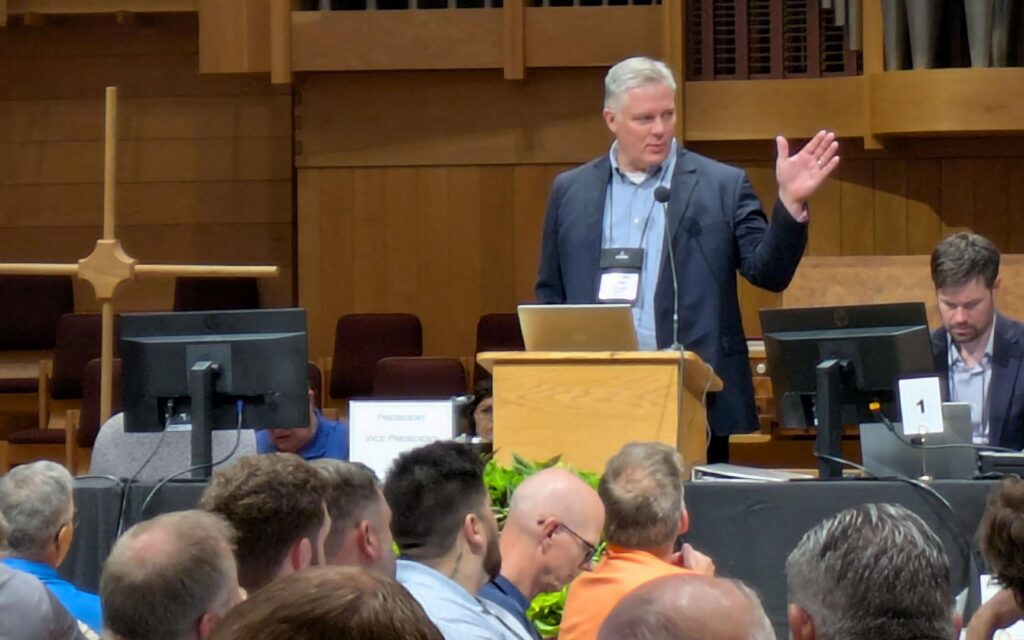
The Abide Project steering committee chair, Chad Steenwyk, was elected President of synod. A long-time Abide steering committee member, Lora Copley was approved to be editor-in-chief of The Banner, the CRC’s official magazine.
A ten-year plan to make disciples and plant churches was approved by a unanimous vote and celebrated with a standing ovation. The CRC is looking forward in the Great Commission.
The CRC has long been in communion with the Reformed Church in America (RCA), which has recently decided to be indifferent on LGBTQ matters. As a result, a mass exodus of those who hold the biblical position have departed the RCA. Many have organized into the Alliance of Reformed Churches with a clear intent to uphold a biblical view of marriage and sexuality. Synod decided to “gratefully receive” the positive response from the Alliance of Reformed Churches regarding the CRC’s invitation to be a “church in communion.”
A sister church in the Netherlands that recently merged with an LGBTQ-affirming denomination was demoted from a “church in communion” to a “church in cooperation.” Additionally, a statement was issued to “clearly inform” the new denomination “of the CRCNA’s position.”
World Communion of Reformed Churches
Most notably, Synod 2026 voted to leave the World Communion of Reformed Churches (WCRC). The WCRC is an international association of 230 churches that was organized in 2010 from a merger of the World Alliance of Reformed Churches and the Reformed Ecumenical Council. The CRC was a member of both associations and was instrumental in organizing the WCRC, even hosting the worship service celebrating the WCRC beginning at the CRC’s own Calvin College (now Calvin University).
The WCRC, however, includes the most liberal denominations in the world, among them the United Church of Christ (UCC) and the United Church of Canada who have open atheists among their ministers.
The WCRC general secretary Philip Vinod Peacock attended Synod 2026 to bring greetings and persuade the CRC to remain.
The CRC is an “important and valued member” of WCRC, he said.
Two proposals came to the synod floor. The majority report recommended leaving the WCRC. The minority report recommended remaining in the WCRC for the next three years while “evaluating our leavening influence.”
One concern raised was the WCRC Pro-Choice stance on abortion.
The WCRC 2025 Public Witness Report says, “Reproductive rights are an essential dimension of the integrity of human life. Within the broader framework of reproductive justice, these rights affirm the sacredness of bodily autonomy and the well-being of families and communities. Limited access to contraception, safe abortions, education, and accurate information, along with a lack of health resources and denial of care during pregnancies and postpartum, lead to preventable deaths. These factors reinforce systemic inequities in reproductive health.”
Peacock came to the microphone and attempted to defend the WCRC statement.
“The matter before the floor in this particular instance about the sacredness of choice is really about the sacredness of choice,” he said. “It is not sacralizing abortion. Rather I believe the position comes from trusting women to make the right choice and it’s really not about the sacralization of abortion.”
Peacock’s attempt to clarify the WCRC position on abortion served to demonstrate to the Pro-Life CRC how the WCRC is solidly Pro-Choice. Only the year prior, Synod 2025 unanimously voted to “deplore the legalization and practice of medically assisted suicide.”
CRC General Secretary Zach King weighed in on how the WCRC gives opportunity to connect with ecumenical partners.
Peacock had the last word, reading a prepared statement for a full ten minutes before delegates voted.
“I stand before you sad and in pain,” Peacock said, “partly because our union is breaking, but also partly because I have been grossly misrepresented, and words I did not say were put into my mouth.”
Against the headwinds of history and an in-person appeal from the WCRC head, synod voted to depart the WCRC.
A New Day in the CRC
The CRC has long been characterized by three emphases. One group focuses on right doctrine and confessional roots. A second group focuses on heartfelt piety and devotional habits. The third group focuses on transforming the world for Christ, often with a social justice lens.
Delegate Mark VerBruggen described the CRC denominational moment in this way: “The doctrinalists are in the driver’s seat, and the pietists are running shotgun, and the transformationalists like myself have been relegated to the backseat. That’s ok. But we’re all in the same car and we’re all going in the same direction.”
This writer will testify that Synod 2026 was the most cordial and peaceful synod I have ever attended. A few of the debates were passionate and personal, but opponents on the floor could be seen talking and laughing together afterwards.
Martin Spoelstra, minister delegate from Classis Quinte in Canada, expressed his appreciation for Synod 2026.
“What surprised me most about Synod was that the gathering was not characterized primarily by controversy,” he said. “It was characterized by hope.”
The Rev. Aaron Vriesman is pastor of North Blendon Christian Reformed Church in Hudsonville, Mich.
More from IRD:
Christian Reformed Church archived articles
As Dissenters Exit, Christian Reformed Church Resists Same-Sex Affirmation
Christian Reformed Church Stands Strong for Biblical Sexuality



Comment by Wilson R. on July 10, 2026 at 9:51 am
I wish these people who profess such devotion to the “biblical position” on sexual issues acted like they cared about the biblical position on what Jesus called “the weightier matters of the law.”
Comment by Angelo Latorre on July 10, 2026 at 3:57 pm
Sometimes denominations become more traditional. The American CRC is a beautiful example.
Comment by Cal on July 10, 2026 at 4:41 pm
I was in the CRC in the mid-90s when there was a big push for feminism, so I left for the PCA. Glad to see it is getting back to a more conservative reformed identity. Frankly, as more white liberals leave the scene, the church situation should get better, from the viewpoint of orthodox belief.
Comment by David on July 10, 2026 at 6:44 pm
I agree with the CRC synods on sexuality, but I disagree with the decision to pull out of the WCRC, of which the CRC is a founding member. Certainly there are problems with the WCRC and its stances on various political and social issues. The presence of the United Church of Canada and similar denominations does make the WCRC a mixed bag, so to speak. But it contains the CRC’s daughter and sister churches around the world. These are entirely orthodox in their confession of faith. The CRC shouldn’t be abandoning them to the liberal Protestants whose share of the organization is now increased. Reformation is one thing, but sectarianism is quite another.
Comment by Yours Truly on July 11, 2026 at 10:10 am
“I wish these people who profess such devotion to the “biblical position” on sexual issues acted like they cared about the biblical position on what Jesus called “the weightier matters of the law.”
Your wish is granted. And not only do they act like they care, they do care. Even better, they always have.
Now I suggest you go back and review the 9th commandment.
Comment by Wilson R. on July 13, 2026 at 11:25 am
Well, I guess that settles it. LOL.
Comment by Thomas on July 16, 2026 at 3:02 pm
Very good news from the CRCNA. I wish some sort of miracle could make the Reformed Church in America, which shares a similar origin, go back to the same stance on human sexuality.
Comment by Thomas on July 22, 2026 at 11:47 am
David, the solution for conservative Reformed denominations would be leaving the WCRC and create an alternative organization. It has been done, for example, in the Lutheran world.
Comment by Thomas on July 22, 2026 at 11:53 am
WCRC is apostate to the core. That is a political, not a religious statement. Where is the unborn human life value and sanctity, that Christianity always defended? Luther, Calvin and other 16th-century Protestant reformers would be horrified with the apostasy of WCRC. Good riddance.
Comment by Thomas on July 22, 2026 at 12:32 pm
CRC is now a member of the theologically conservative World Reformed Fellowship. They are in a much better organization.