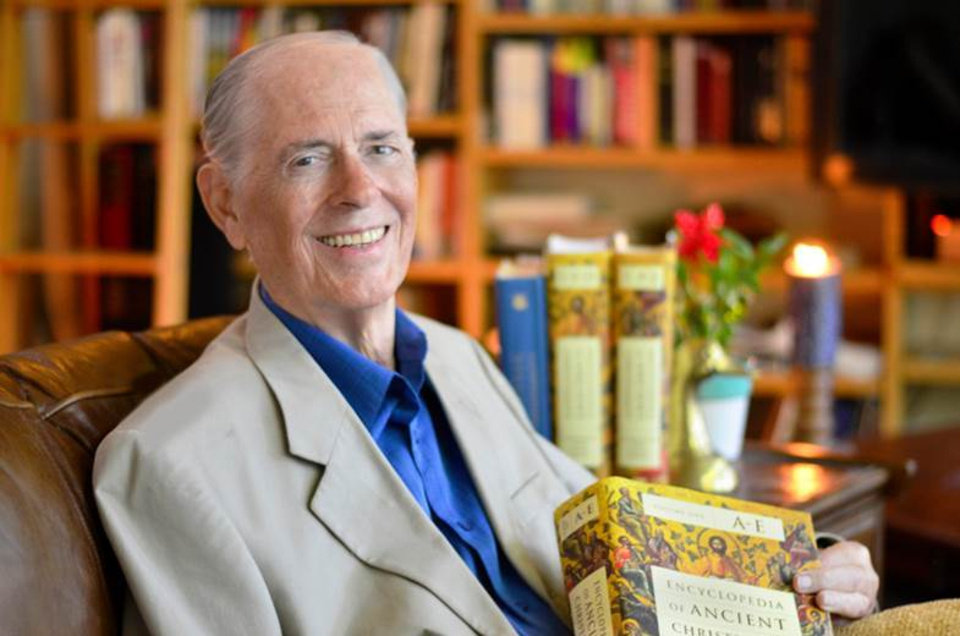
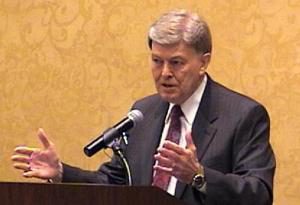
This December will mark a decade since Methodism’s loss of Tom Oden, a theologian and churchman who was a giant in the theological world. Tom was a colleague to many of us and a friend to the renewal and confessing movements within Methodism. In fact, he was a friend of Wesleyans around the world.
G. K. Chesterton spoke about the “democracy of the dead,” his famous words reminding us that the voices and wisdom of our ancestors should still hold value in whatever age. I smile at his caution about yielding power and influence to a “small and arrogant oligarchy of those who merely happen to be walking about.” How timely when we think of the monumental legacy of Thomas C. Oden.
I was reminded of this recently while leafing through his lesser-known work Turning Around the Mainline: How Renewal Movements are Changing the Church (Baker, 2006). I was struck again by the depth of the man’s historical wisdom and massive theological understanding.
His Turning Around the Mainline reminded me that Tom was indeed a friend to most all of the orthodox and evangelical renewal ministries in America’s mainline churches. In September of 2002, Tom invited a group of prominent theologians (18 attended) from most of the mainline Protestant denominations in America to meet for a theological consultation in Dallas, Texas. “This team represents what we think are the best qualified theologians at work in the mainline Protestant renewal movements,” Oden reported.
The gathering met under the auspices of the Association for Church Renewal, a fellowship of mainline renewal executives that had been meeting annually for more than 20 years. Since I chaired the Association, Tom graciously invited me to join the gathering. (As a pastor in denominational renewal, I confess I was out of my league with those career theologians, which included Diogenes Allen, William Abraham, Episcopal Bishop James Stanton, Philip Turner, R.R. Reno, to mention a few.)
The group developed a document “Be Steadfast: A Letter to Confessing Christians,” which was presented just a month later to the Confessing the Faith Conference, a national gathering of clergy and lay confessing Christians in North America that met in October, 2002, in Indianapolis, with some 600 in attendance. All the renewal executives respected and admired Oden.
Were I a seminary professor today, I would want Oden’s works to be mandatory reading. This would include not just his three-volume systematic theology Life in the Spirit, but other works that tell of his life-altering theological reversal, such as The Rebirth of Orthodoxy (Harper, 2003) and his autobiography A Change of Heart (InterVarsity Press, 2014). Of course, I would make sure they knew he was the general editor of the acclaimed Ancient Christian Commentary on Scripture series, the twenty-seven-volume work published by InterVarsity Press.
As I have read repeatedly about Tom’s theological reversal, my admiration and gratitude for him only grows. His reversal/conversion happened while he was a faculty member at Drew University. Though years have passed, we must not forget what had been consuming Tom’s attention back then. He described himself as a movement person. He confessed that he had adapted the Bible to his ideology, which was one of social and political change largely shaped by soft Marxist premises. This ideology led him into numerous trendy movements, such as the United World Federalists promoting world government, liberalized abortion, the demythologizing movement (on which he did his PhD dissertation), transactional analysis, parapsychology, biorhythm charts, tarot cards, and the list goes on. But thankfully this got set aside.
His entire theological and intellectual direction began taking Oden in a different direction from his activism—a change which would have found little agreement among his faculty colleagues. Many of those faculty must have wondered what had happened to this winsome, movement-oriented young professor, who they must have thought had gone off the rails professionally.
I love Tom’s account of the conversation that was pivotal to his change of direction. I hope it might become well-known to seminarians and theologians of this and future generations, perhaps in a way similar to Wesley’s account of his Aldersgate experience has become to many of us Wesleyans.
In The Rebirth of Orthodoxy, (Harper SanFrancisco, 2003), Oden gives this account of how it came about:
“The reversal occurred when Will Herberg, my irascible, endearing Jewish mentor and my elder colleague at Drew, held me accountable to my religious heritage. He told me straightforwardly that I would remain theologically uneducated until I had studied carefully Athanasius, Ambrose, Basil, and Cyril of Alexandria. In his usual gruff voice he said, ‘Tom, you have not yet met the great minds of your own tradition. Just as I, after my Communist days, found it decisive to read the Talmud and the Midrashim carefully to discover who I was as a Jew, you will have to sit at the feet of the ancient Christian writers to discover who you are as a possible person of faith. Without solid textual grounding, you will become lost in supposed relevance. If you are going to deepen to become a working theologian instead of a know-it-all contemporary pundit, you had best get at it—and until you do, you are not a theologian except in name, even if remunerated as one.’ I was stunned. He had nailed me,” Oden confessed. (p. 87)
What a moment that must have been! When thinking of consequential conversations, Oden’s exchanges with Herberg proved life-changing for him. It brings to my mind another life-changing conversation—the bold, forthright conversation John Wesley had before his Aldersgate experience when Moravian leader, August Gottlieb Spangenberg, pressed him with penetrating questions. When John affirmed Jesus was the Savior of the world, Spangenberg became more direct, asking “True, but do you know he has saved you?” When John responded lamely “I hope he has died to save me,” the Moravian pressed on, “Do you know yourself?” Wesley answered that he did. But later he admitted “I fear they were vain words.” (From The Message of the Wesleys, compiled and with an introduction by Philip S. Watson, New York: The MacMillan Company, 1964, p. 4.)
Consequential conversations, indeed! For Wesley, that was a significant part of his journey leading to his life-changing Aldersgate experience of May 24, 1738. Likewise, it was Oden’s conversation with his forthright Jewish colleague Will Herberg that challenged Oden to rethink and eventually change the entire theological direction of his life. We should pray for more such gracious directness like Spangenberg’s and Herberg’s among clergy colleagues and seminary faculty today.
Oden admits he heeded Will Herberg’s bold charge. “I reemerged out of the secularizing maze to once again delight in the holy mysteries of the faith and in the recurrent puzzles of human existence. Rather than interpreting the texts, I found the texts interpreting me.”
He continued, “I had earlier learned to understand my pastoral task as that of finding the best fad therapy or popular political strategy and baptizing it. Long after receiving my Ph.D in theology, after pretending for years to be a theologian, after publishing books on theology, and after teaching theology for years, something happened. What was it? A reversal, a conversion, a repentance? However it is named, that something occurred only incrementally, like a mustard seed growing.” And it happened without affirmations from his Protestant colleagues at Drew.
Oden’s change did occur incrementally. However, its powerful beginning was a bold, honest challenge from his Jewish academic colleague at Drew. (For the fuller account, see pp. 86 and following in Rebirth of Orthodoxy. See also his A Change of Heart: A Personal and Theological Memoir, InterVarsity Press, 2014, pp. 136ff).
What is the crisis facing the mainline churches in America? At the outset of Turning Around the Mainline, Oden states “Mainline churches stand today not merely in a crisis of numbers, but in a deeper crisis of faith. Though often portrayed as a crisis of politics or demographics or moral values or sexuality, it is more profoundly a crisis of biblical authority and theological integrity.” (p. 21)
He observes wisely that the challenges for the beleaguered and divided mainline churches in America “have to do with evasive or equivocal assertions about the very center of Christian teaching: Jesus Christ.” He notes that these are not minor or ancillary points. “Some reject his atoning work as unique Savior of the world and deny his resurrection and his teaching on the sanctity of marriage.” More specifically, he writes that “The mainline churches are now unready to confess with one voice the orthodox Christian faith in God the Father, God the Son, and God the Holy Spirit. To confess Jesus Christ as the only Son of God, Savior of the world constitutes a particular stumbling block.”
This bold assessment was not made carelessly by an inexperienced young pastor serving his first charge, but by a preeminent world-class theologian. The results, he adds, are that “worshippers have had to suffer through wild and idiosyncratic versions of the faith that they find nowhere in Scripture or classic Christian teaching.” (p. 22)
What about mainline seminaries? This, of course, was Oden’s career for a lifetime; it was the world he knew well. He writes that many theological seminaries “have been inundated for three decades with such far-ranging diversions as highly speculative Scripture studies, neopaganism, channeling, voodoo, sexual permissiveness, absolute moral relativism, and gay-lesbian-bisexual-transgender activism.”
Many may be astonished at such claims. But this was Oden’s world. He writes, “Once a seminary faculty has been filled with permanently tenured radicals, its members easily fall into the temptation of cloning themselves with look-alike future colleagues. The ensconced bureaucracies of hyper-tenured faculties have learned well the fine art of Xeroxing themselves politically, repeating ever anew their own ideological biases, making sure that no one gets tenure who will challenge the prevailing ideological tilt.” (p. 25)
He knew these were serious claims. He writes, “The description I am making may tempt some to think that I am exaggerating. I am reporting only what I have seen. I have been teaching and lecturing in mainline seminaries from 1959 to 2004. This is not hearsay, but eyewitness reporting from the line of fire.” (p. 25)
Faculty say they are liberated, Oden claimed. This was not a term applied to them by detractors, but a term they constantly insist on applying to themselves. He adds, “As a former full-time card-carrying liberator, I know from experience how mesmerizing this enchantment can be.” (p. 25)
He then concludes with this powerful critique:
“When the liberated have virtually no immune system against heresy, no defense whatever against perfidious teaching, and no criteria for testing the legitimacy of counterfeit theological currency, it is time for the worshiping community to act to guarantee faithful Christian teaching.” (emphasis Oden’s) (p. 26)
When it came to theological education, Oden was not optimistic. Reflecting on the future, he wrote: “But those of us who have spent a lifetime in Scripture-deprived theological education are those most wary of the stubborn fact that the present system, short of some mighty act of Providence, is highly resistant to reform, and indeed seems practically irreformable.” (p. 26)
Thomas C. Oden loved the denomination to which he had devoted his life teaching its seminarians. In this book about the mainline, published in 2006, he had a chapter “Discipline, Not Separation.” That was clearly his heart at the time he wrote it. But he had clearly lost patience with the teaching of the “liberated” professors at mainline seminaries, including those of his own denomination. He said if the liberated “have the freedom to teach apostasy, the believing church has the freedom to withhold its consent.” Moreover, the church “has no irreversible moral obligation to give them support or bless their follies.” (p. 26)
One wonders what Tom would say today, seeing two entire jurisdictions of United Methodism publicly defy the vote of their denomination’s 2019 General Conference—actions that eventually led to the disaffiliation of some twenty-six percent of the UMC’s congregations. My sense, and I don’t say this casually as Tom loved his struggling denomination, is that he would with deep sadness but firm conviction be on the side of those affirming the Great Tradition of the Christian Church.
My prayer is that the richness and timeliness of his writings, briefly sampled above, might lead those unfamiliar with his works to want to read, study, and bask in the wisdom of his writings.
Hebrews 11:4 says, “And by faith Abel still speaks, even though he is dead.” May that be so for Tom Oden to ours and coming generations. Thank you Lord, for this faithful servant.
James V. Heidinger II is President emeritus of Good News
More from IRD:
Methodist Theologian Thomas Oden 1931-2016, Champion of Christian Orthodoxy
Thomas Oden (1931–2016), Theologian and Friend
Thomas C. Oden archived articles


Comment by Tim Mc on August 18, 2026 at 3:36 pm
Quote: My prayer is that the richness and timeliness of his writings, briefly sampled above, might lead those unfamiliar with his works to want to read, study, and bask in the wisdom of his writings.
Just ordered, thank you for the write up.
Comment by David Gingrich on August 22, 2026 at 9:34 am
I have so much respect for Oden who, after years teaching “liberal” theology, found Truth.
I wish the author had quoted Oden’s theological maxim which Oden adopted after his turn to Truth: NO NEW THING. Amen.
Comment by Thomas on August 22, 2026 at 11:02 pm
Thomas Oden was a predecessor of the Global Methodist Church. He showed that the way is truly orthodoxy, not creating a new religion.
Comment by Thomas on August 28, 2026 at 9:25 am
“Few theologians of the past 100 years can claim to have had tea and cookies with Rudolf Bultmann, discussed theology with Karl Barth at his hospital bed in Basel, had lunch with Joseph Cardinal Ratzinger, had an audience with Pope John Paul II, driven through Galilee in a Fiat with Avery Dulles in the passenger seat, and conferred with Coptic and Pentecostal theologians in Africa. Oden did all of these and much more. Along the way, he was both scorned and lionized, and he bore scars from some of the scrapes he was in.” (Timothy George)