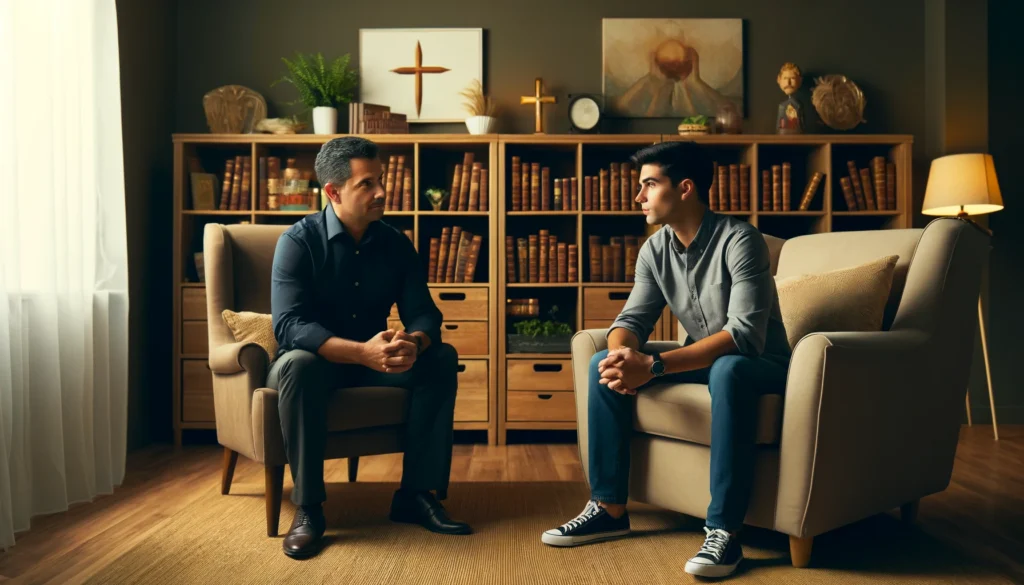
Earlier articles (here and here) reviewed the Chiles v. Salazar case, decided by the Supreme Court early in the spring. The court decided that Kaley Chiles, a Christian who is a Licensed Professional Counselor in Colorado cannot be prevented by Colorado’s Minor Conversion Therapy Law (MCTL) from expressing herself freely to clients who set attainment of opposite sex attraction or identification with their biological sex as goals. Briefs to the court supporting Colorado’s law and also supporting Kaley Chiles were reviewed; this article will review specifically briefs from religious organizations supporting Chiles and offer some concluding comments.
Counseling Bans and Catholic Teaching
The United States Conference of Catholic Bishops emphasized that “fundamental and enduring” issues of human life are at stake in the Chiles v. Salazar case. Specifically, “what is the right way to live, and how can individuals move toward that ideal?” People find that they must talk with someone, and they want and have always sought counseling and guidance from “from trusted sources.” In the Chiles case, the question was “whether, when individuals seek advice and counsel on these questions [homosexuality and gender identity], the First Amendment permits the state to regulate the viewpoints they may hear in response.”
Behind MCTL there is a threat to the “timeless” and “nearly universal human experience: seeking counsel from a trusted advisor to discern right from wrong in confusing or complex situations.” In many pressing personal situations, “what we should do is not necessarily the same as what we want to do. Right and wrong are not subjective preferences but fundamental aspects of reality and human nature. Christianity, and Catholicism in particular, has constantly affirmed this principle.” Christianity has always held that there is a natural order to things, including particularly the human world, which is part of this order “designed by its Creator and that this created order is good.” Thus, “human actions are morally right when they respect this natural order and morally wrong when they conflict with it.” Yet according MCTL, right and wrong are determined by a minor’s wishes and feelings, not by objective reality.
Particularly nettlesome is that a minor patient may wish to pursue change counseled by general Christian and Catholic faith on LGBT issues yet was forbidden to do so by MCTL. Thus, “Colorado is ordering Catholic clients and counselors that they may not—even when they want to—discuss the ideas that they believe in or take the approach that their Church has expressly recommended.”
These highly personal and religious conversations must be protected by the First Amendment, if any conversations are. Quoting the landmark West Virginia Board of Education v. Barnette (1943) decision, USCCB said that the most “fixed star in our constitutional constellation is that no official, high or petty, can prescribe what shall be orthodox in politics, nationalism, religion, or other matters of opinion.” This is the “bedrock principle underlying the First Amendment,” which “is at its strongest when the government finds speech ‘offensive or disagreeable,’ as Colorado plainly finds” the prospective speech of Kaley Chiles. USCCB also cited an American flag burning case, Texas v. Johnson (1989) in support of the Supreme Court’s jealous protection of offensive speech.
The bishops conceded that “licensed counseling is a heavily regulated profession, but it is also a profession that implicates profound and even religious questions, as here. Counseling would be impoverished without a sphere of protection for speech.” The NIFLA v. Becerra (2018) decision was cited to argue that the freedom of speech found to exist in medical practice “is at least equally true of counseling and psychotherapy: ‘[d]octors help patients make deeply personal decisions, and their candor is crucial;’ and so the freedom of speech is an essential bulwark to prevent government from ‘manipulat[ing] the content of doctor-patient discourse.’”
USCCB maintained that the Chiles case was easier to decide than the NIFLA decision, since in NIFLA non-speech professional conduct was involved, whereas in the Chiles case, it was pure speech. The case thus involved both suppression of speech based on content (forbidding counseling to encourage identification with one’s biological sex), and viewpoint discrimination (counseling to encourage identification with the opposite sex).
A brief from Catholic Licensed Counselors noted that “countries formerly in the forefront of treating minors suffering with gender confusion and gender dysphoria by surgical and pharmaceutical means have called a halt to those procedure[s], as longitudinal studies do not confirm their presumed benefits. The medical authorities in those countries are now encouraging talk therapy instead.” States which have laws like Colorado’s impose viewpoint discrimination on counselors, “enshrining a contested point of view into law.” Colorado attempted to say by statute what the “medical truth” is, and possibly its greatest effect was to chill “diverse, conscientious models of healing.” The law did not just violate the right of the therapist, “but a client’s right to hear and to choose a therapist whose worldview matches their own.”
CLC said that “there is generally minimal risk in engaging in a therapeutic process, as the main activity is conversation. The typical and most frequent risk is feeling emotionally uncomfortable, although that is typically just a function of facing the emotional difficulty the patient is already experiencing. For example, a patient that describes a marital conflict may feel a fair amount of discomfort (e.g., anxiety, anger, irritation, uncertainty) in the course of ordinary presentation and exploration of the conflict.”
CLC also pointed out that scientific progress in the twentieth century was exceptionally confirmatory of Catholic belief. The separate male and female sex chromosomes (XY and XX) were discovered in 1923, and the sex determining region of the Y chromosome, which triggers the development of a male individual was discovered in 1959. It was found as well that although the material of the human body is entirely changed with remarkable frequency (mostly different after no more than two years), yet obviously the identity of the body and person remains the same. In the Catholic perspective “the whole is always larger than the sum of its parts—the human body is more than the sum of its atoms and molecules … consistent with the Church’s Thomistic metaphysics.”
The male-female complementarity, rooted in the body-soul unity of human beings, is more than the sexual identity of the individual, and is oriented toward procreation. But the body/soul separation in the modern thought of recent centuries has permitted a conceptual separation of biological sex from one’s perception of sexual identity and sexual desire (i.e., “gender”). “Sexual existence and identity become based more upon one’s perception and/or desires than on given material reality.” Transgenderism has “mainstreamed” this belief. With homosexuality “the separation is not as pronounced because the sexual component is regarded as an intrinsic and especially intimate aspect of one’s identity as a human being.” However, sexual reality derives its meaning from the distinction of male and female, and this is rooted in the body and its reproductive function, rather than primarily from sexual gratification or feelings.
Catholic practitioners thus do not treat the human person – body, soul, and spirit – separately, but “as a fully integrated whole. The goal of therapy is helping the client harmonize these aspects into a healthy, functioning, well-integrated person.” Thus, “when a minor expresses distress over sexual orientation or gender identity, [Catholic] therapists explore underlying causes—e.g., trauma, unmet developmental needs—with consent.” Their understanding of harm “includes psychological and spiritual dimensions often ignored by other therapists,” but which align with the worldview of clients who accept Christian and particularly Catholic teaching. Living according to this teaching is for clients in Christian traditions “central to their well-being.” But explaining this worldview on LGBT issues to minor clients was illegal under Colorado’s law.
Importantly, the CLC brief pointed out that “therapists must have the freedom to decline to continue talk therapy if they sincerely believe the patient’s therapeutic goals are not healthful.” Care can be transferred to a therapist chosen by the patient. But counseling bans, because of their common viewpoint discrimination, would likely make such a course of action illegal. By denying counseling freedom, these bans turn therapy into “a prescription of rules that may not be much different than an AI-generated ‘dialogue’ between a person in the flesh (the patient) and the therapeutic lists provided by the non-human agent.” Laws like Colorado’s restrict “speech, imposes secular values, and harms clients and therapists by limiting autonomy and faith-based care.” They thus deny both freedom of religion and free speech, violating the First Amendment.
Evangelical and Reformed Perspectives
The Association of Certified Biblical Counselors pointed out what others highlighted, that lower courts upholding the MCTL improperly considered speech to be conduct. They thereby threatened the free speech of all licensed professionals. With speech held to be conduct, and judging the ideas communicated to be harmful, lower courts were able to hold that the forbidden speech was merely “incidental speech” to treatment.
But the communication of ideas is precisely what the First Amendment protects. Speech is the essence of therapeutic conversations about sexual behavior and identity. It is thus not “incidental” but speech essential to talk-based therapy. Further, there are a number of cases in which “courts have developed and clarified that minors are entitled to First Amendment protection for the information they receive. Those cases affirm that minors have robust First Amendment rights” (Brown v. Entertainment Merchants Association (2011) and Entertainment Software Association v. Blagojevich (2005)). Thus, ACBC noted in a second brief that its interest in the case was that it sought for itself “the right to speak its religious viewpoint. Both Amicus and Christian minors have a constitutional right to speech and belief.”
The American Association of Christian Counselors and others likewise argued that lower courts erred in considering pure speech therapy to be conduct. It also maintained that “hundreds of recent studies show that integrating discussions of religious beliefs and practices in mental health therapies leads to better outcomes. These studies have compelled the mental health professions to incorporate religious and spiritual concepts in their therapies. For instance, the World Psychiatry Association now urges the inclusion of spirituality and religion in psychiatric clinical practice.” Also, “scientific studies have consistently found religious practices and beliefs are associated with better mental health outcomes. For example, a 2012 review of 454 studies showed how religious and spiritual beliefs and practices helped people cope with a wide range of illnesses and stressful situations, including chronic pain, kidney disease, diabetes, pulmonary disease, cancer, blood disorders, cardiovascular diseases, neurological disorders, psychiatric illness, bereavement, and end-of-life issues.”
The Christian Medical and Dental Associations and the Alliance for Hippocratic Medicine offered a brief arguing that “gender transitioning” is harmful to future health and observes that therapists would be liable to prosecution for pointing this out. It observes the high desistance rate (commonly cited at 80%), which would indicate that many are being robbed of future fertility and sexual function by “gender transitioning,” which is difficult to fully reverse if begun, and impossible if one has undergone sexual anatomy altering surgery (really sexual mutilation). Referring to a Swedish study that this writer has referred to more than once, it was found that persons who had undergone complete “gender transitioning” (i.e., with sexual anatomy altering surgery) were nineteen times more likely to complete suicide than the general population, as well as having three times greater mortality and in-patient psychiatric care.
The Colson Center for Christian Worldview, the Family Policy Alliance, and Summit Ministries stressed that Colorado was attempting to enforce an orthodoxy about a controversial matter in religion and society. Once again, the landmark West Virginia State Board of Education v. Barnette (1943) case was cited, and its key wording that no government authority shall prescribe “what shall be orthodox in politics, nationalism, religion, or other matters of opinion.” These organizations observed that churches and religious organizations serve people whose minors want professional counseling concerning same-sex attraction and gender identity, and that Kaley Chiles reported that she “frequently receives patient referrals from churches.” The brief also denies the claim made by others, that Chiles had no standing because she did not profess an intention to break the law. “To the contrary, in its two major pre-enforcement standing cases, this Court twice found standing where the plaintiff specifically disclaimed an intent to break the law.”
The National Religious Broadcasters expressed concern about the Chiles case because “radio and television stations operate under licenses from the government. If licensing agencies may silence mental health professionals from expressing opinions contrary to official viewpoints, a dangerous precedent is set that could lead to the empowerment of regulators to silence unwelcome speech by broadcasters. Free speech must never be regulated under such principles.” NRB noted the “key holding “of the lower court that advice by licensed mental health professionals was “conduct” because it was “medical treatment.” There is no reason why censorship and viewpoint discrimination should be limited to LGBT issues. Once licenses become a basis for government censorship, why should censorship be limited to medicine? What is broadcast affects many people. This could easily become an argument for censorship of religious broadcasting, or other broadcasting.
Diverse Religious Perspectives
A brief submitted by the Anglican Church in North America, the Church of Jesus Christ of Latter-day Saints, the Coalition for Jewish Values, and the National Association of Evangelicals emphasizes that the term “conversion therapy” originally meant only physical treatments to eradicate homosexuality. But the American Psychological Association’s 2009 report represented a “sea change” in counseling people reporting their homosexuality or gender dysphoria. It made “sexual orientation change efforts” (SOCE) or “sexual orientation and gender identity/expression change efforts” (SOGIECE) cover any counseling that did not affirm reported same-sex attraction or gender identity, and condemned all such efforts as dangerous, even though some people reported being benefitted by SOCE.
The brief maintains that what it calls “exploratory therapy,” which these organizations say they practice, is neither “affirmative” (supportive of same-sex attraction or opposite sex identity) nor “conversion” or “reparative” therapy (which seeks reorientation to opposite sex attraction or identification with one’s biological sex). It simply seeks to provide clients with “a safe therapeutic space to discuss how their current values ha[ve] shaped and informed how they view their sexuality in ways not understood by many [n]onreligious clinicians.” But because it might involve moving away from homosexuality or transgenderism, it is not “affirmative” and thus was banned in Colorado. It would seem, however, that a committedly Christian counselor would have to decline further conversation if the client feels he or she should move toward some LGBT identity, which again would have been illegal under MCTL, because of its viewpoint discrimination.
The Manhattan Institute, the Islam and Religious Freedom Action Team, the Jewish Coalition for Religious Liberty, and Dr. Dovid Schwartz observed in their brief that proper identification of males and females is essential to the practice of Judaism. A Jew experiencing gender dysphoria must identify with his or her biological sex to participate in the life of the community, but licensed counseling to help with this for a Jewish minor was illegal under MCTL. This “is a serious burden on the exercise of Judaism.” There are many situations in Orthodox Jewish religious life where biological sex is important (a ritual haircut for boys on their third birthday, wearing the kippah (skullcap) and tzitzit (ritual fringes) for the first time, girls reciting a morning blessing thanking God that they are women, and “strictures that govern all areas of Jewish life, from marriage, sex, and privacy to prayer and even death and burial.” Laws that prohibit counseling to identify with one’s biological sex “inhibit the free exercise of Judaism by burdening Jewish patients, therapists, and communities.”
The impact on the practice of Islam is similarly grave. “Belief in the distinct biological sexes is not only rooted in sacred teachings but goes to the very core of religious exercise. Rules governing decency, modesty, and seclusion apply to all Muslims and require clear distinctions between men and women … Prohibiting therapy that would make patients more comfortable with their biological sex interferes with religious free exercise, which Muslim therapists would consider to include helping fellow Muslims fulfill Islam’s obligations. It also contradicts Muslim therapists’ religiously driven mission to alleviate pain and suffering. It imposes a set of values that are alien to Islam and violates the principles of proper care.” Although these claims were cast in terms of religious freedom, which the court did not consider, they easily translate into claims of free speech, and MCTL’s censorship and viewpoint discrimination. The brief further noted the separate seating areas for men and women in prayer, and the male-only obligation for Friday prayers. A minor child growing up in Islam will naturally want to participate in this and may want counseling illegal under MCTL.
An Islamic therapist associated with the Islam and Religious Freedom Action Team very persuasively said:
“In professional counseling, it is in our code of ethics to work with the values of our client. Denying clients this service is contradictory to our very mission to elevate [sic] [i.e., alleviate] human suffering and contradicts our code of ethics because we are saying they are not entitled to help, in essence imposing another set of values on them. A Muslim therapist who is not allowed to assist clients with issues related to gender and sexuality in congruence with their and the clients’ beliefs would actively be harming the client.”
Looking to the Future
Christian counseling must in fact be Christian, upholding the exclusive opposite sex marriage and morality taught in Scripture, and rejecting anything else. Colorado’s law required that any LGBT inclined persons be directed to LGBT identity and behavior. Christians and other adherents of Biblical and traditional sexual morality can be grateful for the Supreme Court’s 8-1 decision striking down the censorship and viewpoint discrimination in Colorado’s law. The law was an audacious act to prescribe a particular viewpoint of what can be said or must be said. Strictly speaking, the Chiles v. Salazar decision did not strike down “conversion therapy” bans in other states. And other states and jurisdictions have such laws. But for the foreseeable future, it is hard to see how similar censorship and viewpoint discrimination provisions in such laws can survive court challenges. This also means there will be reluctance in enforcement of these laws, and less reluctance by counselors, licensed and unlicensed, to provide the help they believe is needed to sex-confused clients.
But this is only because we have the First Amendment, and a Supreme Court willing to stand by the strong free speech jurisprudence of the recent past. It is not so in Europe, or Canada, or other countries affected by societal trends in the West. Canada recently removed the religious exemption from its “hate speech” law, making quotation from the Bible or other religious texts on LGBT issues liable to prosecution, while Great Britain’s Labour government is considering a “conversion therapy” ban of very broad scope, which would make most religious activity discouraging homosexuality or transgenderism illegal (counseling, prayer, exorcism, etc.).
While the Colorado law did not cover non-licensed religious counselors in the scope of the law (and really all non-licensed counselors), once a principle of what is “safe” and “unsafe” has been established in law for counselors whose credentials imply some degree of scientific competence (psychologists, psychiatrists, etc.), and that such restriction does not violate the First Amendment, it becomes easier to argue that the same advice given by anyone is unsafe. Current First Amendment jurisprudence allows disfavored speech on the street, but in the last analysis, the First Amendment is as secure as the majority protecting it on the Supreme Court. The current conservative majority has a strong incentive to maintain a strong free speech doctrine, since many institutions and many sections of the country are dominated by liberal/left ideas. But the political situation in the country, and the court majority could change in the future, and erode the First Amendment to the point that ideas deemed oppressive, such as the religious and traditional ideas about sex, are considered “unsafe.” Then the kind of restrictions on speech seen in Canada and Europe could appear in this country. Christians must be prepared to stand by and live by God’s revealed truth on sexuality, regardless of how the law or society changes.


Comment by Skipper on July 5, 2026 at 12:39 pm
It’s hard for me to believe that even Colorado would try to block free speech. I guess that’s the West Coast influence we have been hearing about.