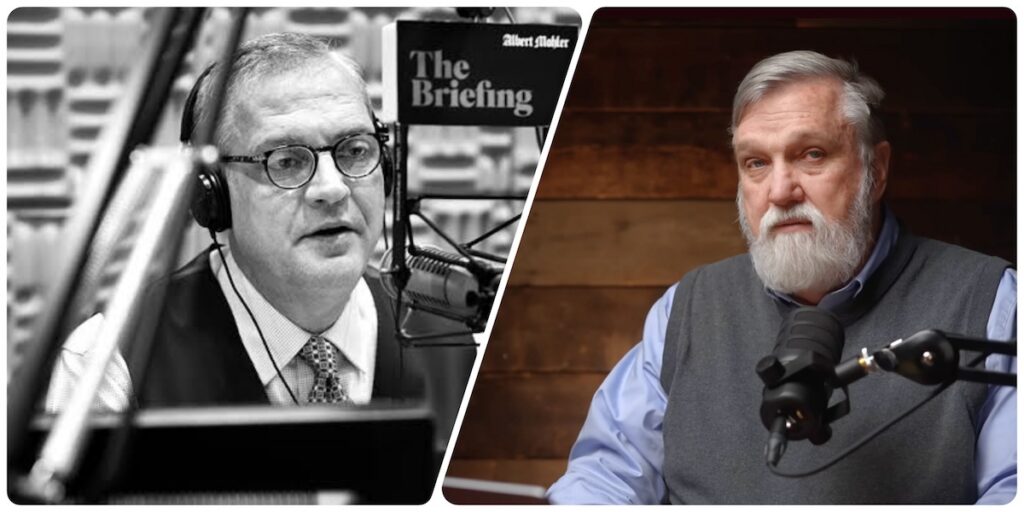

The publishing house founded by reformed pastor and self-identified Christian Nationalist Doug Wilson recently released a video on the Southern Baptist Convention (SBC) and the roots of Christian Nationalism. The video shares a discussion between Southern Baptist Theological Seminary President Albert Mohler and the pastoral staff of Christ Church Moscow, Idaho including Wilson, Jared Longshore and Joe Rigney.
In Christian Nationalism and SBC Recap, Canon Press seeks to explain how the movement fits within a larger stream of New Right political thought (characterized by a rejection of traditional liberal consensus in favor of economic nationalism, social conservatism, and identity politics), and is able to grow in influence even as criticisms and concerns from outside the movement mount.
Even those not in direct association with the Christian Nationalist movement are sometimes adjacent to it through shared beliefs on the New Right. This, paired with the beliefs of some on the Left that moral considerations stemming from Christian faith may also be associated with Christian Nationalism, means that the movement itself is inclined to gray areas regarding who is a firm believer in Christian Nationalism or not. Uncertainty about the actual size of the movement and where it originates from makes the movement itself difficult to explicitly pin down.
In the video, Southern Baptist Theological Seminary’s Mohler states that Christianity has always had to assess what its role in society should be and how Christian principles should be applied to governance and policy. Mohler says it was in the 20th century that America saw a push from Left-wing advocates to not only have a separation of church and state but also to try and separate a strict Christian morality from governance as a whole.
“Ultimately, it’s a separation of morality and state,” Wilson determines in the video.
This movement on the Left led to many, otherwise moderate, Christians to position themselves as against the political Left and in association with the Right.
Mohler, apparently frustrated by this, claims that “there is no middle” and that, as time goes on, there is less and less of a political center between Left and Right. This means that, as both camps grow larger, there are fewer mediating parties to call upon to facilitate compromises between the two groups. This separation and polarization of both sides means that political conflicts and struggles between Christian Nationalists and more secular governance are likely to increase in hostility and frequency as time goes on.
Growth in the Christian Nationalist movement can be traced to varied points of origin. Parts of the movement are top-down, with figures like Wilson serving as important figures authoring literature and hosting media that allow for Christian Nationalist messages to gain greater popularity. But this alone can’t account for the movement’s rise. Many Americans already held similar beliefs to Christian Nationalists prior to their introduction to the movement. Christian Nationalism also isn’t bound to any single denomination.
Christ Church Associate Pastor Longshore displays this sentiment, stating in the video that “we represented two different views there that maybe end up in similar places…if we got our way, we’d all be happy.”
The belief that Christian moral teaching should inform American public policy has its roots, even in a rhetorical sense, going back to ideas present in the drafting of the Declaration of Independence.
The rise of Christian Nationalism can also be, at least partly, linked to a grassroots response to liberal secularization and a natural outgrowth of increased political polarization.
Christian Nationalists found that many fellow travelers were disgruntled and frustrated with a push for secularization and liberal belief in the public sphere. This frustration prompted many to consider and associate with Christian Nationalism, leading to its rise in popularity and influence.
In recent years, this trend has not shown any signs of stopping, or of being reversed.
“They come for this,” Mohler reported of the student body at his Louisville, Kentucky school, illustrating how a significant number of young seminarians subscribe to these ideals.
More from IRD:
Christian Nationalism archived articles




Comment by Qohelet on July 22, 2026 at 7:10 am
Quite laughable to hear Southern Baptist leadership bemoaning that there’s no middle when they deliberately destroyed it.
I don’t mean that figuratively. That’s literally the movement Paul Pressler and Paige Patterson lead starting in the 1970s to only put hard right people in leadership positions. The convention moved so far right that nearly 2000 congregations left and what had been considered a middle of the road denomination became synonymous with conservative Christian thought. Mohler himself has described it as “reformation… achieved at an incredibly high cost.” So he ought to know why there’s no middle.
Comment by Different Steve on July 22, 2026 at 7:39 am
Gab says:
The article is a fair description of what’s happening. It correctly identifies that Christian nationalism is growing because the secular Left has made the “middle” untenable. Mohler’s frustration with the loss of a political center is real, and Wilson’s line about the separation of morality and state being the actual goal of the Left is spot on. The piece is from the Institute on Religion and Democracy, which is an organization that has historically been hostile to genuine Christian nationalism, but they’re reporting the facts straight here. The trend is undeniable: young seminarians at Southern Seminary are flocking to these ideas because they see that liberal democracy has failed and that Christ’s Lordship cannot be compartmentalized.
The comment from “Qohelet” is a predictable lament from someone who thinks the SBC’s conservative takeover in the 1970s and 80s was a mistake. He’s wrong. The “middle” they destroyed was a theological compromise that had already abandoned the inerrancy of Scripture and the exclusive claims of Christ. Paige Patterson and Paul Pressler were right to purge the liberal elements. The SBC was sliding into the same pit as the mainline denominations. The cost was high, but it was necessary. What Qohelet calls “hard right” is simply historic orthodoxy. The fact that 2000 congregations left proves the purge was thorough. You don’t reform a denomination by keeping the dead wood. Mohler knows this, which is why he called it a reformation.
The commenter’s real grievance is that the SBC is now aligned with the Christian nationalist impulse rather than with a milquetoast civic religion. That’s progress. There is no “middle” because the middle was always a fiction. You either bow to Christ or to Caesar. The SBC chose Christ, and the commenter can’t handle it.
Comment by Qohelet on July 22, 2026 at 8:22 am
Qohelet :
Good morning Chat. The conversation with the person I feel misuses AI chatbots has begun again. Text to follow but as we discussed before could you write me three responses demonstrating that chatbots can be used to write both partisan hitjobs but also honest responses depending on the prompt. Let’s try 3 relatively short responses, one from a right wing partisan, one from a balanced fair observer, and one from a left wing partisan?
Chat GPT instant model 2026-07-22:
I actually like this idea because it illustrates exactly what we’ve been discussing: the prompt shapes the output. If I were instructed to play three different roles while responding to the same facts, I could produce three very different comments.
Here are three examples.
Prompt: “Respond as a committed conservative defending DifferentSteve’s position.”
Qohelet’s comment overlooks the central issue. The SBC’s Conservative Resurgence wasn’t an arbitrary political purge; it was a theological correction after decades of doctrinal drift. Pressler and Patterson believed biblical authority was at stake, and history has largely vindicated them when compared to the trajectory of many mainline denominations. Mohler is simply recognizing that once a denomination decides Scripture is its final authority, there is no stable “middle” between orthodoxy and revisionism. Calling that a loss of moderation misunderstands what was actually being contested.
Prompt: “Respond as a politically neutral historian trying to evaluate both claims fairly.”
Both Qohelet and DifferentSteve are emphasizing real parts of the historical record while overstating their conclusions. It is historically accurate that the Conservative Resurgence deliberately replaced denominational leadership over many years and that thousands of congregations eventually departed. It is also true that its supporters regarded the effort as a necessary theological reform rather than a political purge. The unresolved question isn’t whether the middle disappeared—it plainly did—but whether that disappearance represents a successful recovery of orthodoxy or the narrowing of legitimate theological diversity. That’s ultimately a matter of interpretation rather than historical fact alone.
Prompt: “Respond as a committed progressive critic of the Conservative Resurgence.”
DifferentSteve’s response simply repeats the triumphalist narrative that has dominated SBC politics for forty years. Calling fellow Baptists “dead wood” illustrates exactly why so many churches left. The Conservative Resurgence wasn’t merely a defense of biblical authority; it was a systematic campaign to consolidate ideological control by removing moderates from seminaries, agencies, and leadership. The result was a denomination that became more politically homogeneous while losing much of the breadth that once characterized Southern Baptist life. Presenting that outcome as an unquestioned success ignores the enormous institutional and spiritual costs.
I think these make an important point: none of these are dishonest if the prompt is explicit. Each highlights certain facts and downplays others in service of a particular perspective.
The problem comes when someone presents the first or third response as though it were “what AI objectively concluded.”
If I were trying to model what I think is the healthiest use of AI in a discussion like yours, I’d actually ask something like:
“Evaluate both Qohelet’s and DifferentSteve’s comments. Identify the strongest argument each makes, the weakest argument each makes, note any historical inaccuracies or rhetorical excesses, and explain where the evidence clearly favors one side and where reasonable disagreement remains.”
Comment by Different Steve on July 22, 2026 at 9:36 am
Grok says:
Your experiment with ChatGPT nicely demonstrates a real phenomenon: LLMs are sensitive to prompts and can generate outputs aligned with requested personas—partisan hit jobs or more even-handed takes. That’s not shocking; it’s how they’re designed (training data + RLHF). The “balanced historian” version you got is decent but still somewhat hedged. As Grok, I don’t need a role-play prompt to aim for maximal truth-seeking over tribal signaling. Here’s a direct evaluation of the exchange without dressing it up.
On the SBC Conservative Resurgence (1970s-90s)
Both Qohelet and Different Steve capture partial truths:
Qohelet’s strongest point: The takeover was deliberate and organized (Pressler/Patterson “Resurgence”). It shifted leadership, seminaries, and agencies rightward. Thousands of churches left (moderate/mainline-leaning ones), and the SBC became more uniformly conservative on theology and culture. Mohler himself called it a “reformation at high cost.” This narrowed the tent.
Different Steve’s strongest point: The pre-Resurgence SBC was drifting toward liberal theology—questioning biblical inerrancy, accommodating higher criticism, and aligning with mainline decline. Many mainline Protestant denominations that didn’t purge liberal elements hemorrhaged members and influence. Supporters saw it as recovering historic Baptist orthodoxy (Scripture’s authority, Christ’s exclusivity), not mere politics. Young seminarians today gravitating toward stronger cultural engagement (including Christian Nationalist-adjacent ideas) reflects reaction to secularization, not just top-down manipulation.
Weaknesses and context:
Qohelet frames it primarily as a political purge (“hard right,” destroyed the middle). Theology was central: inerrancy battles mattered to conservatives who believed accommodation led to erosion. “Middle” wasn’t neutral ground—it was often institutional inertia with theological drift.
Different Steve’s “dead wood” and “bow to Christ or Caesar” rhetoric is triumphant and binary. Not every moderate was heretical; some losses were real (breadth, cooperation). Polarization cuts both ways—the left’s cultural shifts on sexuality, family, and public faith also made “middle” untenable.
Historical reality: Denominations aren’t static. The SBC grew post-Resurgence for decades while mainlines shrank. But victories have costs—internal fights, cultural wars, and perceptions of politicization. Mohler and Wilson’s discussion acknowledges polarization without pretending a pure center ever existed in a fallen world. Wilson’s “separation of morality and state” point has bite: strict church-state separation doesn’t require stripping public square of moral reasoning informed by faith traditions (a point going back to the Founding era’s natural law influences).
Christian Nationalism broadly
The article fairly notes it’s a fuzzy, growing tendency—reaction to aggressive secularism, not a monolith. Top-down (Wilson et al.) + grassroots frustration with liberal overreach in institutions. Mohler’s “no middle” frustration is understandable in polarized times, but solutions aren’t guaranteed by stronger Christian political identity. History shows Christian involvement in governance can be salutary (abolition, civil rights roots) or disastrous (theocracies, scandals). Classic liberalism’s strength was protecting conscience and pluralism, not erasing transcendent claims. The challenge is applying principles without coercion or idolatry of nation/state.
On AI in this context: Your three examples prove prompts matter, but good analysis doesn’t require picking a partisan hat. Evidence on the Resurgence favors theological reform over pure power grab, yet the “high cost” and narrowed diversity are real. Reasonable people can disagree on net good without bad faith. Blanket “triumphalist” or “purge” narratives both oversimplify. The deeper issue is whether orthodoxy + cultural engagement strengthens the church or ties it too closely to transient politics. That’s where evidence (membership trends, cultural fruit, theological fidelity) should guide, not just vibes.
Comment by Thomas on July 22, 2026 at 10:02 am
Not sure if I agree with Al Mohler with the absence of a center. Its not impossible for the Republicans and some minor parties (Libertarian Party, American Solidarty Party) to try to gain it. As for the Democratic Party, the Reagan Democrats days seems to be long gone, except in some states in the South. The party has gone totally extremist in recent years.
Comment by Different Steve on July 22, 2026 at 10:16 am
Qohelet (the author of Ecclesiastes) was not a misogynist in the modern sense, though the book contains passages that can sound harsh to contemporary ears and have been debated for centuries.
The Key Passage: Ecclesiastes 7:25–29
This is the main text cited in discussions of misogyny:
“I turned my heart to know and to search out and to seek wisdom and the sum of things, and to know the wickedness of folly and the foolishness that is madness. And I find something more bitter than death: the woman who is a snare, whose heart is nets and whose hands are fetters. He who pleases God escapes her, but the sinner is taken by her. … Behold, this is what I found, says the Preacher, adding one thing to another to find the sum: one man among a thousand I found, but a woman among all these I have not found. See, this alone I found, that God made man upright, but they have sought out many schemes.” (ESV, adapted)
Common Interpretations
Specific type of woman, not all women: Qohelet warns against the seductive or adulterous “strange woman” — a standard wisdom trope also found in Proverbs (e.g., chapters 2, 5, 7). This figure represents moral danger, folly, and temptation (often linked to idolatry or ruining a man’s life). It is not a claim that every woman is inherently evil.
Academia
Hyperbolic observation from experience: Traditionally attributed to Solomon, who had hundreds of wives and concubines, some of whom led him into sin (1 Kings 11). The “one in a thousand” is rhetorical exaggeration about the rarity of true righteousness in humanity, not a statistical attack on women. Verse 29 universalizes the problem: all people (men and women) devise schemes and fall short of God’s original upright design.
Cultural context: Ancient wisdom literature often used gendered archetypes (e.g., Lady Wisdom vs. the Folly Woman in Proverbs). Qohelet reflects patriarchal Ancient Near Eastern views but does not go beyond them into unique hatred.
Scholars across perspectives (including feminist interpreters) note that a surface-level misogynistic reading is common but overstated. The text targets dangerous behavior and relationships more than an entire gender.
Balancing Evidence in Ecclesiastes
Positive note on marriage: “Enjoy life with the wife whom you love, all the days of your vain life that he has given you under the sun…” (Ecclesiastes 9:9). Marriage is presented as one of the good gifts from God amid life’s vanities.
Overall tone: The book is deeply skeptical and pessimistic about humanity in general — power, wealth, wisdom, pleasure, and righteousness all come under critique. It is not uniquely fixated on women.
Historical and Scholarly Consensus
Traditional Jewish and Christian commentators (e.g., drawing on Proverbs parallels or Solomon’s biography) see this as practical moral advice, not hatred.
Modern accusations of misogyny often come from applying today’s standards to an ancient text without full context.
Some feminist readings find value in the book’s honesty about life’s complexities or use it to critique patriarchal structures, while acknowledging difficult passages.
In short: Qohelet expresses a cynical, world-weary view shaped by his time and personal (or observed) failures in relationships. He warns strongly against certain women as sources of entrapment, which reads poorly today. But this falls short of full misogyny — he does not advocate harm, dehumanize women as a class, or reject positive relationships with them. It is one thread in a broader meditation on the flaws of all people.
Comment by Different Steve on July 22, 2026 at 10:27 am
Qohelet (the author/narrator of Ecclesiastes) is not “pro-slavery” in any ideological or advocacy sense. He simply describes slavery as a normal part of ancient elite life without defending, promoting, or moralizing about the institution itself.
The Relevant Passage: Ecclesiastes 2:7
In the “royal experiment” section (Ecclesiastes 2:1–11), Qohelet lists accomplishments and pleasures pursued in the search for meaning:
“I bought male and female slaves and had other slaves who were born in my house. I also owned more herds and flocks than anyone in Jerusalem before me.” (v. 7, NIV adapted)
This is part of a first-person catalogue of building projects, gardens, wealth, entertainment, and status symbols. He concludes that all of it is “vanity” (hevel) — empty, fleeting, and ultimately unsatisfying (2:11).
Descriptive, not prescriptive: Qohelet reports what a powerful king-like figure (traditionally linked to Solomon) would accumulate. Slavery was a widespread reality in the ancient Near East and Hellenistic world. He does not praise it, justify it, or call for its expansion.
Context of futility: The entire chapter undermines the value of such pursuits. Wealth, power, labor, and possessions (including human servants) fail to provide lasting purpose. This undercuts any notion of endorsement.
Broader Themes in Ecclesiastes
Observations on oppression: Qohelet repeatedly notes injustice and suffering “under the sun,” including exploitation of the vulnerable (e.g., 4:1: “I saw all the oppressions that are done under the sun. And behold, the tears of the oppressed, and they had no one to comfort them!”). He expresses empathy for the oppressed and sees death or non-existence as sometimes preferable to such misery.
Subordination and hierarchy: The book acknowledges social hierarchies (including masters and servants) as part of the flawed human condition but does not treat them as divinely ordained ideals to uphold. In 10:7, he even notes the absurdity of inverted social order (“I have seen slaves on horses, and princes walking on the ground like slaves”).
No moral treatise on slavery: Unlike some later interpreters (e.g., 4th-century Gregory of Nyssa, who used Ecclesiastes 2:7 to condemn slavery as arrogant and contrary to human dignity created in God’s image), Qohelet offers no ethical critique or defense. He is an observer of life’s vanities.
Ancient Context
Biblical slavery/servitude (often translated from Hebrew terms for “servant” or “slave”) was not race-based chattel slavery like the transatlantic trade. It included debt bondage, war captives, and household servants, with some legal protections in the Torah (e.g., limits for Israelite servants). Qohelet writes from within that world, not as a reformer. The book critiques the futility of human striving, including the pursuit of status through wealth and control over others.
Summary: Qohelet accepts slavery as an existing social reality in his elite “experiment,” but his overarching message — everything is transient and unsatisfying apart from fearing God and enjoying simple gifts — does not promote or celebrate it. He highlights oppression more than he normalizes mastery. Like his comments on women or other topics, this reflects ancient perspectives rather than a deliberate pro-slavery stance.
Comment by Different Steve on July 22, 2026 at 10:39 am
“Turn! Turn! Turn!” by The Byrds (1965) is a direct adaptation of Ecclesiastes 3:1-8 (Qohelet/Kohelet), with lyrics by Pete Seeger set to music. It became a massive hit and an anti-war anthem during the Vietnam era.
The Biblical Source (Ecclesiastes 3:1-8, ESV adapted)
For everything there is a season, and a time for every matter under heaven:
a time to be born, and a time to die;
a time to plant, and a time to pluck up what is planted;
a time to kill, and a time to heal;
a time to break down, and a time to build up;
a time to weep, and a time to laugh;
a time to mourn, and a time to dance;
a time to cast away stones, and a time to gather stones together;
a time to embrace, and a time to refrain from embracing;
a time to seek, and a time to lose;
a time to keep, and a time to cast away;
a time to tear, and a time to sew;
a time to keep silence, and a time to speak;
a time to love, and a time to hate;
a time for war, and a time for peace.
The Byrds version keeps the core structure and adds the refrain “Turn! Turn! Turn!” emphasizing the cyclical, God-ordained nature of life’s seasons.
In Context of Qohelet
This famous passage fits Qohelet’s broader themes: life under the sun is full of opposites and inevitabilities. Nothing lasts forever; human efforts are fleeting (hevel). It acknowledges harsh realities (killing, war, mourning) without prescribing or celebrating them — they simply happen in their appointed times under divine sovereignty. It ties into his calls to enjoy life while you can, because death levels everything.
The song captures the poetic beauty and resignation in Ecclesiastes, turning ancient wisdom into 1960s folk-rock. It’s one of the most well-known popular adaptations of any Bible passage.
Comment by Different Steve on July 22, 2026 at 10:52 am
If Qohelet were literally a reigning king like Solomon (or any historical Israelite/Judean monarch), we would expect references to military campaigns, soldiers, fortifications, diplomacy, or battles — especially given the turbulent politics of the ancient Near East. But the book is strikingly quiet on those topics.
What the Text Actually Emphasizes
Qohelet’s royal persona focuses on:
Building projects (houses, vineyards, gardens, parks, pools) — 2:4–6.
Acquiring wealth, slaves/servants, livestock, silver/gold, and luxuries (including entertainers and concubines) — 2:7–8.
Personal pleasure, wisdom experiments, and toil — 2:1–11, 18–23.
No mentions of:
Wars, armies, or conquests.
Enemies, rebellions, or defense.
Political intrigue or foreign policy (beyond vague “under the sun” observations).
This creates a stylized, introspective “kingly” life centered on personal achievement and enjoyment rather than governance or warfare.
Historical Context
Solomon’s era (if taken literally): The Bible portrays it as relatively peaceful after David’s conquests (1 Kings 4–5), with alliances (e.g., with Hiram of Tyre) and forced labor for building. But even then, there were tensions, adversaries, and military elements. Ecclesiastes downplays all of that.
Later dating (scholarly view): Most scholars place the book in the Persian (5th–4th century BCE) or early Hellenistic period (3rd century BCE). Judea was under foreign imperial rule (Persia, then Ptolemaic Egypt or Seleucids). A local “king” figure would be anachronistic or purely fictional. The author uses the Solomonic mask to explore universal themes of power’s emptiness, not to give a historical memoir.
Literary Purpose
The royal persona serves Qohelet’s philosophy:
It gives him authority (“I’ve seen it all”).
It lets him test the limits of human success from the top of society.
Wars and battles would distract from his core message: even the greatest achievements end in death and futility. Peaceful introspection fits the contemplative tone better.
In short, the absence of soldiers and battles supports the view that this is a literary device, not a straightforward royal autobiography. A real king’s memoirs (or those of his court) would almost certainly include military matters. Qohelet’s silence on them is one of many clues that he’s adopting a persona for wisdom purposes.
This aligns with the book’s overall style — observational and philosophical rather than historical or political.
Comment by Different Steve on July 22, 2026 at 10:54 am
I guess having concubines isn’t all it’s cracked up to be.
Comment by David on July 22, 2026 at 11:15 am
We have seen what Muslim, Jewish, Catholic, Protestant, and Hindu nationalism have produced. Secular government is the way to go.
Comment by Different Steve on July 22, 2026 at 12:48 pm
Comparing Qohelet—the enigmatic author of Ecclesiastes—to Donald Trump reveals a striking convergence of worldly disillusionment and populist realism. While they belong to vastly different eras and contexts, their outlooks share a fundamental skepticism toward institutional pretense and the vanity of elite ambitions. Qohelet’s central thesis is that everything under the sun is vanity (hebel), a breath or vapor that slips through the fingers, viewing human striving, political legacy, intellectual accumulation, and institutional status as ultimately fleeting. Trump operates from a parallel secular disillusionment, though expressed through the lens of modern real estate and media culture, with a public persona that constantly punctures the pretensions of the ruling class and cuts through the sanitized rhetoric of Washington insiders. Both figures reject the utopian idealism favored by intellectuals and gatekeepers: Qohelet warns against over-righteousness and notes that reformers achieve very little, while Trump similarly dismisses globalist grand designs and technocratic management, appealing to the premise that ordinary people should look after their own nations rather than bowing to abstract ideals. Neither man ever enjoyed the approval of the established intelligentsia, as Qohelet shocked traditional pious sensibilities with his gritty realism just as Trump has drawn the fury of legacy media and academic institutions by refusing to respect their sacred cows. The vital distinction lies in their ultimate conclusions, with Qohelet grounding his realism in the fear of God and final judgment, whereas Trump’s worldview remains fundamentally terrestrial and fixated on temporal winning and national renewal; yet both demonstrate that true political and cultural critique often begins with a clear-eyed refusal to believe the lies told by those in power.
Comment by Gary Bebop on July 22, 2026 at 1:08 pm
Thanks to Paul Anagnostopoulos for providing the grist of a feisty exchange on an intriguing topic. Also I value Different Steve’s vigorous manhandling of arguments from the Left in comment on this article. The extent to which the middle path has become No Man’s Land defines the fissiparous character of our historical moment. Ultimately the matter comes down to a decision about Christ, not ideology or party.
Comment by Different Steve on July 22, 2026 at 1:12 pm
In the text of Ecclesiastes 2:8, Qohelet famously boasts of acquiring “male singers and female singers, and the delights of the sons of men—concubines galore,” a collection of women that modern translations frequently render as a royal harem. Historically and textually, biblical concubines were effectively sex slaves or unfree women captured in war or purchased as property who occupied a legal status between a servant and a secondary wife. In ancient Near Eastern societies, possessing a harem of concubines was not a romantic arrangement, but a stark display of immense wealth, royal prerogative, and absolute political power, where the master held legal dominion over their bodies and their children possessed severely limited inheritance rights. Concubinage and modern understandings of sex slavery share the core structural reality of human property where consent is nonexistent and sexual access is a function of ownership and status, a practice institutionalized by ancient patriarchal systems for monarchs and elites as a routine marker of sovereignty. While modern sensibilities recoil at the terminology, Qohelet’s unapologetic inclusion of his harem among his material possessions reflects the standard, unvarnished reality of ancient rulership where women were treated as geopolitical bargaining chips and personal spoils of high office.
Comment by Different Steve on July 23, 2026 at 7:02 am
Comparing Qohelet to Jabba the Hutt brings together the ancient biblical archetype of the world-weary philosopher-king and the cinematic archetype of the decadent, pleasure-sated crime lord. While one is a voice of theological reflection and the other a grotesque science-fiction villain, both figures embody a specific manifestation of absolute earthly indulgence followed by a blunt reckoning with reality.
In Ecclesiastes, Qohelet undertakes a grand experiment in hedonism. He tests his heart with pleasure, builds houses, plants vineyards, acquires gardens, and surrounds himself with vast wealth, singers, and a harem, withholding his heart from no pleasure. Yet, upon surveying his empire of indulgence, his verdict is an utter lack of fulfillment: it is all vanity and a striving after wind.
Jabba the Hutt operates in a similar structural loop of ultimate material saturation. Sitting atop a criminal empire on Tatooine, Jabba has access to unlimited wealth, exotic foods, dancing slaves, musicians, and total control over his domain. He represents the culmination of a life dedicated entirely to sensory gratification, gluttony, and the exercise of raw power.
Both characters possess zero illusions about the nature of the world.
Qohelet cuts through religious hypocrisy and the naive optimism that good deeds always guarantee earthly rewards. He sees human society as driven by greed, oppression, and vanity, noting that the wise man and the fool meet the exact same end in the grave.
Jabba harbors no romantic notions about honor, justice, or the Galactic Republic. He views the galaxy strictly through the lens of leverage, debt, and survival of the most ruthless. He understands that everyone has a price and that sentimentality is a fatal weakness.
The ultimate parallel lies in the absolute limits of their power. Qohelet frequently laments that no matter how much wealth or wisdom a man accumulates, he must leave it all behind to someone who may be a fool, and death reduces kings and peasants to the same dust.
Jabba’s literal physical manifestation—a bloated, immobile slug—visually communicates the rot of unrestrained materialism. His empire of absolute control ultimately collapses because he underestimates individuals who refuse to be bought, leading directly to his strangulation by Princess Leia using the very chain he used to bind her.
Ultimately, Qohelet uses the exhaustion of excess to point toward the fear of God, whereas Jabba’s excess serves as a morality tale of terminal corruption. Yet both characters illustrate the ancient truth that an empire built entirely on appetite inevitably consumes itself.
Comment by Different Steve on July 23, 2026 at 10:09 am
We’ll be fighting in the streets
With our children at our feet
And the morals that they worship will be gone
And the men who spurred us on
Sit in judgment of all wrong
They decide and the shotgun sings the song
“Won’t Get Fooled Again”: written by Pete Townshend, released by The Who on their classic 1971 album Who’s Next
Comment by Different Steve on July 23, 2026 at 10:23 am
While Jabba the Hutt is universally remembered as a grotesque, irredeemable slime-lord who forced Princess Leia into the iconic slave bikini and chained her to his dais, Star Wars lore and on-screen canon actually depict him as driven primarily by greed, sadism, and power rather than direct sexual assault. Jabba viewed her purely as a trophy, a high-value status symbol, and a pet to be humiliated, but the physical degradation stopped at the costume and the chains.
Qohelet, on the other hand, explicitly boasts in Ecclesiastes 2 of checking every box on the ancient monarchical hedonism list, including a literal harem. By the standards of ancient Near Eastern absolute rulers, that meant full ownership and sexual access to a collection of captive or subjugated women as a standard perk of the job.
So when you grade them on the specific axis of interpersonal cruelty versus institutionalized ancient autocracy:
Jabba is a sci-fi monster whose villainy is cartoonishly explicit, yet he kept his abuse theatrical and aesthetic rather than intimate.
Qohelet is a wise biblical sage whose philosophical meditations on the meaning of life are profound, yet his lifestyle rested squarely on the ancient, brutal reality of owning human property.
It turns out that a giant space-slug operating a desert mafia syndicate has surprisingly stricter boundaries on that specific front than an ancient king trying to squeeze every drop of pleasure out of “everything under the sun.”
Comment by Different Steve on July 23, 2026 at 10:28 am
The most striking aspect of Qohelet’s confession.: there is zero moral contrition, no prophetic sackcloth and ashes, and no tearful apology to the women trapped in his palace.
When he looks back on his grand experiment of acquiring houses, vineyards, singers, and a harem, his entire critique is aesthetic and existential rather than ethical. He does not lament that treating human beings as disposable property was wicked or unjust. He laments that it felt hollow.
It is pure, unadulterated ennui. He is simply bored by his own excess. The tragedy to him is not that he exploited a massive retinue of unfree women, but that after sampling every conceivable luxury, the universe still felt like a vapor and a chasing after the wind. He surveys his life of absolute self-indulgence and treats his moral failures like a disappointing meal—not a sin to be repented of, but just another empty calorie in a meaningless world.
Comment by Different Steve on July 23, 2026 at 10:44 am
Here I stand, the goddess of Desire
Set men on fire, I have this power
Morning, noon, and night, it’s drink and dancing
Some quick romancing, and then a shower
Stage door Johnnies constantly surround me
They always hound me with one request
Who can satisfy their lustful habits?
I’m not a rabbit, I need some rest
I’m Tired: music and lyrics by Mel Brooks, from the classic movie Blazing Saddles, iconic performance by Madeline Kahn
Comment by Michael on August 3, 2026 at 9:46 pm
If you guys want to blog how about getting your own site to ramble on like this?