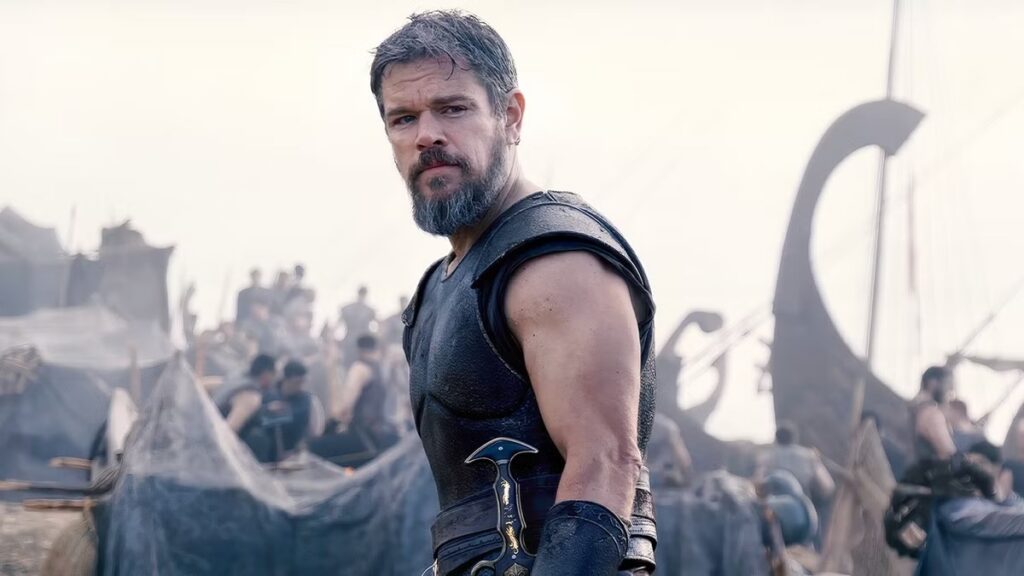

To quote Director Christopher Nolan’s greatest film, The Dark Knight, “Sometimes people deserve to have their faith rewarded.” On Saturday evening, mine was when I viewed his adaptation of The Odyssey.
But many on the Right, especially the hyper online Right, came in believing (and hoping) they would dislike what they predetermined to be woke denial of western culture, and to further quote The Dark Knight‘s Bruce Wayne, “Sometimes the truth isn’t good enough… Sometimes people deserve to have their faith rewarded.”
It has provided them many a hot take on social media, but it has also deprived them an opportunity of seeing that, rather than jettisoning the western tradition, Nolan has done the most western thing possible, following a long line of western storytellers, he baptized the myth he loved. Understanding that allows the viewer to understand the beauty of what Nolan has done and our own birth right as inheritors of the western cannon.
The chief critiques have been that Nolan radically changes the story not just in casting choices that critics find distressing but with the direction of the tale itself. They dislike Odysseus feeling guilt and shame over the Trojan Horse because they feel it makes him weak. They claim that he is now just a man with PTSD. There have also been complaints about Nolan equating Zeus’s Law (xenia) with the golden rule. Also, Odysseus’s affairs on his way home have been stripped from the story.
These themes are present only if a person insists on reading the least charitable take possible into the movie.
In college, I fell in love with Anglo-Saxon literature as a window into a past exceedingly different from our present culture and yet preparing to become our culture through the introduction of Christianity. That is what King Arthur is about, the waning of the Celts and the glory of the dawning Christian Britain ruled by a king, who, as time went on, began to more and more resemble Christ. Beowulf, too, preceded the introduction of Christianity, and yet, the tale we are left with blends the two, with characters tracing their lineage back to the biblical Cain. Their literature shows us their desire to root their history in the biblical epic. It also demonstrates what they found compatible between their old culture and the new faith. Even more fascinating, it shows us why the faith was compelling to them. We see a culture come face to face with the gospel for the first time and find it enchanted them. It’s an encounter that we, who have the blessing of living in a time that is saturated with the vestiges of faith, can’t fully comprehend.
Interestingly, great literature of the past also provides commentary on The Odyssey. For those complaining that Nolan is destroying Odysseus, who they are discussing as a model of masculinity, cunning, and virtue, I would remind them that the poet Dante Alighieri places him within the 8th circle of Hell for possessing precisely the qualities that The Odyssey treats as virtues. Notably, it is the Roman poet Virgil that guides Dante through the different levels of Hell. His Aeneid paints a less charming picture of Odysseus.
Nolan, then, doesn’t seem to be making his updates out of whole cloth. Rather, he has taken in voices weighing in throughout the western tradition and added his.
The weariness towards directors distorting beloved intellectual property is understandable, but this is not the Star Wars sequels — and not only because it is within the public domain. There is no evidence that Nolan hates the source material with which he is working. On the contrary, he has taken the time to understand how the broader western tradition has seen the story before adding his own mark. That is acceptable, respectful, and in accord with the tradition.
Also, when is the last time our cultural discourse has been elevated to debating The Odyssey? For that alone, Nolan deserves our gratitude.
More present to us, both British authors C.S. Lewis and J.R.R. Tolkien baptized their favorite myths. They were not destroyers of the old epic poems, but rightful inheritors, and their work honored this inheritance.
As for the specific changes, it is wrong to say that Nolan makes Odysseus a bitter man with post-traumatic stress. He shows a man who carries great weight and remorse for violating the natural law (Zeus’s Law). At one point, Nolan, a lapsed Catholic, even has Odysseus dressed as a beggar confessing his failings through a screen. The imagery is that of contrition for an action that, as Odysseus explains, has caused such a great rupture of the natural law that it has resulted in the corruption and downfall of his culture.
There is a far greater emphasis on the value of human persons than the original tale would allow. Nolan’s The Odyssey is clear that Odysseus is wrong for not burying the dead, for sacrificing young Greek warrior Sinon, and for use of the Trojan Horse because it was unjust. In the end, Nolan’s Odysseus must leave Ithaca not for Dante’s adventure, but because sin requires atonement. These are Christian virtues brought into the Odyssey, and that is good. It is also striking that Nolan’s Odysseus doesn’t have affairs and engage in casual sex. Apparently, we want our epic heroes to be better than our current moral standards.
The newly Christianized Anglo-Saxons wrote to show why they embraced the gospel. Nolan’s The Odyssey tells us why our increasingly secularized world is unwilling to fully reject the gospel.
If the sanctimonious self-appointed lone guardians of the western tradition can’t get their act together long enough to take the win, then they will not only lose elections, they will miss the moment, and forfeit the culture, and with it the tradition they claim to love. That is a tragedy worthy of the Greeks.
More from IRD:
Nolan’s “Odyssey” Is a Defense of Western Civilization




Comment by Salvatore Anthony Luiso on July 23, 2026 at 2:26 am
Thank you for this article.
The criticism of the film for not preserving and promoting pagan virtues is telling. I can see why someone might criticize that as being unfaithful to the author and the text, but I can also see why someone might criticize it out of a preference for pagan virtues over Christian ones. From what I’ve heard, I think the latter is happening more than the former–and it is being done by Christians who criticize modern society as pagan!
Especially telling is the criticism that the guilt and shame of Odysseus make him look weak. How sadly ironic for Christians to do that–especially Christians who want other people to feel guilt and shame, and repent.
It the survival of Western civilization depends upon the current vociferous guardians, defenders, and champions of it, it will not survive.
Comment by David on July 23, 2026 at 8:13 am
The whole Trojan War was caused by three vain goddesses vying over who was the most beautiful. After Zeus wisely refused to get involved, they turned to the Trojan prince Paris. All three attempted to bribe Paris, and he ended up with the beautiful Helen, offered by Aphrodite. The other two goddesses, Hera and Athena, were offended and sought the downfall of Troy. Other gods and goddesses joined in the dispute, and none appeared in a very favorable light. The immortals were really no better than the mortals.
Comment by Mark on July 23, 2026 at 5:38 pm
I think this article speaks to a larger trend I’m seeing in public discourse around Western Civilization and the classics that needs to be addressed. Many conservative voices today talk about classics like The Odyssey as if they’re fragile porcelain dolls that will break if you touch them or millennia old papyrus scrolls that must be kept under glass to protect them from exposure to the “poisionous airs of contemporary culture”. This attitude is totally anathema to the very dynamism of Western Civilization that has produced such great works. As Steward mentions above other great authors from Shakespeare to Twaine to Tolkien have been rewriting, reinterpretating, and in some cases even parodying the great works of the past for centuries. Men like Dante and T.H. White were allowed to play with the characters of Odysseus and King Arthur like they were footballs. Meanwhile we demand men like Nolan today approach them like a kid playing the game Operation. Why are we so afraid we’re going to break them?
Musk’s decision to use AI to create his own Odyssey move to spite Nolan (a tantrum expense if I ever saw one) may in fact be the farce we need to snap ourselves out of this self-imposed cultural stasis. It may be as Musk intends a film devoid of diversity or allusions to contemporary ideas or beliefs. But it will also be a film devoid of people, devoid of emotion, and devoid of spirit. None of these can be generated by AI, much we might like to pretend otherwise. Like a comatose hospital patient, Musk’s film will depend on nothing but machines to live. In our fear of being woke, we’re on the verge of becoming truly soulless.
Comment by Different Steve on July 24, 2026 at 10:07 am
Went to YouTube for some context on the Elon Musk stuff: as the video points out, Musk has a history of succeeding despite naysayers and should not be counted out.
The Odyssey by Christopher Nolan Gets WAR NOTICE from Elon Musk! $100M Mel Gibson Version?!
PRO WDW Pro
9.9k views – 14 hours ago
https://youtu.be/cjFV8Igc3zA?is=y8shjjJOgzkxGkAG
Comment by Different Steve on July 24, 2026 at 10:51 am
A winner never quits.
A quitter never wins.
When the going gets tough, the tough get going.
Memo to My Son, by Randy Newman, from his classic 1972 album Sail Away
Comment by Wilson R. on July 24, 2026 at 5:29 pm
I have not yet seen The Odyssey; we’re going next week. But from what I’ve read, you’d think conservative Christians would be praising the film because the Greek gods have such a small presence and the story is easy to interpret through a modern, Christian lens. Yes, some secular liberals criticize this choice, but I suspect that Nolan wanted to make the story seem more timeless and more relatable, and that’s valid. Instead, conservative Christians seem to be howling because Helen is played by a Black woman and there’s an actor who is trans.
Comment by Different Steve on July 24, 2026 at 10:59 pm
More context (decide for yourself):
THE ODYSSEY IS JARRING – Nerdrotic & Critical Drinker on Piers Morgan Uncensored
Also: Victor Davis Hanson!
And some other smirking nobodies.
If you don’t like their takes here, they’ve got plenty others all of which have views that crush the dying dynosaurs cnn and msnbc.
https://youtu.be/z-M6WyYcVfk?is=21XJ7bTOX7865o23
Comment by Thomas on July 25, 2026 at 10:17 am
I saw it yesterday. I thought “The Odyssey” mindblowing, a modern retelling of a classic, with some new takes, that make the film more relatable and meaningful for modern viewers. Pre-Christian morality is really shown there. The article by Sarah Stewart explains why this happens. As for some casting choices, its all mythical. It doesn`t matter if Helen of Troy could be black or not. What I found unnecessary was Agamemnon sacrifice of his own daughter to the gods, because its totally absent of the “Odyssey”, its taken from Euripides dramas. I recommend the film vividly and it shows once again that Christopher Nolan is one of the greatest living filmmakers.
Comment by Wilson R. on July 27, 2026 at 3:43 pm
Hardly anyone ever preaches about it, for good reason, but sacrificing one’s daughter for victory in battle is also found in the Bible. It’s the story of Jephthah, in the book of Judges, who makes a vow to God and then winds up having to kill his daughter in order to keep it.
Comment by Thomas on July 27, 2026 at 8:59 pm
Wilson R, he did that for the wrong reasons, and human sacrifices were always banned in the Mosaic Law. He should have refused to do so.
Comment by Wilson R. on July 28, 2026 at 11:16 am
Thomas, I understand and agree that Jephthah was presented as a negative example. I probably should have made that clearer. Much of the content presented in Judges is shown as a negative example, and the authors present this period as a chaotic time when “everyone did what was right in their own eyes.” Still, I find it interesting that this story is there, along with the even more tragic updating of the Sodom story involving a Levite’s concubine. I’ve only heard one sermon on Jephthah (presented from the point of view of his daughter) and never heard any sermon on the Levite’s concubine. I suspect that 99% of Christians don’t know either of these stories.
Comment by Wilson R. on July 31, 2026 at 10:38 am
I saw the movie yesterday. I suspect that people who got inflamed over casting a Black woman as Helen haven’t bothered to see the film and will never bother. Helen barely qualifies as even a minor character. I agree with the writer here that the most interesting part of the movie is the moral burden Odysseus must bear for what he has brought about (not unlike Oppenheimer). But I suspect conservative Christians will also be unhappy about that theme, because they will regard it as veiled criticism of US foreign policy and “America-hating.” (I have seen THAT movie many times over.)
The whining about a Black Helen obscures something about the overall casting choices. A South Asian (Himesh Patel) plays Odysseus’ trusted lieutenant. An East Asian plays a soldier who can’t resist the sirens’ song. A multiracial actor plays Athena. A Puerto Rican American plays Odysseus’ loyal servant. To me, the diversity in casting suggests Nolan wants people to understand that the story isn’t just timeless but speaks across cultures to say something about human behavior and emotions. And there is nothing wrong with that. The same is routinely done with Shakespeare.