In 1948, Richard M. Weaver published Ideas Have Consequences, a short but forceful book that traced the roots of modern Western decline. He argued that the “unfixing of relationships” began in the fourteenth century. At that time, a philosophical shift called nominalism displaced the older view known as realism. Realism taught that abstract ideas such as justice, duty, beauty, and order were real and permanent truths, rooted in a higher reality beyond human opinion. Nominalism, by contrast, insisted these were nothing more than convenient labels or names we invent for our own convenience. Once those fixed anchors gave way, social bonds that had once felt permanent started to seem optional, like contracts that could be rewritten or broken whenever it suited someone.
Weaver saw education as the way back. He called for shaping whole persons through broad, general learning rather than narrow specialization. True leaders, he believed, stand at the metaphysical center of knowledge, able to integrate disciplines under first principles instead of fixating on isolated facts. The medieval “philosophic doctor” embodied this ideal. The modern specialist, by contrast, is a partial figure, technically proficient yet poorly equipped to guide institutions or sustain culture.
Seventy-eight years on, these ideas have moved beyond small intellectual circles. A growing counter-movement is putting them to the test with hard numbers.
The Rise of Classical Christian Education
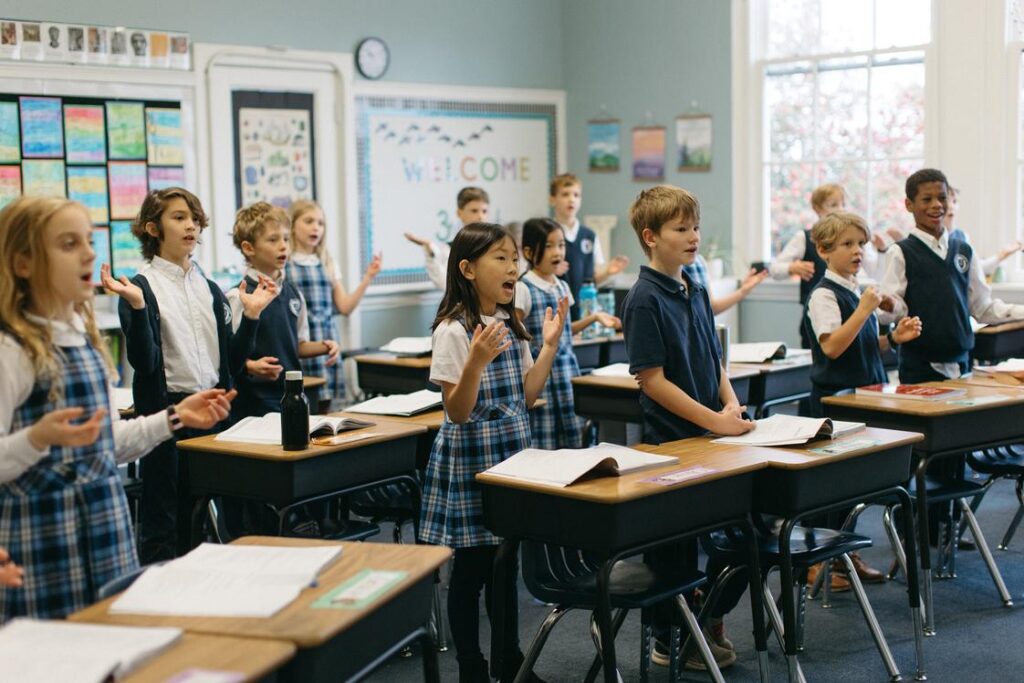
Recent data highlighted by Forbes in April 2025 show that classical Christian education ranks among the fastest-growing sectors in American schooling. Enrollment topped 677,500 students across 1,551 institutions in the 2023–2024 school year. Between 2019 and 2023 alone, 264 new classical schools opened. Projections point to 1.4 million students by 2035 and a sector that could top $10 billion in annual economic impact.
These schools reject the fragmented, elective-heavy model Weaver criticized. Students follow the classical trivium—grammar, logic, rhetoric—and quadrivium, immersing themselves in Great Books, philosophy, theology, and the Western tradition. The goal is not job training but building an integrated personality capable of judgment, virtue, and leadership. This matches the older ideal Weaver drew from medieval and Renaissance models.
The appeal runs deeper than nostalgia. Independent studies, including the Good Soil Report from the University of Notre Dame, using Cardus data, reveal clear differences. Graduates of classical Christian schools show higher rates of religious retention, civic engagement, reading, charitable giving, and sense of life purpose than peers from other models. They also report stronger friendships and a greater feeling of coherence in their lives.
Colleges that share this approach—Hillsdale (home to Weaver’s own library), St. John’s, Thomas Aquinas, and Wyoming Catholic—keep drawing students who want unified curricula instead of specialized tracks. Their graduates tend to prize synthesis across fields over technical mastery in isolation.
Why This Matters Now
Weaver warned that nominalism’s legacy would leave people fixated on immediate particulars while losing any unifying frame. Today’s conditions echo that concern. Social media deepens isolation. Elite institutions often turn out highly trained specialists whose moral or philosophical grounding feels thin. Leadership failures across sectors are increasingly described as failures of judgment rather than of technical skill.
In this light, the classical resurgence offers a path toward restored coherence. Its advocates argue that education should reestablish stable intellectual and moral reference points. Rhetoric is taught as a disciplined art of persuasion, not manipulation. Metaphysics is treated as the foundation for ethics and politics, not an abstract diversion. The aim is synthesis, not fragmentation.
The movement is largely parent-driven and decentralized. Its growth reflects real dissatisfaction with models that many see as producing anxiety, disconnection, or intellectual thinness.
The growth figures are substantial, and the reported outcomes are hard to dismiss. At the same time, classical education still occupies a minority position in the larger system, and the broader cultural drift continues. In that sense, today’s revival looks less like a rupture and more like an effort to recover an older vision of education centered on unity, meaning, and the formation of judgment.
More from IRD:
Developing a Course of Christian Education Adequate for Our Day
Lady Bird, Catholic Education, and the Solid Little Chapel




Comment by Wilson R. on May 8, 2026 at 2:01 pm
I get emails from Hillsdale every single day touting their courses, their book giveaways, and their philosophy. Judging from that, Christian education is not what they’re about, although they’d like you to believe that. It’s more about Christian indoctrination, particularly toward a narrow, incomplete view of America’s history and its relationship to evangelical Christianity. The emails convinced me I would never want to recommend the place to a kid. Critical thinking there is clearly not encouraged.
Comment by Rick Plasterer on May 8, 2026 at 6:15 pm
Wilson R,
Christian education is by definition inculcation of Christianity. Critical thinking is one thing, but to criticize first principles, which is what classical education purports to teach, is immediately destructive. Critical thinking today has suggested that mathematics is racially biased. As C.S. Lewis said, “to see through everything is not to see.”
Rick
Comment by David on May 8, 2026 at 6:40 pm
I wonder how these schools teach science, especially evolution. I studied comparative religions in high school. Are these schools so broad in their teaching?
I suppose I had a classical education in public high school 65+ years ago. There were very few electives other than a choice of foreign language—I had Latin, which is no longer offered there. I am aware that the school now has half-semester electives—something unknown in my tenure.
Comment by Gary Bebop on May 8, 2026 at 8:16 pm
Rick Plasterer nails it with his reply to a commenter. Classical Christian education is flourishing because gullible absorption of “cultural drift” no longer holds sway. Families are rejecting the rootless narratives that have contributed to an unhinged society. Meanwhile, the lies and lawlessness of such a society will increase and must be resisted.
Comment by Wilson R. on May 8, 2026 at 10:23 pm
Critical thinking also applies to refute the argument that mathematics is racially biased. And one applies critical thinking to recognize that you have erected a straw man.
I received a Christian education. A Christian education does not misrepresent history for the sake of an agenda. That’s what Hillsdale clearly does.
Comment by Different Steve on May 8, 2026 at 11:11 pm
Wilson makes two main claims: 1) Hillsdale practices “Christian indoctrination” rather than education, and 2) it presents a “narrow, incomplete view of America’s history” while discouraging critical thinking.
1. Wilson confuses “frequency of outreach” with “content of curriculum.”
Wilson’s entire case rests on getting “emails from Hillsdale every single day.” He assumes that aggressive marketing equals a flawed pedagogy. This is a non sequitur. The volume of promotional emails says nothing about whether a school teaches critical thinking or history honestly. By his logic, any institution with a large advertising budget (universities, NPR, Amazon) would be guilty of indoctrination. He has not cited a single syllabus, lecture, or assigned reading from Hillsdale—only the existence of its email list.
2. His definition of “indoctrination” is question-begging.
He claims a “Christian education does not misrepresent history,” but he offers no evidence that Hillsdale actually does so. He simply asserts it. Meanwhile, the article notes that classical Christian education produces graduates with higher rates of reading, civic engagement, and life purpose—not traits associated with uncritical, indoctrinated minds. If Hillsdale were truly anti-critical thinking, why would its students voluntarily read Great Books (which include Locke, Hume, and Darwin) and learn rhetoric as a disciplined art of persuasion, including refuting opposing views?
3. Wilson mistakes teaching a moral framework for banning dissent.
Classical education teaches that first principles (justice, truth, beauty) are real—not merely social constructs. That is a philosophical position, not an absence of thinking. Rick Plasterer correctly notes that “to criticize first principles is immediately destructive” of the enterprise itself. Wilson wants critical thinking applied only to views he disagrees with, while treating his own assumption (that all history teaching must be value-neutral) as beyond question. That is not critical thinking; that is naive positivism.
4. The “narrow view of history” charge is asserted, not proven.
Wilson says Hillsdale misrepresents America’s relationship to evangelical Christianity. But the article’s topic is Weaver’s realism vs. nominalism, the trivium, and integrated curricula. Nothing in Wilson’s comment engages with what Hillsdale actually teaches—e.g., its required courses on the Federalist Papers, the Declaration, or Western political thought. He rejects the school based on email frequency and a vague accusation. That is the opposite of the critical thinking he claims to champion.
5. Empirical outcomes contradict Wilson’s fear.
If Hillsdale truly discouraged critical thinking, we would expect its graduates to show lower reasoning scores, higher dogmatism, and poorer judgment. Yet the Good Soil Report (cited in the article) finds classical Christian school graduates report stronger friendships, greater coherence in life, and higher charitable giving—all markers of autonomous, integrated agents, not robotic followers. Wilson offers no data, only personal annoyance at his inbox.
Conclusion: Wilson’s argument is a textbook example of what Weaver warned about: fixation on immediate particulars (daily emails) while losing any unifying frame of evidence or logic. He has not demolished classical Christian education; he has merely confessed that he finds marketing tiresome. That is a preference, not a refutation.
Comment by Qohelet on May 9, 2026 at 11:02 am
It’s important to understand that Classical Christian education is a subset of general Classical education. The distinction is that the former tries to imbue Christian values into the curriculum. This I suspect is where Wilson takes issue with Hillsdale. It is a highly partisan institution with a very right-wing version of Christianity. Questioning whether students are allowed to have other ideas under such a curriculum is valid.
As for the broader view of Classical education, I do see some of the attraction to it. I suspect there’s many fine institutions structured around it. As to whether they’re better than traditional public schools, I think you’ll find the usual answer: students can thrive in expensive private schools or exclusive charter schools because they can exclude challenging students. It’s easy to have institutional success when you just get rid of the kids you’re not able to succeed with.
All of that is of course secondary to parents whose job it is to put their child in a place they can thrive. If a school allows this, great.
The one litmus test I apply to any education other than the default public school is “is this being done in the child’s interest, or someone else’s?” There are parents in this country that believe parental rights mean they own their children. If the reason for keeping a kid out of public school is so that they don’t meet people or cultures their parents are bigoted against, or that they don’t want their kid exposed to ideas they disagree with, then that’s a bad educational choice. Christian theologians since the beginning have understood free will as something God gives us because if we didn’t have the choice to do good or evil, we’d be no better than animals (see for example Paradise Lost.) Depriving children of the information they need to make an honest choice about controversial issues is bad parenting and will lead to bad outcomes.
Comment by Gary Bebop on May 9, 2026 at 3:00 pm
“Different Steve” understands what’s going on here in the comment section. Great job of unmasking the dilettantes who crowd this site like a street takeover. My compliments to Different Steve.
Comment by Different Steve on May 10, 2026 at 10:17 am
DoesHillsdale College teach a far right version of Christianity?
Short answer: no, Hillsdale College does not officially teach a “far-right version of Christianity,” but it does promote a conservative, traditional Christian worldview that overlaps with parts of American conservative politics.
Here’s the more accurate breakdown:
1. What Hillsdale actually is
Hillsdale College is:
A private liberal arts college
Christian in heritage and identity, but non-sectarian (no required faith statement for students)
Hillsdale College
Founded in 1844 with Christian (Free Will Baptist) roots
Focused heavily on Western civilization, classical education, and the American founding tradition
So it is not a seminary or church school, and it doesn’t officially function like a denominational religious institution.
2. What it teaches about Christianity
Hillsdale includes Christianity in a few ways:
Theology and Bible-related courses exist (e.g., Christianity, Medieval Christianity, Biblical studies)
Christian ideas are often treated as part of Western intellectual history and philosophy, not as doctrinal instruction
Hillsdale College
Campus life includes many Christian student groups and worship opportunities, but participation is voluntary
Hillsdale College
Importantly: it does not require students to affirm a creed, and it doesn’t function like a church teaching one official “correct” theology.
3. Why people associate it with “far-right Christianity”
This perception comes mostly from its political and cultural positioning, not from formal theology:
It strongly emphasizes constitutionalism, limited government, and Western tradition
It is frequently aligned (culturally and through public speakers/programs) with conservative and right-leaning political movements
Some critics argue its framing of issues like history, government, and morality reflects a “Christian conservative worldview” tied to modern U.S. political conservatism
That said, “far-right Christianity” is not an academic or institutional label Hillsdale uses for itself, and it does not teach a unified political theology in that sense.
4. What it is closer to, in practice
A more accurate description would be:
Traditional / conservative Christian cultural outlook
Combined with classical liberal arts education
With strong emphasis on Western canon and American founding philosophy
Bottom line
Not a far-right Christian institution in a formal doctrinal sense
Yes, it leans culturally and philosophically conservative and Christian-influenced
Comment by Qohelet on May 10, 2026 at 1:18 pm
Different Steve
Ask ChatGPT to tell you about the 1776 Curriculum that Hillsdale wrote and conservatives are using to push truthful history out of schools.
Comment by Glenn Wheeler on May 11, 2026 at 12:08 am
What Hillsdale teaches is not a “traditional Christian worldview.” There’s nothing traditional about it as far as historical Christianity goes, if you go back further than 100 years and go outside the United States, and there’s certainly nothing Christian about it if you get beyond right-wing evangelical distortions of Christianity. It is a sectarian, secular, pseudo-Christian example of institutional Christianity as chaplain to society…i.e., a contrived religion as a mechanism attempting to give divine sanction to a particular subset of society.
This is not to say, of course, that the public schools deserve our support. It’s merely to say that these so-called Christian, “classical” alternatives are no better and may in fact be worse.
Comment by Wilson R. on May 11, 2026 at 1:50 pm
Different Steve:
You and ChatGPT have missed the point. The question is not whether Hillsdale teaches a far-right version of Christianity. It’s whether it teaches a far-right version of U.S. history.
It does.
I am a historian by training. Whitewashed history is just as dangerous, if not more so, than “woke” history. Both present a distorted perspective.
The 1619 Project is a good example of what gets labeled as “woke history.” That’s not to say that everything in it was wrong. For example, it’s an exaggeration to say that slavery was part of US history since 1619 (There was no USA in 1619; it’s more accurate to say that, when the US was born in 1776, it was like a crack baby–addicted to slavery and racial subjugation because of the addictions of the mother country, Great Britain. It’s an exaggeration to say that the American Revolution was about slavery, although without question slavery WAS a real motivation for independence in the Southern colonies.)
Hillsdale’s 1776 Project, intended as a counter to the 1619 Project, is pitched as a “patriotic” view of history. That is to say, it whitewashes the teaching of history to leave out the aspects we find unpleasant and would rather not talk about.
Most of us were taught the whitewashed view.
For example, did you know that one reason it took so long between the decisive British surrender at Yorktown in 1781 and the signing of the Treaty of Paris in 1783 was that George Washington was negotiating with the British in New York for the return of slaves who had fled to British lines when the British offered them freedom? Did you know that, while the British did return some of those slaves, they evacuated others to Atlantic Canada, and ultimately, to Africa, where they established the new colony of Sierra Leone?
Did you know that, during the Civil War, 500,000 enslaved people (that’s 1 in 8) liberated themselves by escaping to the protection of advancing Union armies, and that they were employed in support positions (cooks, orderlies, nurses, carpenters, even scouts) that multiplied the manpower of Union forces while depriving the Confederacy of 15% of its labor force? Did you know that the reason Lincoln’s Emancipation Proclamation applied only to enslaved people behind Confederate lines is that it effectively made the Union Army a force of liberation?
Did you know that, in the wake of the great Mississippi River flood disaster of 1927, when thousands of square miles of the Mississippi Delta were underwater, and the only dry ground was the levees along the river, steamboats came to evacuate the white people who had made it to safety, but black people were held there at gunpoint by the National Guard and force to work, without pay, on repairs and rebuilding?
I didn’t know any of those things, even as a history major in college, because like most of us I was taught a whitewashed version of history.
Teaching ALL of our history is not about some woke ideology. It’s simply about teaching the truth. Hillsdale refuses to do that. Don’t they believe the truth will set us free?
Comment by Qohelet on May 11, 2026 at 4:49 pm
Glenn the public schools deserve our support because they’re public. They’re our responsibility.
They also for the most part work pretty well, as do most private schools. Most people who give their careers to young people try and act in their best interest. The supposed failures of public schools are really failures of society. An education can get you a lot; it can’t fix that in some ZIP codes parents can give their kid every opportunity and in others parents have to pray that a stray bullet doesn’t find their kid. Not surprisingly, blaming such inequality on the local schools hasn’t solved much.
Comment by Wilson R. on May 11, 2026 at 6:35 pm
Yes to what Oohelet says. Not suggesting this is where Glenn is coming from, but there is definitely a mindset out there that private schools and charter schools (which are technically public) are inherently better than traditional public schools in terms of academic performance. And the data just does not bear that out. In fact, only about 25% of charter schools perform better than traditional public schools, and another 25% actually perform worse. In my state, Tennessee, the governor has forced a voucher program down the throats of legislators that none of them originally wanted for kids in their own counties. Mostly, the program has been subsidizing parents whose kids were already in private schools. The voucher kids actually performed less well on tests than the public school kids. So the legislature’s solution this year was to do away with the testing requirement for private schools
Comment by Glenn Wheeler on May 11, 2026 at 10:12 pm
I’m not one of those people who think the public schools are undermining society or anything like that. My position is that the entire educational system, whether public, private, charter, classical, or whatever, has failed in that it does not teach people to think, does not teach logic. It merely produces lemmings who unquestioningly believe whatever they hear and are susceptible to whatever narrative is put out by the government, institutional Christianity, science, or whatever. Just witness, on one hand the Trump supporters, and on the other hand, the Democrats. Or, witness the followers of evangelical “Christianity.” Or witness the COVID mania. In a society where people could think, none of that would be tolerated.
Comment by Wilson R. on May 12, 2026 at 10:33 am
Glenn, I have seen this phenomenon, too. Once, the teaching of critical thinking skills is what distinguished American education from the Chinese system, which emphasized rote learning. Our system actually gave us big advantages. Now, critical thinking skills are declining–in part, because of rampant “teaching to the test” and, in part, because reading skills have declined. Evangelical Christian schools are particularly guilty of producing lemmings.
Comment by Qohelet on May 12, 2026 at 2:59 pm
I think what’s happening is that schools are reflecting the general malaise that has taken over so much of American society. To some extent John Steinbeck predicted this in his 1966 “America and Americans” when he noted that throughout history, the vast majority of Americans had an obvious purpose in life: factory work or farm labor. As industrialization and then globalization happened, both were hollowing out. So what was the next generation to do? It caused a lot of angst and still does. Billy Joel’s “Allentown” nails this feeling exactly.
Schools are supposed to prepare kids for the workplace. But what workplace will they enter? By the mid 1990s, in a lot of America it was either white collar management jobs or poverty. So schools doubled down on the idea everyone should go to college and we aggressively tested to see if schools were making that happen. And of course it failed, because that’s not a balanced educational system. So we’ve reacted and over reacted and reformed and tested, but we’re still waiting for our society or answer the question: what value is a human worker and what are we training them for? With AI the question is even more urgent.
I’d argue that this is where we as Christians can play a role. Even if naked Capitalism has no role for the person whose labor can’t be exploited, they are still our neighbors