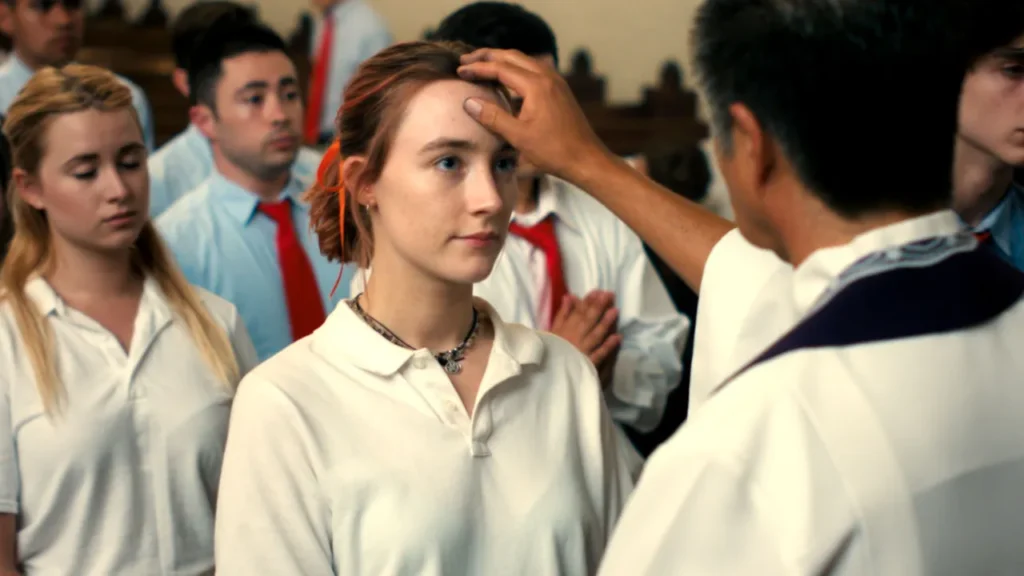

Gretta Gerwig’s Lady Bird is an excellent example of what Babe Ruth once called the “solid little chapel in the heart.” It is the coming-of-age story of a young rebellious girl sent to a Catholic school. Gerwig called her movie, “the only existent love letter to Catholic school [in cinema].”
Babe Ruth detailed his reversion to the Catholic Church in a Guidepost article stating, “The more I think of it, the more important I feel it is to give kids ‘the works’ as far as religion is concerned. They’ll never want to be holy–they’ll act like tough monkeys in contrast, but somewhere inside will be a solid little chapel. It may get dusty from neglect, but the time will come when the door will be opened with much relief. But the kids can’t take it if we don’t give it to them.” He credited his solid little chapel with his time in Catholic school.
Gerwig was not raised Catholic and grew up Unitarian Universalist, yet her work occasionally shows a fascination with the faith shared with her in Catholic school. Both her film and her own life demonstrate how the Christian faith can captivate someone even before they are ready for conversion.
The artistic aspects of Lady Bird were probably overhyped. It has awkward dialogue and, at times, clunky pacing, but it does depict well the dramas and intrigue that accompany the lives of many teenage girls today. In this way, it is a good coming-of-age story, but what sets Lady Bird apart is the way in which the Catholic school becomes a character itself and how, without the main character realizing it, she is shaped by her time there.
The story depicts Christine, who has changed her name to Lady Bird in an act of teenage rebellion. She is embarrassed by her family’s lack of wealth and status. Her family has decided to send her to the local Catholic school. She regularly fights with her mother, Marion, and dreams of moving across the country to New York. As the year progresses and she desperately seeks acceptance with more popular students, she becomes more and more rebellious, eating unconsecrated hosts, vandalizing a nun’s car, and insulting the speaker at a pro-life assembly.
By the end of the film, she and her mother are no longer speaking, and she has accomplished her goal of moving to New York. Very quickly she realizes that the life she has dreamed of is empty. As it turns out, moving away from the people she loved and who loved her was not as thrilling as she thought it would be. One morning, Christine leaves the hospital in tears having landed there for intoxication. She walks around trying to get people to tell her what day it is and finds a church. She enters and cries through the service. She leaves, calls her parents, and tells them that her name is once again Christine.
Lady Bird is not a conservative movie. It is liberal when it comes to social issues and adult content. What it does well is demonstrate the value, even when initially unrealized, in providing children with Christian education, in this case specifically Catholic education. It allows for Christ to pervade even the seemingly ordinary moments of the teenage years. He stares down from crucifixes, His words are written on posters, He shapes the curriculum, and students stand by statues of His mother at dismissal. The simple beauty of Catholic education is that even in seemingly banal moments, Christ is present in the day’s activities, whether or not the students initially recognize it.
Catholic education also requires a sacrifice that shapes how students know they are loved and valued. The film movingly depicts this sacrifice. Many families financially sacrifice to send their children there, teachers sacrifice not just in reduced pay but in the giving of their time, and many Catholic schools sacrifice, going to great lengths to make the education affordable. I know mine did, and the sacrifices that I watched the teachers and school make forever shaped the way in which I view work and vocation.
Catholic schools also have moments that require you to reckon with Christ. Teenagers so desperately want to become part of the world, but when Catholic education is done well it simply won’t allow for that. Students dress differently and don’t eat meat on Fridays. Not only each day but each class period begins with prayer, students wait together in the gym for their turn in the confessional, and attend masses at school with their parents, siblings, and teachers. And in a myriad of other small ways that are incongruent with the world, students enter into a liturgical way of living that is both comforting and something that teenagers desperately want to rebel against. And yet, despite their best efforts, the “solid little chapel” is built.
Gerwig captures well both moments of liturgy and rebellion, whether it’s the crucifix always in the background, students in line for Ash Wednesday, or the girls rolling up their skirts. In Lady Bird, one of the nuns tells Christine that there is a relationship between attention to detail and love. In this way, Gerwig’s movie really is a love letter. And while much of the content she produces is culturally liberal, I hope that some of the brief glimpses of interest in Christian faith one day result in her opening the door to the solid little chapel.




Comment by Dan W on June 4, 2025 at 7:53 am
This film is from 2017?