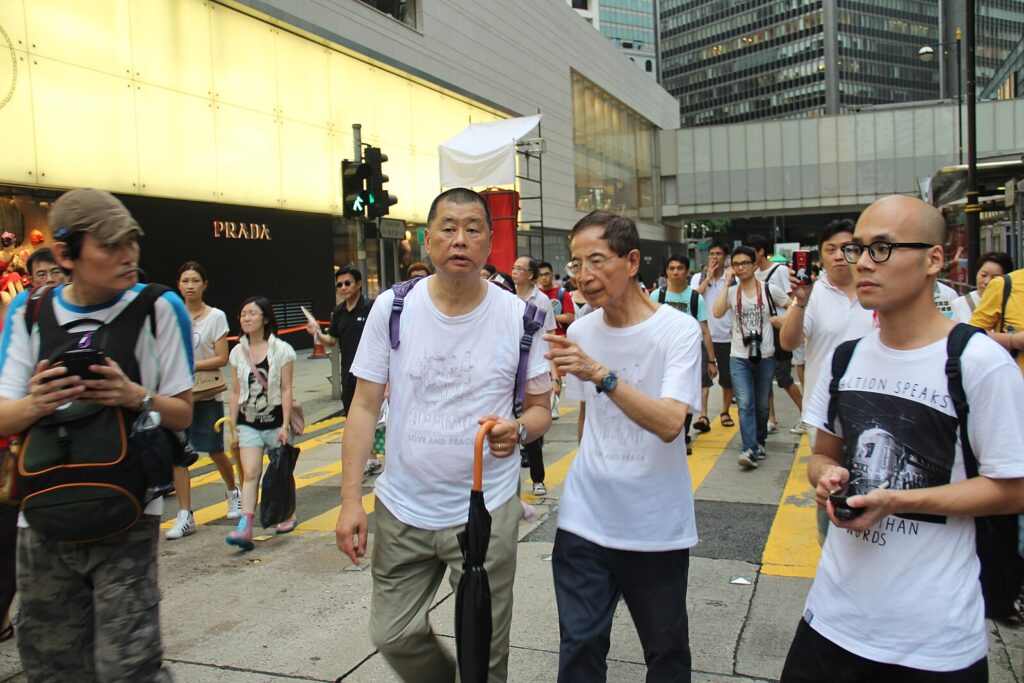
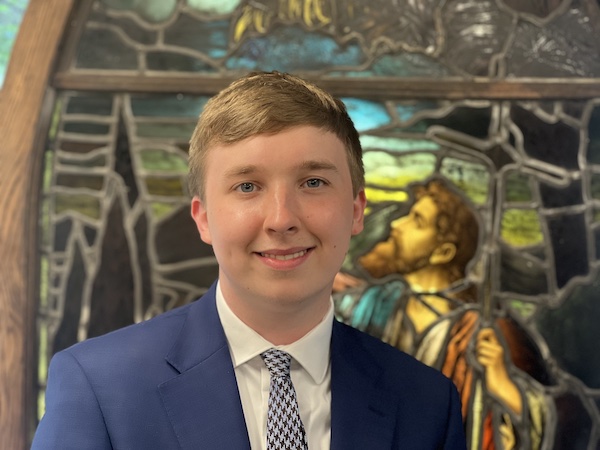
“We are human beings. We have souls. We are not a dog. And not willing to accept increasing interference from Beijing,” Hong Kong businessman Jimmy Lai told CBS News in 2019 during the massive pro-democracy demonstrations that challenged the Chinese government’s heavyhandedness in Hong Kong.
On December 15, Lai was found guilty of violating the 2020 Law of the People’s Republic of China on Safeguarding National Security in the Hong Kong Special Administrative Region, a sweeping ordinance passed by the Chinese government to, with little specificity, punish those deemed threatening to China’s grip on Hong Kong. Lai may face life imprisonment.
This conviction is the culmination of a decades-long CCP campaign against Lai for his ties to Hong Kong’s democracy movement. A clothing and newspaper magnate, Lai has opposed China’s anti-democratic politics since the 1989 Tiananmen Square protests. In 1995, as the British handed Hong Kong back to China, Lai founded Apple Daily, one of the city’s staunchest defenders of free speech. When the Chinese clamped down on Hong Kong in 2019, Lai and his paper became the foremost defenders of the city’s sovereignty on the world stage. In 2020, Lai was imprisoned for taking part in “illegal assembly,” those peaceful protests which he unflinchingly supported. Later that year, he was arrested again under the new national security law and has since been repeatedly detained for further violations of the government’s draconian regulations.
In the government’s case against Lai, he was depicted as the mastermind behind the Hong Kong autonomy movement, callously colluding with Western and Taiwanese forces to sever the city from the Chinese motherland. This trumped-up charge aligns with the practices of China’s totalitarian Communist regime. China’s purge of Lai and his allies is reminiscent not only of previous Chinese crackdowns on human rights campaigners, such as in Tianjin in 2016, but also recalls tactics employed by the Soviet Union. During the 1920s and 1930s, Stalin led campaigns against individuals accused of subversion, detaining members of fictitious conspiracies, like the Union of Liberation of Belarus and the Union for the Freedom of Ukraine. While differences exist between Soviet and Chinese repression, this suppression of democratic organizing is a recurring strategy among Communist governments, with China’s recent history providing many unfortunate examples.
Despite the injustice Lai faces, he is not alone. Aside from his work for democracy, he is also a committed Catholic. Having converted in 1997, Lai credits his faith with giving him strength amid persecution. In an interview with the Napa Institute, Lai said, “If you believe in the Lord, if you believe that all suffering has a reason, and the Lord is suffering with me…I’m at peace with it.” Lai’s faith has garnered broad support among Christians in the West, including from the Acton Institute’s Fr. Robert Sirico and U.S. Commission on International Religious Freedom Commissioner Johnnie Moore.
Sirico and Moore are members of a tradition as old as the People’s Republic of China that has consistently stood for the freedom of the Chinese people to pray and act as they believe in the face of state oppression. In 1958, Pope Pius XII articulated this strong stance against the PRC’s repression of the Church, writing in Ad Apostolorum Principis,
“Against methods of acting such as these, which violate the principal rights of the human person and trample on the sacred liberty of the sons of God, all Christians from every part of the world, indeed all men of good sense cannot refrain from raising their voices with Us in real horror and from uttering a protest deploring the deranged conscience of their fellow men.”
In light of Pius XII’s call for a universal stand against the Chinese Communist Party’s violations of human dignity, we must renew our commitment to supporting Jimmy Lai during this critical period. Although U.S. President Donald Trump has stated his intention to petition Chinese President Xi Jinping for Lai’s release, describing it as “easy,” the complexities of international diplomacy and ongoing political obstacles mean such efforts require persistent and unified advocacy.
It is crucial that the United States and its Christian communities continue to champion Lai’s cause, standing in solidarity with all those in Hong Kong who endure oppression under authoritarian rule. By doing so, we affirm our dedication to the fundamental rights and freedoms Lai’s struggle embodies.
More from IRD:
Hong Kong’s Imprisoned Jimmy Lai and ‘Choosing a Life of Freedom’
Jimmy Lai and the Plight of Hong Kong Christians


Comment by David on December 18, 2025 at 7:24 am
Publically commenting on the recent catastrophic fire in Hong Kong can get one on trouble.
Comment by David Gingrich on December 23, 2025 at 7:39 am
The Chinese Communist Party is the enemy of free people everywhere.