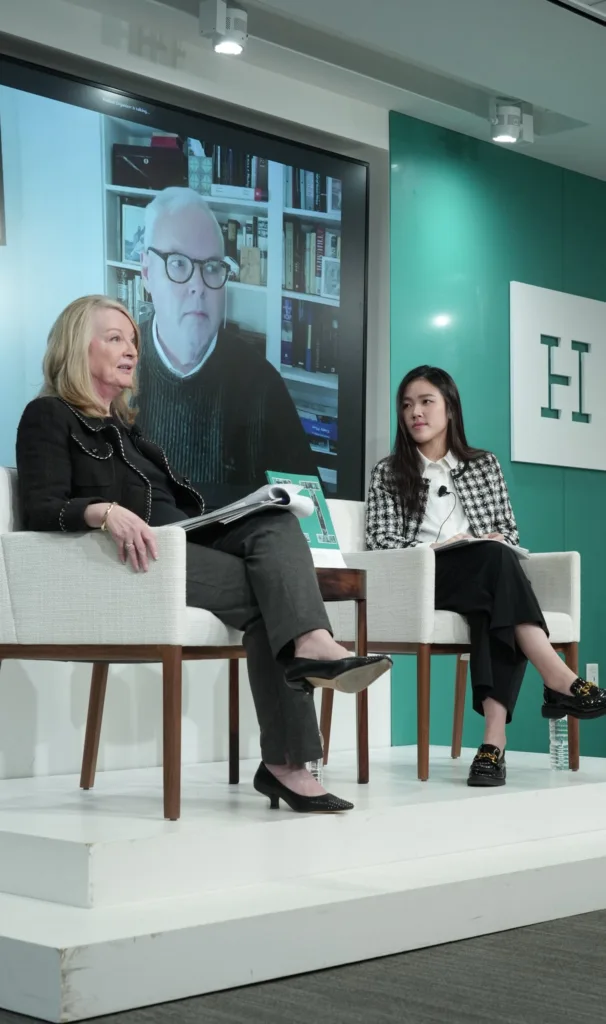
Amidst wars in Ukraine and Gaza, China’s activities in Hong Kong have not been as much in the spotlight of global news in recent months. During a recent Hudson Institute event, however, Senior Fellow and Director of the Center for Religious Freedom Nina Shea discussed the state of freedoms in Hong Kong with William McGurn of the Wall Street Journal and Frances Hui of The Committee for Freedom in Hong Kong Foundation. The conversation especially focused on Hong Kong businessman Jimmy Lai, imprisoned by the Chinese Communist Party (CCP). McGurn, a personal friend of Lai, described the businessman’s life and imprisonment; Hui, an activist originally from Hong Kong, provided context on the CCP’s activities in Hong Kong.
Shea began the discussion with an overview of recent Chinese activities in Hong Kong, noting the erosion of the freedoms of speech, assembly, association, religion, and due process in Hong Kong through the CCP’s 2020 National Security Law. Lai was charged and imprisoned under this law, now facing a court with a 100 percent conviction rate. Hui later described the law as “a very vaguely written law that applies to the whole civil society,” leading to censorship and rights violations.
McGurn then outlined the history of his friendship with Lai, which began in the 1990s. McGurn, working in Hong Kong for the Far Eastern Economic Review when they published a story on Lai’s chain of clothing stores marketed to the middle class, bonded with Lai over a shared love of Austrian economist Friedrich Hayek. McGurn and Lai’s wives also became close friends, and McGurn was involved in Lai’s conversion to Roman Catholicism in 1997. McGurn ashamedly admitted that he initially doubted the strength of Lai’s faith due to surrounding social pressures but noted that this strength became clear over time. This became especially evident from Lai’s letters to him from prison, McGurn said, showing a sketch of Christ on the cross on the back of one of these letters.
In addition to commenting on Lai’s loyalty to his faith, McGurn commented on Lai’s remarkable loyalty to his country: “He could have gone anywhere and saved himself, but he just wouldn’t do that. He always says ‘Hong Kong made me rich, gave me everything I am. How could I turn my back on it?’ Anyone who thought he might leave just doesn’t know the man.”
Hui then described how the National Security law affects religious freedom in Hong Kong, noting that many protesters in Hong Kong “included in their testimonies that their faith is what led them to be standing out in the streets and participating in social movement.” She also highlighted the arrests of Lai, Roman Catholic Cardinal Joseph Zen, and a Protestant pastor sentenced to 13 months in prison.
Hui also described how the National Security Law affects education, noting that it requires schools to include pro-CCP values in curriculum, even in religious classes. This is related to the CCP’s Sinicization policies, which “require religious groups to align with the party’s priorities and their socialist values.” Hui noted that though Sinicization has historically been pursued mostly in China, it is now a larger force in Hong Kong too, negatively impacting religious freedom.
“It’s important to remember China is an atheist regime, and the only reason that they’re keeping religions around is that they want to use them as a political tool,” Hui emphasized.
McGurn warned that religious freedom in Hong Kong could continue to get worse if the CCP increases its implementation of policies already in force in China. Shea concurred, commenting that the CCP’s Patriotic Church of China has refused to recognize some elements of Roman Catholic authority in Hong Kong. Hui noted that the Vatican’s approach to Hong Kong and China has been complex, but the Vatican has not been outspoken in its support of religious freedom in Hong Kong. McGurn called the Vatican’s approach to China “disastrous,” also expressing concern that a new Catholic bishop in China has not spoken out in support of Lai.
Shea highlighted that other religious groups in China have also been repressed, including Muslims and members of the Falun Gong religious movement. Hui noted that the latter has been highly critical of the CCP. She also suggested, however, that Catholics have been especially singled out by the CCP due to their social action.
Asked by Shea what the United States should do to support religious freedom in Hong Kong, McGurn commended the overall U.S. approach but suggested they highlight Lai’s unjust imprisonment whenever possible in negotiations with China. Responding to the same question, Hui highlighted China’s Article 23 legislation, which would restrict the role of foreign groups in Hong Kong, including the Roman Catholic Church. She suggested that the U.S. speak out against this likely impending law and be willing to leverage sanctions against China if necessary. Hui also suggested naming a Washington, DC street after Jimmy Lai to raise awareness for his situation and the broader plight of those fighting for freedom in Hong Kong.
As this conversation at the Hudson Institute revealed, the state of religious freedom in China is dire, and worsening in Hong Kong. It is imperative that both the United States and the Church do what it can to combat the CCP’s unjust and oppressive meddling in Hong Kong. And those of us with little political influence still have an obligation to fellow believers impacted by the CCP’s persecution: prayer.
No comments yet

Leave a Reply