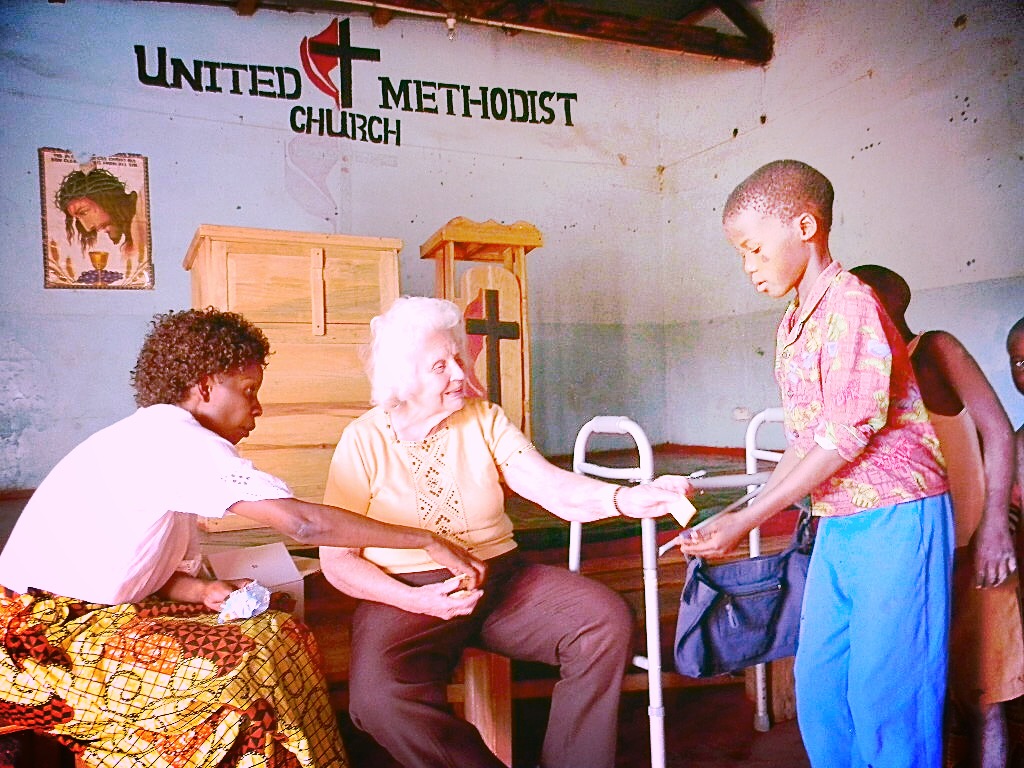

How is it going these days for Christian faith, both in America and in the world? In this series of articles I address this question by sharing personal experiences that grow out of my 69 years as a Methodist pastor. This article deals with the numerical decline of Christianity in North America and Europe but also with the rapid rise of Christianity in third world countries, especially in Sub-Sahara Africa.
I was appointed as a superintendent of the Marion District in Indiana in 1983. The denomination was getting serious in the fight against racism, sexism, ageism, and a few other “isms.” The National Council of Churches had just released its new Inclusive Language Lectionary, which was, as part of a larger strategy to rid hymns, church talk, Sunday school material, and, in this case, even the Bible, of “sexist” language.
This was not a decision discussed by local churches. It was imposed by denominational conferences and church leaders. The churches I served were not happy (although it was not that any of my rural churches were using lectionaries). All the same in seven of the first nine charge conferences I conducted, matters around imposed “inclusive” language became an issue. Instead of telling my people to get with the program (like my other district superintendent colleagues), I told them I would pass their concerns along. Which I did, at which point I was informed I should “get with the program.” I mention this only as an example of what I have often referred to as “the gap” between church leadership and ordinary church goers in the United Methodist Church.
Our North Indiana Conference was doing well in church vitality. In my district, an open country church, Hanfield, was growing and in a few years recorded an average weekly attendance of 960. Another open country church, Mt. Olive, counted 450. Another open country church just outside the district, Union Chapel, turned charismatic, moved near Muncie, and counted 874 in attendance. Another church, Granger, a new church started near the Michigan border, in less than 20 years had grown to 3,584 attendees, the largest in the jurisdiction and one of the five largest in the denomination.
Not one of these churches today is United Methodist. They were either among the group that disaffiliated or, in a couple of instances, simply left Methodism altogether.
All of the pastors of these churches (and some more) were identified with our Evangelical Fellowship, a group associated with the Good News movement, which sought to bring renewal into United Methodism.
Not all churches were or are thriving in our conference and throughout the denomination (as well as other mainline denominations) in America. Some of this—perhaps “much” of this—related to reactions to the new institutional directives related to gender, age, sexual inclusivity and understanding of family. I remember several instances at our General Conference where monitoring groups kept track of how language was used to make sure all language was “inclusive.” Some of the African delegates, especially those for whom English was a second language, were confused and in some instances offended. It did not help that several church officials (including at least one bishop) commented that it was time that the Africans “grew up” to be in tune with the modern world as far as matters like gender and human sexuality were concerned. Our church leadership was not communicating well, either in America or overseas.
In Kokomo, Indiana, where I once served and now reside, in 1971 there were 12 United Methodist churches. The combined average attendance of those 12 churches was 2,355. Twenty years later, in 1990, the churches still reported 1,822 in attendance. However, by 2024 five of the twelve churches had closed, four had disaffiliated, and only three were still United Methodist. The three churches still within the UMC reported only 280 total worshipers on an average Sunday.
During this period, renewal was taking place within a number of our overseas churches. Some churches in our area were supporting the Kafakumba Station and Training School (with locations in Congo and Zambia). This was mostly because the main missionaries had connections in North Indiana and with our district. The program, run independently of the Board of Global Ministries, called for ministerial families to live at the school for several weeks in the summer. Activities were scheduled for families while pastor fathers and mothers went to class. After eight or so years the pastors were trained and ready for ordination. The school was supported in large part by Indiana churches.
After a while, some of our churches had a vision that if American churches could raise enough money the whole program could be endowed. I am privileged to be a part of this Endowment Fund Committee. While a number of pastors had traveled to Africa to help with the teaching I have been the only pastor on the Endowment Committee. At the moment we are well over a million dollars on the way to two million. This is almost totally lay-led. On several occasions we have invited bishops and/or district superintendents to our fund-raising banquets. None have taken up our invitation.
By this time a high percentage of the pastors in Zambia and parts of Congo have been trained at Kafakumba. In addition, Kafakumba has initiated other service ministries. It now sponsors a school, a clinic and some business opportunities. These, in the past and in the present, have included bananas, fish hatcheries, goats, and bee keeping. These are among the reasons why the Church in Africa has grown so dramatically.
But a note for United Methodists and former United Methodists caught up in the issues of disaffiliation. Much of the present Methodist interest (as well as support, financial and otherwise) in places like Zambia, Zimbabwe, Congo, Nigeria and other sub-Sahara countries originates from Global Methodism and some disaffiliated but independent Methodist churches. Kafakumba is a good example.
Keep in mind that, from the Kafakumba perspective, the work there is United Methodist. The truth is that issues around disaffiliation have not all been worked out in Africa, as well as in other countries outside the United States. So, we pray and work for cooperation, compromise and understanding which comes from Spirit-led Christian unity.
How is it going these days for the Christian faith? We pray for a Spirit-led sense of cooperation and unity as we seek to build God’s Kingdom.
Riley B. Case is a retired United Methodist clergy member of the Indiana Conference.
More from IRD:
Monitoring and the New Morality within United Methodism


Comment by Glenn Wheeler on December 9, 2025 at 11:13 pm
Seek to build God’s kingdom?
That is a very liberal position, reminiscent of the liberalist Social Gospel movement.
The traditionalist view is that it is God Himself who “builds” the kingdom.
If you think you’re going to “build the kingdom,” you’re sadly mistaken. That is something that only God can bring about.
Comment by Jeffrey Walton on December 10, 2025 at 10:55 am
Glenn, I think you’re correct that is ultimately the case, but people can seek to be willing partners in God’s providence.
Comment by Skipper on December 10, 2025 at 7:28 pm
The United Methodists thought they were welcoming the world when they redefined marriage, when actually the worldly world has welcomed them.
Comment by David Gingrich on December 16, 2025 at 6:19 am
It’s not about you, Riley.
Comment by Different Steve on December 17, 2025 at 7:50 am
Final Verdict (ChatGPT):
This is a valuable testimonial essay that documents real institutional dynamics many church members experienced but rarely saw acknowledged. While it is not a comprehensive analysis of global Christianity’s trajectory, it is an important primary-source perspective on how decisions made at denominational levels can reverberate—sometimes destructively—at the congregational level.
Its greatest contribution is not statistical proof, but memory: a record of how decline and growth felt from inside the system, and why many ordinary churchgoers concluded that something essential had been lost along the way.
Comment by Cal on December 29, 2025 at 3:29 pm
The PCUSA church I used to attend made a huge deal about diversity, while maintaining a worship and preaching style that appealed only to elderly white liberals. You can guess how “diverse” was the congregation.