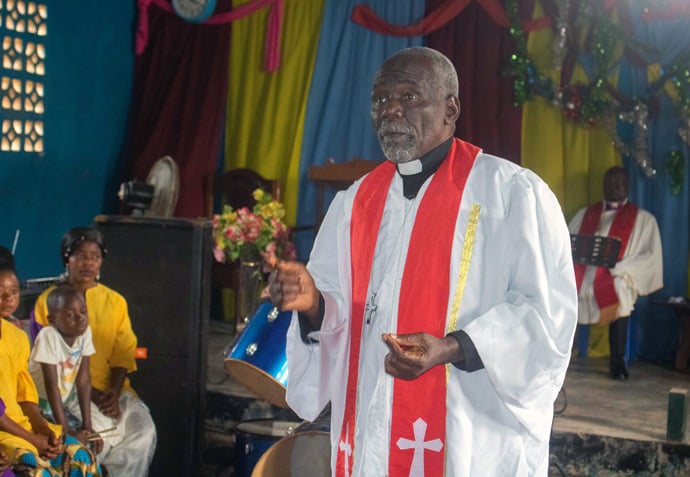

The numerical decline of Christianity in North America and Europe across recent decades corresponds with a rapid rise of Christianity in “third world” countries, especially in Sub-Sahara Africa.
For revivalistic Protestant groups, such as Methodists, the modern missionary movement began in the early 1800s. Camp meetings, revivals, and times of great spiritual renewal spread, especially across North America. For many of the revivalists this was accompanied by the belief in post-millennialism, the end-times view that the world (and society) would eventually be converted to Christ. This would lead to the prophesized kingdom on Earth and Christ’s thousand-year reign. The last great evil to be overcome—at least in America–was the system of slavery. This sentiment is expressed in the Civil War hymn, “Battle Hymn of the Republic”:
Mine eyes have seen the coming of the glory of the Lord; he is trampling out the vintage where the grapes of wrath are stored; he has loosed the fateful lightning of his terrible swift sword; his truth is marching on.
Unfortunately, the Civil War and the legal end of slavery did not bring about the hoped-for kingdom. This did not deter progressives from keeping the kingdom hope alive. What was not accomplished by revivalism could be accomplished by human betterment, socialism, the way of Christ, education, and democracy. The goal was a new society. World War I brought a dampening spirit to this vision, especially in Europe. In 1910 out of 21,000 foreign missionaries about 70 percent were European. By 1968 out of 45,000 foreign missionaries in the world only about 30 percent were European and most of the rest were American.
Theological modernism was the next big challenge for the missionary enterprise. In the view of modernists, “fundamentalist” missionaries (and most missionaries were very conservative theologically) who still believed in prayers for rain and that God created the world in seven days and that Christ was the only way to salvation, were scarcely more civilized than the superstitious third-world natives they were trying to convert. If there was value in mission work, it was in working with all religions to discover universal values and to conduct humanitarian work.
Despite all these challenges, mission operations in the 1920s, 30s, 40s and 50s continued in their traditional ways: win people to Christ and establish institutions such as schools and hospitals to advance Christ’s kingdom. In 1938, even in the midst of the depression, Methodist Episcopal Church missionaries numbered 1,453, second only to the Presbyterians.
By 1960 the number of Methodist foreign missionaries had increased to 1,742—more than any other denominational group. This can be compared to the present number of about 300 United Methodist missionaries. In 1956 the Board of Missions of the Methodist Church at an interfield consultation of missionaries at Epworth-by-the-sea declared that missions and evangelism are one.
This emphasis underwent radical change in the 1960s. “Death of God” theology, growing criticism of the church’s complicity in societal racism, growing independence movements leading to an intense criticism of what was considered European and American imperialism—all this led to accusations that institutional Christianity was irrelevant and outdated. The future was with revolutionary movements.
The denominational merger of Methodists and Evangelical United Brethren created not just a new denomination but also structural changes. The quota system mandated:
Not less than 20 percent of the total membership of each board shall be under 35 years of age, with not less than 10 percent between the ages of 25 and 34, nor less than 5 percent between the ages of 19 and 25, and not less than 5 percent 18 years of age or under at the time of election. Among the at-large members of each board, it is recommended that there be no less than two of each of the following: Asian Americans, blacks, Hispanic Americans and Indian Americans.
Did this bring about a more diverse church? The answer is no. Today United Methodist Church membership within the United States remains over 92 percent white. Compare this with the Assemblies of God at only 60 percent white. United Methodists have a membership older than any other denomination except for Presbyterians and Missouri Synod Lutherans.
All the same, the 1960s, 70s and 80s were wonderful times to be a Methodist (and United Methodist) pastor. Much of the programming — at least in our North Indiana Conference – was district-based. I remember district church camps, missionary banquets, lay witness missions, family life conferences, and ministers’ banquets. Our senior high church camps would include a missionary-in-residence. At one of these, Epworth Forest was the name of our church grounds, one of the missionaries, Ken Enright, in the early 1960s, was so enthused by the week’s experience, that he announced he was going to carry the idea to the Congo, where he served. What developed from that, after many adaptations, was what today is the Kafakumba Training School (the subsequent article in this series will feature the story of this school).
Meanwhile, liberation theology, and an obsession with Marxism as a system to bring about justice in the world, more and more dominated United Methodist mission philosophy. Traditional missionaries, especially those interested in evangelism, were decreasingly recruited and sent to the field. This, in turn, generated some push-back from local churches and districts.
When John Enright, son of Ken and Lorraine Enright, who grew up in Congo and spoke five different African dialects, completed seminary, was pastoring, and was accepted for missionary service but not being deployed, his district superintendent, L. G. Sapp, approached the board for an explanation. A lack of money was the excuse. Sapp gathered funds from local churches and sent a check for the first year’s salary to the board with these instructions: This is to put John Enright on the field. If he is not on the field in six months, this check is to be forwarded to World Gospel Mission.
Enright was sent to the Congo.
When I was a superintendent, Ken Vance, a pastor in the district, who wanted to work with the Enrights, was approved for service but not deployed. Our cabinet wanted to re-appoint him, but I said no because he would soon be in the Congo (which was not happening). I finally made a number of phone calls to New York asking for some straight answers. Ken and Debbie, his wife, were soon on the field. When I asked some staff members why the controversy over Ken Enright. One reply was, “Because he is a Lone Ranger.” A few years later a number of evangelical missionaries, all of whom were serving in Africa, had their relationship severed from the board. This included John and Lorraine Enright, the younger John Enright, Ken and Debbie Vance, Harold Amstutz, and Lowell Wertz. This, however, did not mean these missionaries returned to the states. Churches continued to give support and the missionaries continued their work under the authority of the African bishops. While this was happening, United Methodist Churches in Africa flourished. John Enright stated in one missionary letter they had started 50 new churches in the last year in the district he was relating to.
These comments are meant to illustrate the thesis that even though American churches are in a period of decline, God has been raising up churches in other places. In 1968 the United Methodist Church was 11 million members strong, almost all of whom were in America. Today, the church still can speak of 11 million members, but only 4 million of these professing members are in America. Others are mostly within sub-Sahara Africa.
These churches are thriving not because of strategies conceived by persons in high places in America but because of churches and individuals in America supporting indigenous efforts.
Much of this—and this is also a thesis of these articles—is because the theologies driving the work are evangelical and/or charismatic and/or Pentecostal. At this point it is tempting to speak of issues around disaffiliation. Let it be said that these issues have not yet been fully dealt with in Africa. The growth in many places in Africa is within churches that remain affiliated with the United Methodist Church. Meanwhile, much of the American support is from persons associated with the Global Methodist Church.
This leads to a plea. Can we work together? More in the next article in this series.
Riley B. Case is a retired United Methodist clergy member of the Indiana Conference.
More from IRD:
Inaugural Tennent Annual Lecture on World Christianity
Envisioning the Next Methodism in Africa
Global South Archived Articles




Comment by David on November 19, 2025 at 8:51 am
Africans can believe too much and accept pre scientific notions such as witchcraft. Recently a Nigerian official complained that their national soccer team lost because the opposing team from Congo was using voodoo spells. Generally, this is a credulous population.
Comment by Qohelet on November 19, 2025 at 9:27 am
David half of Americans think guns make us safer despite us being an outlier in violent crime compared to every other industrialized nation. So don’t pretend it’s just Africans who are susceptible to believing nonsense.
Comment by Different Steve on November 19, 2025 at 5:52 pm
That kind of comment is designed purely to provoke you. It’s not meant to be accurate, fair, or even coherent — it’s bait.
A few things you can do that usually help keep your sanity:
1. Recognize the tactic
They’re doing a bait-and-switch comparison plus a moral jab. The goal is to lump you in with a group they can insult, so you’ll get emotional and argue. Once you see the tactic, it loses most of its power.
2. Don’t correct what isn’t meant to be corrected
People who post stuff like that are not trying to reach truth. They’re trying to win reactions. Facts won’t matter, nuance won’t matter, and context won’t matter. You’re playing their game if you bite.
3. Decide whether the space is worth the energy
Some comment sections are basically troll farms; they reward inflammatory behavior. If Juicy Ecumenism consistently draws that type of user, it may be healthier to treat it like background noise.
4. If you respond at all, keep it flat and boring
Trolls hate boredom. Something like:
> “You’re making broad assumptions that don’t relate to what I said.”
No moral argument, no counter-stats, no fuel. They usually move on.
5. Or the healthiest option: don’t engage
You owe nothing to someone who isn’t speaking in good faith.
Comment by Cal on November 19, 2025 at 9:08 pm
White liberals have largely abandoned orthodox Christianity, so I consider it a movement of the Spirit that Africans and others have taken up the mantle. “Thanks for the effort, mate, we’ll take it from here”.