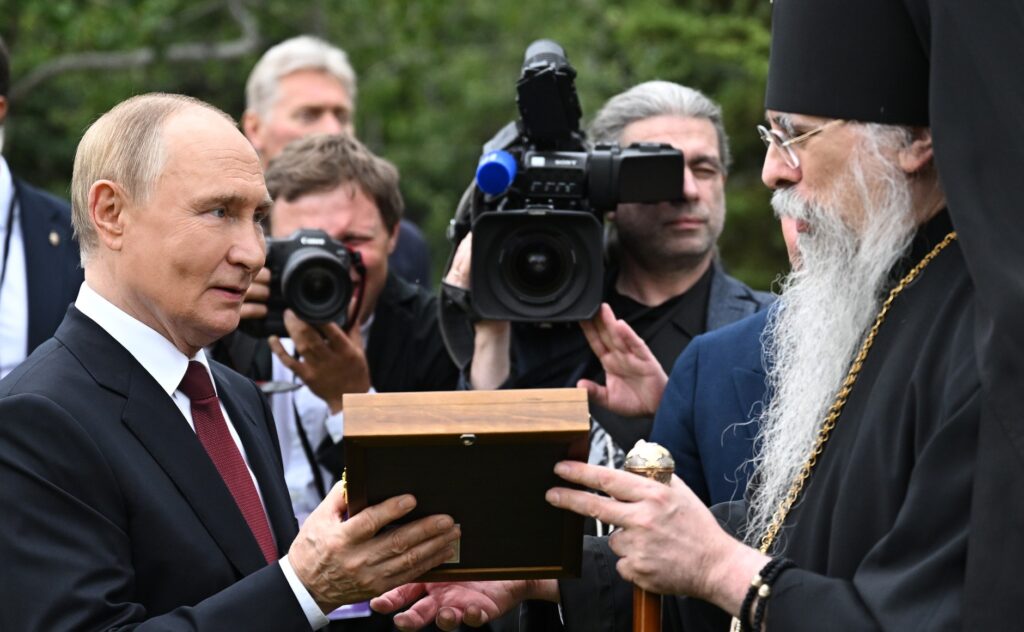
After the much-awaited Alaska summit between President Trump and Vladimir Putin, the Russian president visited the graves of Soviet aviators and met with Bishop Alexei Trader of Sitka and Alaska, head of the Orthodox Church in America’s Alaskan diocese. During their meeting, Bishop Alexei thanked Putin, saying, “Russia has given us what’s most precious of all, which is the Orthodox faith, and we are forever grateful.” He added that when his clergy travel to Russia, “they say, I’ve been home.” The encounter closed with Bishop Alexei presenting Putin an icon of St. Herman of Alaska, Russian missionary and Orthodox patron saint of North America.
The meeting drew immediate fire from America’s Ukrainian churches. The Ukrainian Orthodox hierarchy released a statement titled The Betrayal of Christian Witness in Welcoming a Tyrant and Dictator, accusing Bishop Alexei of “the cowardice of appeasement” and of moral blindness. Metropolitan Borys, leader of Ukrainian Catholics in the United States, condemned what he called the “red-carpet welcome” of a “genocidal war criminal—who speaks openly about his plans to re-conquer the countries that freed themselves from the Soviet yoke.”
Bishop Alexei quickly apologized, admitting he had failed both to clear the meeting with his superiors and demand… peace amid ongoing conflict and suffering.” His apology, however, was met with derision by some Orthodox laypeople, who felt he had backtracked and caved to political pressure to denounce who they see as the leader of the Christian world.
That defense of Putin is not confined to isolated lay voices. The American Orthodox landscape has seen its share of open Russophilia, from the priest Joseph Gleason, who moved his family from Illinois to Russia and now edits a site devoted to praising Putin’s Christian leadership, to the defrocking of Sister Vassa, a nun whose criticism of Moscow provoked sharp backlash from pro-Kremlin Orthodox. The same impulse appears in Sarah Riccardi-Swartz’s Between Heaven and Russia, which chronicles Appalachian converts who look to Putin’s Russia as a spiritual refuge from liberal America.
Such currents of admiration for Russia highlight a deeper contradiction in American Orthodoxy. Like Catholicism in its immigrant days, Orthodoxy in the United States has long been tied to ethnic identity. Just as Irish, Italian, and Polish Catholics imported into their religion fondness for their homelands, the primarily Russian founders of the Orthodox Church in America have done the same. Yet the OCA was created as an American church, meant to plant Orthodoxy in native soil. It is the only denomination to count a Native Alaskan, St. Peter the Aleut, among its saints. It adapts traditions for American life, suspending the Nativity fast for Thanksgiving, and has twice been led by converts, including the current primate, Metropolitan Tikhon.
The OCA, and American Orthodox churches more broadly, have been strained by the pull between filial loyalty to their coreligionists in Russia and respect for the liberal democratic values that drive American support for Ukraine. Yet the Russian Orthodox tradition itself offers a precedent for how to live faithfully even when at odds with one’s mother church in wartime. In 1904, St. Nicholas of Japan, a Russian missionary in Tokyo, found himself ministering as war broke out between Russia and Japan. Though privately supportive of the Russian cause, he held that, as an Orthodox Christian in Japan, it was his responsibility to pray publicly for the Japanese side. His friend and translator, Pavel Nakai, even composed liturgical materials to ask God’s blessing on the Japanese army against their fellow Russians.
America is not at war with Russia, but the principle remains: a church whose faith comes from abroad must learn to be at home in its own country. The OCA, since its 1970 founding, has always aspired to be such a church. Yet in recent years, some Orthodox Americans have been drawn to an idealized vision of Russia as a spiritual counterweight to decadent liberal democracy, an allure that complicates the project of an authentically American Orthodoxy.
The Alaska meeting and its fallout is not simply a passing episode but a reminder of the crossroads facing Orthodox Americans. Their task is to root Orthodoxy in a liberal, pluralistic, and republican order at home, while shunning the authoritarian temptations of foreign powers that vie for their loyalty. The strength of American Orthodoxy will lie not in false visions of piety abroad, but in the faith and freedom it learns to cultivate here.
More from IRD:
Moscow is not the New Jerusalem
Can it Really Happen Here? Review of Dreher’s ‘Live Not by Lies’
The Rhythm of Surrender: The Art of Fasting



Comment by Glenn Wheeler on September 4, 2025 at 7:51 pm
Let’s rewrite this article and replace Russia with “Israel” and Orthodox with “Evangelicals.”
Comment by Thomas on September 4, 2025 at 9:36 pm
How come the Orthodox Church in America can praise a machiavellian ruler, who takes the pro-abortion stance, and has the Russian Orthodox Church under his control? Not to mention that the war in Ukraine is the greatest tragedy of the 21st century, so far.
Comment by Salvatore Anthony Luiso on September 5, 2025 at 11:54 am
I’m not particularly concerned if American Orthodox churches are not pulled by “the liberal democratic values that drive American support for Ukraine”.
I am very concerned if their loyalty to Russia and to Putin is greater than their loyalty to God and His word.
Comment by Glenn Wheeler on September 5, 2025 at 9:43 pm
The Democrats hate Russia. The Republicans hate China. The neocons are all in for any bombing anywhere.
The politics of the author are evident.
But I forgot…they are also Jesus’ politics.
Comment by Konnor Porter on September 8, 2025 at 7:13 pm
Small note: ROCOR also glorifies Peter the Aleut as a Saint. I know this well, as the ROCOR parish I go to is dedicated to him (and only Saints get that privilege).
Comment by Konnor Porter on September 8, 2025 at 7:27 pm
I think what draws respect or admiration for Russia is not what its current state is, as it has all the unsavory aspects of a secular post-communism society, but the ideal of Orthodox Russia, or the “Russky Mir”, that Putin is at least aligned with, if not pushing. That of becoming faithful to legacy of Orthodox saints, martyrs, rulers, and communities from Russia’s past. This is easier for a zealous American Orthodox Christian to hold on to than an ideal for an Orthodox America, as on the one hand many people have received their faith through the Russian tradition, and on the other hand there is great difficulty in determining what the ideal of an Orthodox America would even be. Even though some may confuse Russky Mir for modern Russia, it does nothing to weaken the goodness and longing that are the driving force for it.
Comment by David Gingrich on September 9, 2025 at 7:52 am
I have been to Sitka several times. The Russian heritage in the town is strong. The church is highly Russian-influenced. These are not sins. They are normal human behavior. We should forgive the bishop and move on.
Comment by samuel on September 9, 2025 at 10:18 am
Kirill’s moral and spiritual corruption is evident to all. He services Putin similar to how the Russian Orthodox church served Stalin, and how the whore of Babylon serves the kings of the earth, Rev. 17. Kirill has fully supported Putin’s war in needlessly murdering tens of thousands of Ukrainian civilians.
I cannot fathom how any true Christian would give his money, time, or allegiance to this great evil. No human organization is perfect, but when church leaders cheer on cruelty and the killing of innocent it’s time to leave that org.
Comment by Glenn Wheeler on September 10, 2025 at 7:49 pm
Well then Samuel, I guess you’ve left conservative evangelicalism because they have been cheering on cruelty and the killing of innocents by Israel for decades.
Comment by Kealani L Smith on September 11, 2025 at 8:44 pm
How often is it that an indigenous people thank their colonizers? Truly, Alaskan Orthodox can thank Russia for the faith and for the behavior and moral choices of its missionaries. Missionaries who preserved language, who supported families and communities without removing children to re-education “boarding schools”. Alaskan Orthodox pray for all world leaders and for peace for every country. Bishop Alexei is my Bishop, my Vladyka & I thank him and praise him for delivering the message of his people and for the grace with which he handled this moment of global hospitality.