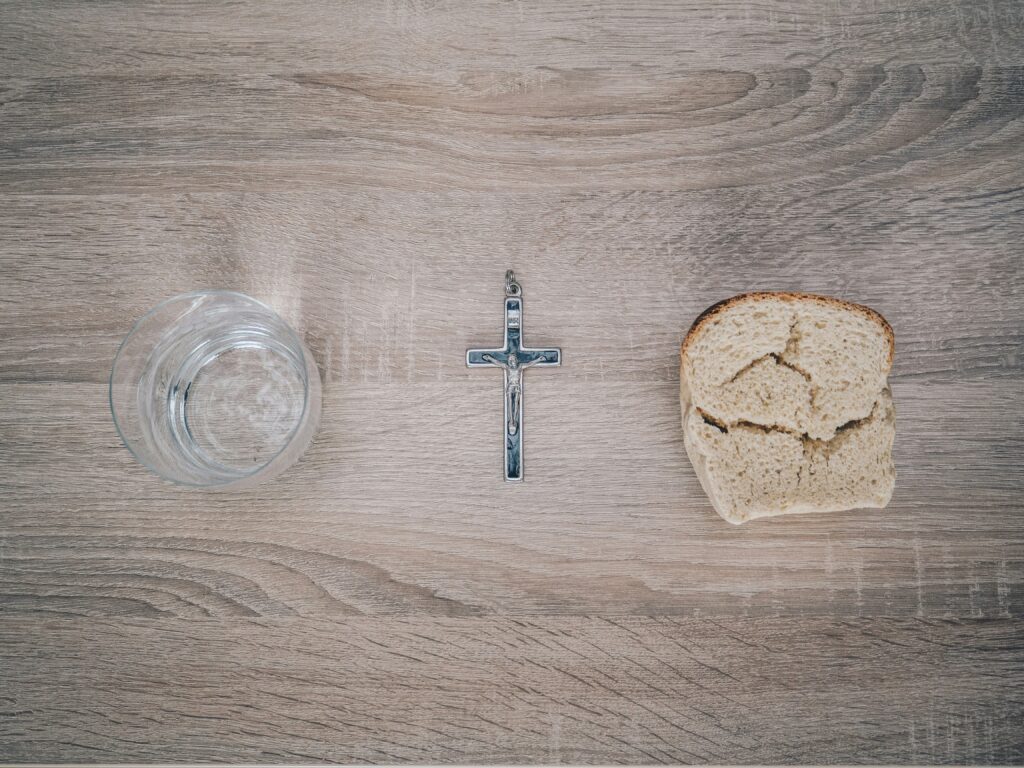

Fasting is arguably among the most ancient and universal of spiritual practices. Across cultures and religions, it serves as a means of restoration by way of stepping back from excess and reordering our desires.
In Islam one of the Five Pillars known as Sawm refers to fasting during Ramadan, which is meant to cultivate empathy, obedience, and self-restraint. In Judaism, fasts like Yom Kippur mark a solemn return to God through repentance (Teshuvah). In Buddhism and Hinduism, fasting serves as a path to discipline that aids in purifying the body for the sake of awakening the mind. Even within the broader scope of Christianity, fasting takes many forms: from the structured abstinence of Catholic Lent to the spontaneous fasts of evangelical Protestant devotion.
The Orthodox Christian tradition, however, offers a distinct and sacramental perspective on the matter. As understood and taught by the Church fathers, fasting is not a spiritual technique for self-improvement, it is about surrendering. It is not chosen at will, but commanded by God and the ability to partake in a fast is received as a gift. One of the most profound cases of fasting in The Old Testament is found with Moses and his encounter with God on Mount Sinai. It was there that the scripture tells us that, “he was there with the Lord forty days and forty nights; he neither ate bread nor drank water” (Exodus 34:28). And his sacrifice and obedience was rewarded with the gift of communing with God and bestowing humanity with the gift of God’s direct commandments.
This encounter with God on Sinai reveals the essence of true fasting, that it is not a pursuit of personal power, but a posture of reverent surrender. Moses did not fast to elevate himself, he fasted in the name of obedience. His abstinence was not self-directed, but God-ordained, and it bore fruit only because it was rooted in obedience and humility. This distinction is crucial because, as with many things we attempt in this fallen state, if we fast to serve our own desires, whether for control, pride, or even spiritual achievement, we have already failed. The Church Fathers warn that fasting without humility is no fast at all; it is a hidden indulgence, cloaked in the appearance of piety.
And scripture speaks directly to this distortion. In Isaiah 58, the prophet is instructed by God to rebuke those who fast outwardly while harboring violence and pride: “Your fasting ends in quarreling and strife, and in striking each other with wicked fists. You cannot fast as you do today and expect your voice to be heard on high.” This is a call to the reverence and integrity one must have for the fast. The fast must reach beyond the stomach. It must transform how we speak, how we act, and ultimately, how we love.
Christ echoes this in the Gospel saying, “When you fast, do not be like the hypocrites… but anoint your head and wash your face, so that your fasting may not be seen by others but by your Father who is in secret.” (Matthew 6:16–18). Emphasizing not only the fact that fasting is required but that the fast is not a means of gaining spiritual status, but one of losing it, so that grace may enter.
To fast correctly is to empty oneself, not for personal gain, but to make space for God. It is a quiet refusal to be ruled by appetite, ego, or ambition. It is a way of saying: I will not fast for myself. I will fast to be free of myself.
Though it may sound obscure, this method of surrender isn’t abstract, it is completely grounded in reality. In the Orthodox tradition, fasting moves with the natural life cycle, not against it. Great Lent begins in late winter, when the earth is quiet and bare, and ends in spring, when everything begins to bloom again. The body, too, responds to this rhythm. After months of heaviness and indulgence, the body welcomes a reset in the letting go of rich foods and distractions.
And it’s not just seasonal. Orthodox Christians fast every Wednesday and Friday, week after week, year after year. These aren’t just habits, they’re acts of remembrance. Wednesday recalls the betrayal of Christ, and Friday His crucifixion. To fast on these days is to carry those moments in the body, to let them shape how we move through the week.
This rhythm teaches us that fasting isn’t a break from life. It’s a way of deepening it. It’s how we learn to live with less, to listen more closely, and to make room for grace.
And this harmony is not merely symbolic, it is physiological. Studies have shown that regular fasting, such as that practiced in the Orthodox tradition, can lead to a healthier immune system, lower cholesterol, and enhanced metabolic function. When the body is given space to rest from constant consumption, it begins to heal. Inflammation decreases, insulin sensitivity improves, and the digestive system resets. Fasting also promotes detoxification, allowing the body to clear out accumulated toxins which restores balance. These benefits are, of course, not the goal of the fast but just some of the fruit it bears.
But the healing is not only physical. In the scriptures, Christ Himself rebuked the disciples for their lack of ability to cast out a demon from a severely sick man.
“Then the disciples came to Jesus privately and said, “Why could we not cast it out?” So Jesus said to them, “Because of your unbelief; for assuredly, I say to you, if you have faith as a mustard seed, you will say to this mountain, ‘Move from here to there,’ and it will move; and nothing will be impossible for you. However, this kind does not go out except by prayer and fasting.” (Matthew 17:19-20) this teaches that fasting is not an accessory to prayer; it’s an amplifier. St. John of Chrysostom notes that the banishment of demons requires faith (v. 20), prayer, and fasting (v. 21) and without all three, there is no physical healing and no victory in spiritual warfare. It is the essence of surrendering that prepares the soul to receive divine power. There are many burdens, wounds, and evils that cannot be cast out by our effort alone. They require the kind of spiritual clarity and humility that only prayer and fasting together can cultivate.
Altogether, these benefits of fasting are not coincidental. They reflect a deeper truth: that the body and soul are not separate domains, they work together as one. And when the body is quieted, the soul can listen. When the body is cleansed, the heart can open. Fasting becomes a way of preparing the whole person physically, emotionally, and spiritually for communion, healing, and transformation in Christ.
In this way, it is clear that the Orthodox way of fasting is not simply a discipline to add onto life but a way of being. It draws the believer into harmony with the Church and with the mystery of Christ’s death and resurrection. In a world driven by consumption and noise, fasting offers a sacred alternative: a life attuned to surrender, and to the slow work of transformation. It teaches us not only how to abstain, but how to receive. Not only how to die, but how to live in Christ.
Lauren Knights is a graduate student pursuing a Master’s degree in Anthropology, with a focus on religion, governance, and public life, at Harvard University. As an Orthodox Christian, she is particularly interested in examining how faith shapes political systems and policy decisions, and how those dynamics influence questions of human rights, education, and peacebuilding. Follow her on Substack here.
More from IRD:
The Suffering Church and a Prayer Contagion
Christianity Birthed Tolerance?
Who are the Middle Eastern Christians? – A Simple Guide for the Western Church




Comment by Wilson R. on September 4, 2025 at 1:00 pm
No discussion of fasting is complete without Isaiah 58. Thank you for including that!