Richard Bradford, director of the Swiss branch of the L’Abri Fellowship, spoke at the annual L’Abri Conference in Rochester Minnesota on February 15 concerning the continuing crisis of meaning in the contemporary West. He began with a quote from Nieztsche: “He whose life has a why, can bear almost any how.”
Bradford referred to a Harvard study of young adults, ages 18-25. It showed that 36% of the respondents suffered from anxiety, while 29% suffered from depression. The most frequently cited cause for distress was “a lack of meaning and purpose.” The madhouse which is public consciousness today was cited as an additional reason, in such factors as “social media, rising tension in the world, political polarization, increased pressure on young people,” etc. But the “lack of meaning” was held by the report’s authors to be the reason that “a large proportion of the population” is “struggling.” Such a cause is more difficult to address than the other causes specific to our time.
Bradford quoted another source from the National Library of Medicine which said that “experiencing meaningfulness is based on a validation of one’s life as coherent, significant, directed, and belonging. A positive appraisal of these components occurs mostly unconsciously, while a perceived lack meaning in life occurs consciously, and is known as a crisis of meaning.” Bradford agreed that meaning in one’s life is noted mainly by its absence. “Depression, suicidal thoughts … heightened anxiety, negative affect, and pessimism … and decreased resilience, motivation, and life satisfaction, hope, self-regulation, and self-efficacy.” This all “results in questioning life’s purpose.”
While a lack of meaning is a problem, there also seems to be an unlimited number of meanings on offer in the contemporary world. This may be contributing to the lack of meaning. However, Bradford looked at some specific reasons for the lack of meaning. God and creation were the framework for meaning in the pre-modern world, but from the Enlightenment on, things began to change.
The Enlightenment and Disenchantment
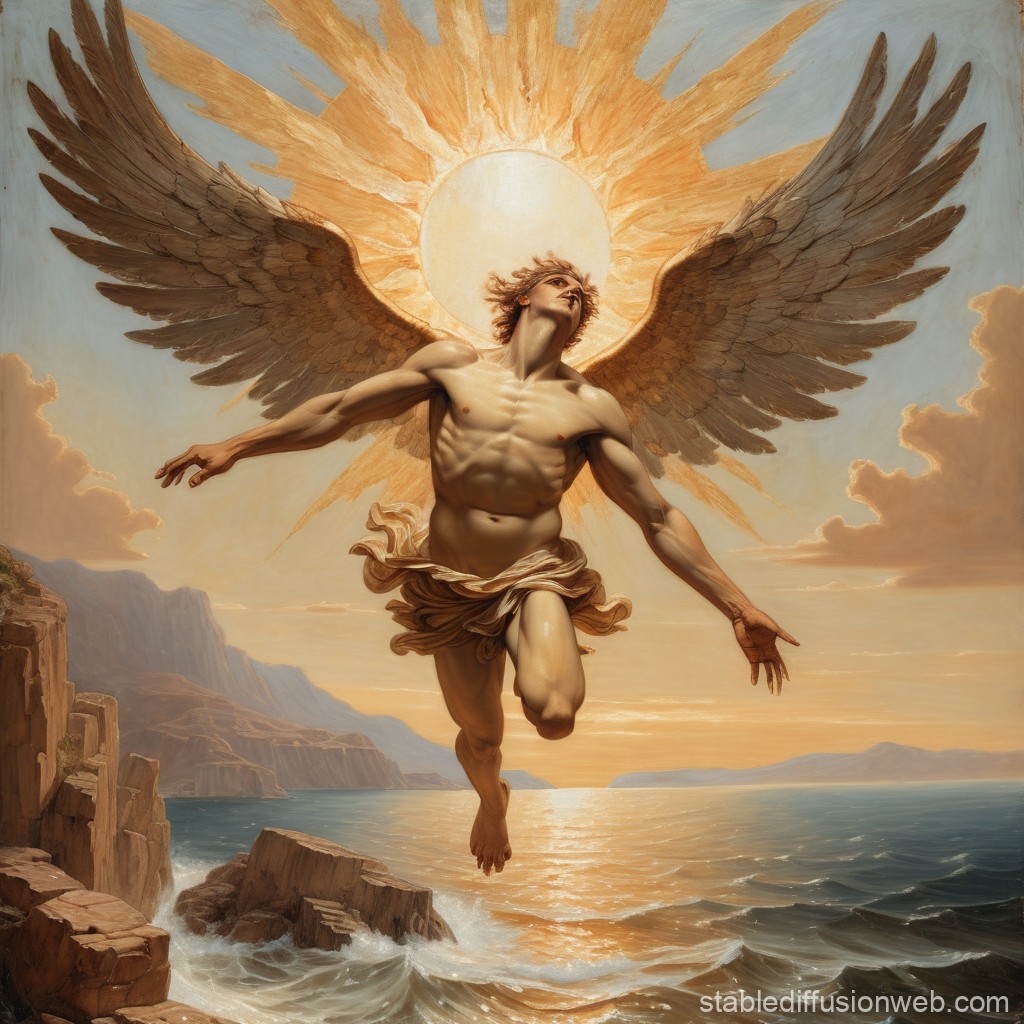
Bradford referred to a book by the French Catholic author Chantel Delsol, Icarus Fallen: the Search for Meaning in an Uncertain World. The story of Icarus comes from Greco-Roman mythology and refers to a man who wanted to free himself from the labyrinth of Crete, and so he flew on a pair of wax wings toward the sun, which he had been warned not to do. The wings melted, and he crashed to earth. In Delsol’s book, Icarus survives the crash, although very badly injured. He then had the problem of returning to ordinary life after having failed to reach the sun. People today, she said, are “in a similar situation.” The attempt at “radically transforming ourselves and society” has failed, and we must return to ordinary life. The radical transformation was promised by modernity, with “war, disease, need, and perhaps even death” eliminated. But the horrors of the twentieth century (and indeed, continuing into the twenty-first) have disabused people of this prospect. The events humanity has experienced, Delsol maintains, make it analogous to a man with whom someone has “thrown him into the game without giving him the rules. When he asked for instructions, he is invariably told that they have been lost. He is amazed that everyone is content to live in a world without meaning, and without identity, where no one seems to know why he lives or why he dies.” Bradford said that she maintains that “the major discovery of modernity consists in affirming that man invented transcendence, morality, and politics.” This is “the disenchantment of the universe.”
He referred next to the Canadian philosopher Charles Taylor, who spoke of “horizons of significance.” These are “objective sources of meaning and morality that exist independent of one’s own will or the satisfaction of personal desires.” Taylor said that “we’re born into a cosmos which requires individuals to search out and understand their position in a broader order.” Taylor believes that “moral frameworks … are inescapable.” Even the claim to authenticity, if it has no external framework, “is left utterly unsupported.” Everyone needs direction in his or her life, and only a moral framework can provide this. To step outside this damages or destroys personal integrity. Without the moral framework, one cannot make judgments about oneself or one’s environment, as there is nothing to compare them to.
The Conflict Between Meaning and Freedom
To be absolute and thus reliable, the standards one uses must have a “transcendent source,” which modernity denies. Nevertheless, people are not willing to be bound by standards outside themselves. In particular, they do not want “to be structured by religious meaning.” The Enlightenment ideals of “reason, freedom, equality, and progress” are held to give value to life. But today, Bradford said, all values are “up for grabs,” and “open to interpretation.” Institutions (church, state, universities, etc.) are held to have failed people. Delsol maintains, however, “that to have meaning is to stand for something other than one’s self.” Bradford added that if our values are simply something we prefer, then “they lose any moral or existential weight.” Meaning must refer to “something outside ourselves.”
The search for meaning in the contemporary world is bounded by the need for an external basis for morality, Bradford maintained, but also by the insistence not to be bound by external constraints. Any public agreement on an external truth results in that truth being imposed on people who disagree, and this has “always has ended badly.” Truth, after all, is held to be simply created by people. Yet we must have standards for life. We need morality, but people have no agreement on “what it is based on.” Delsol holds that leaves people with two choices: 1) return to traditional religion, institutions, and beliefs, or 2) rethink anthropology. We then attempt to understand good and evil apart from the old institutions. Bradford does not believe that these are the only two choices. He importantly does not think that the true church is identical with the visible church. He also asked if we can build a new anthropology “without reference to God.” Morality simply cannot be maintained without reference to a transcendent reality.
Delsol says that there is a “further confusion” that results from rejecting truth “when we’re still faced with moral imperatives.” Moral imperatives, in the contemporary world result from the recognition of evil, which is held to be real, without any moral goods. Each person decides what is good for himself or herself, but evil is held to be objective. But objective evil necessitates an objective good. Delsol said that the rejection of doctrinal or ideological truth by intuition results in 1) “the fear of truth,” and 2) “the redeployment of a new imperative through the intuition of objective evil.” The “new morality, which is seen as an absolute morality, must prevent but not bind. So it must prevent evil, but allow for any subjective expression and understanding of good.” This is how people try to reconcile the objective reality of evil with a subjective doctrine of good, “by erecting barriers that protect us from the unacceptable, while still allowing us to choose our own good.”
But Delsol finds “a certain dishonesty in designating evil but not good. By saying that something is evil, we’re inferring that something else is good. So in saying that murder is evil, what we’re saying is life is good. But in acknowledging that something is good, then we’re also inferring an obligation, which places limits on my freedom. So to denounce evil is to identify a good under attack. So to identify an objective evil is to acknowledge an objective good, but to identify an objective good implies obligation, which again impinges on my freedom.” Bradford believes Delsol’s proposed new anthropology independent of Christianity is weak and does not resolve the problem of morality. What her dilemma shows, he believes, is an example of Charles Taylor’s point that the modern world’s “moral horizons” have disappeared, then re-appeared “without justification, and without content.” People have been left “unmoored” from the source of morality, and thus from the source of life.
The New Atheism and the Crisis of Meaning
Bradford then considered how Delsol’s dilemma worked out with the “New Atheism.” Bradford said that what made the New Atheism new was its claim that religion is evil and should be “eradicated … especially in the public arena.” This was, perhaps, new to the West, but it is hardly new. Communist dictatorships attempted the same thing in the twentieth century. Justin Brierly’s book (together with N.T. Wright), The Surprising Rebirth of Belief in God, traces the history of the New Atheism “from its inception to its demise.” Conflict among its followers contributed to its demise, but the main cause was the realization that the ideal the New Atheism was seeking to advance, which was Western liberalism, could not be supported by atheism. Values of merely human origin “lack any moral weight.”
Bradford then discussed a onetime supporter of the New Atheism, Ayaan Hirsi Ali. A Somali who emigrated to the Netherlands to escapes a forced marriage, she converted to Christianity in 2023, claiming “that secularism poses the greatest threats to the West,” Bradford said. Citing Ross Douthat, he said Ali had a “two-fold” reason for her conversion. First, atheistic materialism cannot support Western liberalism, where such things as “human rights, freedom, and equality before the law are taken for granted.” These values cannot be sustained on a non-transcendent basis. Secondly, while atheism dissolves the obligations of traditional religion, life without spiritual “solace” is “unendurable.”
Secular Advocates of Christianity
Bradford then turned to non-religious thinkers today who are nonetheless supportive of Christian faith because of its personal and social utility. Two of these are Jordan Peterson and Tom Holland. Peterson was a professor of psychology at the University of Toronto. He gained public attention for his opposition to bill C-16 in the Canadian Parliament, which required the use of preferred (really false) pronouns for people identifying with the opposite sex. The New York Times referred to him as “the most influential thinker in the Western world.” He claims to have “a deep appreciation for the [Christian] faith, and for the Bible in particular.” His Twelve Rules for Life “helps people find meaning in the everyday” and “attempts to lead people back to … the true, the beautiful, and the good., i.e., God.” Bradford said that Clarke Scheibe of the Canadian branch of L’Abri has found that young men particularly are claiming interest in the Christian faith after having read Jordan Peterson.
British historian Tom Holland challenges the common belief that Western liberal values “are a product of the Enlightenment,” replacing Christianity. He says to the contrary that the values of freedom and human dignity are the result of Christianity. “We’ve cut these values off from their source.” Bradford quoted British Evangelist Glen Scrivner as saying “we’re all standing on the Bible hurling verses at each other, we’ve just forgotten the references.” But Holland is not sure that Christianity is at all true.
The Need for a Transcendent Basis for Morality
Thus we have values, but no adequate secular basis for them. Can we say that Western liberal values “are self-evident,” Bradford asked. Bradford quoted from the famous “madman” passage in Nietzche’s Gay Science, in which a madman tells his fellow atheists that all things have come unhinged without God, and they do not understand the implications of a world without God. Modern people “no longer see ourselves as part of some larger cosmic order.” This, then, made “possible the meaninglessness … described by Nietzsche. We come to see the world as an object which we the subject stand against and try to understand and control.” Bradford said that this nihilism “goes hand in hand with the scientific view of the world. We become disengaged from this wider world that surrounds us.”
People in this circumstance “are drawn to causes whether it’s the environment, social justice issues, poverty, women’s rights, political causes, identity politics … All of these things purport to offer us meaning.” In the commercial world, advertising does the same.
A major reason for the disorientation and disenchantment, Bradford believes, is “the inward turn.” We seek meaning within ourselves, rather than in external reality. This has led to “expressive individualism,” in which meaning is a “private matter.” He quoted the famous “mystery clause” from the (now overturned) Casey v. Planned Parenthood decision (1992), in which Supreme Court Associate Justice Anthony Kennedy said that “at the heart of liberty is the right to determine one’s own concept of existence, of meaning, of the universe, and of the mystery of human life.” While “we’re told to care about justice, love … there seems to be no strong ground narrative to support these things.” We have many more moral demands than any other time in history, but “what grounds these values?” Bradford noted that Charles Taylor has said that wherever “we believe these values come from, we necessarily treat them as though they are good, independent of ourselves.”
Bradford said that the crisis of meaning is not unique to unbelievers. Christians today also suffer “from a lack of meaning.” Nevertheless, “Christianity offers a very clear narrative about reality, where we come from, and where we’re going.” This is the salvation history of creation, fall, redemption, and consummation. Jesus “mysteriously bore the consequences of all our failures, bringing salvation to the whole world … each person is now invited to step into a future that is defined by the hope of his resurrection and the new world to come.”
It was further observed that everyone has “an innate sense that something is wrong in our world, and that includes a sense that something is wrong with ourselves … Christianity tells us who we are in relation to each other, to creation, and God. And this world view provides us with meaning, and purpose, and hope that we will one day arrive” at the new creation. For many people today, however, the “world feels aimless, purposeless, and as Nietzsche said, unchained from its sun. There’s no moral center.”
Neither Tom Holland nor Jordan Peterson seem concerned about the truth of Christianity. Without Christianity being true, “doesn’t this leave us exactly where we were before? For many people, their renewed interest in Christianity seems to be about its utility, rather than about its truth … Something that is untrue can motivate us for a while but just treating it as true isn’t enough.”
Bradford said that he was not offering an argument for or proof of Christianity but pointing to why there is renewed interest in Christianity. “We need to acknowledge that the church has failed in the past, it’s misused its truth claims, and people have very good reason to be suspicious. But in a cultural moment in which people are desperately longing for meaning, I think Christianity has a unique opportunity to speak up and be heard, but I also think we need to be speaking about its truth rather than simply its utility, and this needs to be done in love and humility.”
More from IRD:
Attacking Biblical Morality to the Same Tune
Secularization and Political Polarization – Part 1
Secularization and Political Polarization – Part 2


Comment by Fr. Dale Coleman on May 3, 2025 at 2:32 pm
Excellent piece. Roger Scruton’s work of exactly this recognition of the toxic nature of secularism, say in his Gifford lectures, “The Face of God”, is fascinating. Tom Holland, married to Ayaan Hirsi Ali, is now a Christian, and he is frequently on You tube communicating this. Peterson has announced his Christian commitment.
Comment by Bryant Poythress on May 6, 2025 at 1:26 am
Rick,
Thank you for the excellent reporting on this. How long overdue and unfortunate it is that only through the world’s troubles do we finally (begin to) realize the incredible, inestimable beauty of the gospel and the unwavering solidity of truth only revealed in God’s word. Let’s rejoice, fill our hearts and minds and share it with the starving and broken neighbors the Lord puts in our path.
… so that Christ may dwell in your hearts through faith; and that you, being rooted and grounded in love, may be able to comprehend with all the saints what is the breadth and length and height and depth, and to know the love of Christ which surpasses knowledge, that you may be filled up to all the fullness of God. Eph 3:17–19