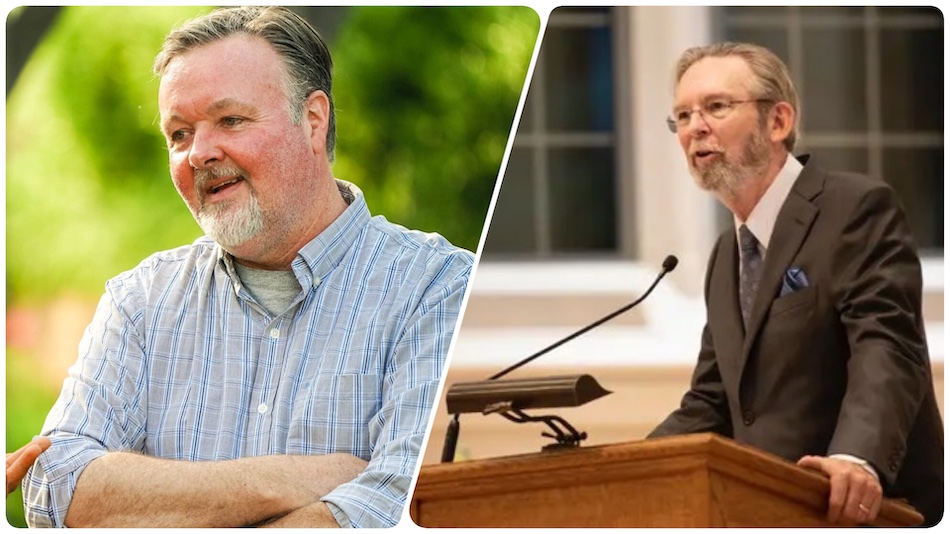

Mark Ryan, Adjunct Professor of Religion and Culture at Covenant Theological Seminary in St. Louis, Missouri, and formerly Director of the Francis A. Schaeffer Institute spoke on the recently published (2024) book by Richard and Christopher Hays, The Widening of God’s Mercy: Sexuality within the Biblical Story, at the annual L’Abri Conference in Rochester, Minnesota on February 15.
The book by the father and son, both theology professors at United Methodist-affiliated Duke Divinity School and Fuller Theological Seminary respectively, retracts the claim of the elder Hays, (Richard Hays) earlier work, The Moral Vision of the New Testament (1996), that Biblical morality precludes homosexual practice. Hays, who passed away shortly after publication, did not retract the claim of the earlier work that Biblical texts taken against homosexuality do in fact condemn it, but claims that, as on other topics, the God of the Bible has changed his mind, in this case about homosexuality, in the interests of love and mercy. Richard Hays’ place in the neo-Anabaptist movement of the late twentieth and early twenty-first centuries was reviewed in an article last year by IRD President Mark Tooley, along with his change of mind on homosexuality to be explained in his yet unpublished book.
Ryan began by referring to correspondence of Francis Schaeffer with European Christians in 1968. Responding to a European pastor, he said that homosexuality: is becoming more common, and there are two mistakes Christians can make regarding it. On the one hand, we must avoid the relativism of saying that “homosexual practice is not wrong.” The other mistake is to think that “same sex tendencies are sin in themselves even if there is no same-sex practice.” Schaeffer believed that this means that the person with same-sex tendencies “is pushed out” of orthodox churches even if they do not engage in homosexual practice. He said that this “is both cruel and wrong.” Ryan said that many Christians are still inclined to fall into one of these two mistakes. He believes that these mistakes are “pertinent” in responding to the Hayses’ book.
The Nature of the Book
In reviewing the book Ryan said that we should notice three things about the it. First, it is a book of theology that “adds its voice to current ecclesial debates.” It takes “self-conscious aim at those who understand themselves as defenders of the Christian tradition.” It is aware of current academic literature, “as well as various debates within denominational bodies.” It is not a neutral book, but concludes that “many religious conservatives … are wrong about the most essential point of theology, the character of God.” Defending traditional sexual morality is “profoundly toxic” the authors believe. It hurts people, so we should accept homosexuality, and “move on in peace and harmony.” Ryan thinks while the book “desires a way forward beyond the rancor of debate and disagreement,” it is nonetheless “strident, and ill-suited to achieving its invitation.”
Secondly, the book “is a work of hermeneutics.” But although it endeavors to provide a good hermeneutic, the authors say that “repetitive arguments” about how to read Biblical passages that condemn homosexuality are “superficial and boring.” The authors seek to find a way to read the Bible’s narrative and ethical teachings in regard to homosexuality without homosexually inclined persons having “the burden of leading celibate lives.” Requiring celibacy is held to be “unviable, untenable.”
Thirdly, “much of the attention this volume has gained, together with much of its appeal derives” from the importance of the earlier book The Moral Vision of the New Testament: a Contemporary Introduction to New Testament Ethics (1996), which was considered a landmark. The new book, The Widening of God’s Mercy, “is an explanation of why the elder Hays [Richard] has changed his mind.” While maintaining that his treatment of homosexuality in the earlier text “still seems correct,” Richard Hays proposes to “re-envision how God means us to think and act today with regard to human sexuality.” In Ryan’s view, however, Christopher Hays “seems to be the principal author” of the new work.
Ryan observed that Richard Hays holds that while “the texts [against homosexuality] mean what they say, but we cannot deploy or use or live in light of those texts today.” Ryan further observed that having abandoned a strict hermeneutic of the Biblical text, many writers now enlist the Bible against traditional teaching on human sexuality. He said that after having read the book “thoroughly twice, I have now laid it down, disappointed at almost every level.”
Analysis of the Book
Ryan acknowledges both authors’ theological publications and accomplishments, saying that they “are not lightweights.” But he said that despite the book’s subtitle “Sexuality within the Biblical Story,” the book “does not grapple with the sweep of the Bible’s witness concerning human sexuality.” The authors trace “a trajectory of mercy” through both testaments, but “inexplicably, indefensibly they do not trace a marriage trajectory. Neither do they present any evidence that the sexual norms relative to homosexuality are relaxed.” This passing over the sexuality and marriage trajectories in the Bible is remarkable, especially since the authors explicitly decided not to treat the Biblical texts condemnatory of homosexuality.
The argument the authors do present is that God “repeatedly changes his mind, in ways that expand the spheres of his love, and that those who do not conform to traditional expectations to sexual orientation should be the next to be explicitly included.” The book, then, focuses on mercy as the key in addressing contemporary debates on sexuality.
Part 1 of the book “focuses on the widening of God’s mercy in the Old Testament, exploring the character of God, especially his expansive and gracious love, and God’s propensity to change his mind … Furthermore, faithfulness to God means sometimes doing the same.” It’s clear then, that the authors are suggesting that traditional believers are morally obligated to accept changed sexual standards.
In Part 2, concerning the New Testament, “we are asked to consider Jesus as the one who upsets people because his teachings and actions penetrate to the heart of Israel’s scriptures and disclose a generous, unsettling vision of God’s mercy. We’re also asked to ponder how might the gospel stories of Jesus’s convention altering words and actions affect our thinking about norms for sexual behavior.” Jesus’s treatment of the Sabbath, his calling of Matthew the tax collector, and the mercy he extended to “foreigners and outsiders” is held to indicate that Christians should think “more broadly” about same-sex attracted persons. Later, chapter 12 concerns the Holy Spirit, chapter 13 with Paul’s conversion, chapter 14 with God’s command to Peter to accept the gentile convert Cornelius, chapter 15 with the Jerusalem council that established minimal requirements rather than the whole Jewish law for gentile followers of Christ, and chapter 16 on Paul’s ministry among the churches. He said that these chapters are “some of the best chapters of the book.” Ryan thinks that the reasoning in these other chapters “is mostly sound, and well expressed.” But he said that despite this, and regardless of “a most tenuous connection to matters of human sexuality, this material is also claimed, and made to advance the call, for today’s church to open its doors fully” not only to homosexually inclined persons but to non-celibate homosexuals. Ryan called this “a grand example of a non-sequitur.”
Part 3 is the book’s concluding part, and “focuses on the present day.” It includes two chapters. Chapter 17 “doubles down on a vision of God who changes his mind and who expects that we do the same … the many Biblical stories of God’s widening mercy invite us to re-envision how God means us to think and act today with regard to human sexuality. The Biblical narratives throughout the Old and New Testaments trace a trajectory of mercy that lead us to welcome sexual minorities no longer as strangers and aliens, but as fellow citizens with the saints, also as members of God’s household.”
In his epilogue, Richard Hays “addresses what he wrote about homosexuality in his previous book.” Typical of public figures who renounce their earlier defenses of Biblical sexual morality, he expresses sorrow “at the impact of his earlier work.” He does not, however, change his claims about the meaning of Biblical texts regarding homosexuality, explicitly saying that these texts do mean what they say. He simply, in Ryan’s words, has changed his mind “about the livability of these texts in our cultural moment.” Living as the Bible teaches is “simply not acceptable,” Ryan summarized. His chief argument “seems to be the wounds that conservatives have caused by taking up his writings, taking up his chapters, and using them to justify, or to promote a more conservative vision.”
Evaluation
Ryan found the book “shallow” and “strained,” especially the Old Testament section. He said that the authors’ depiction of God seems “highly problematic to me, a clear departure the historic global church’s reading of Scripture.” He referred to the review of Hans Madueme, Professor of Theological Studies at Covenant College has provided helpful guidance in understanding the Hayses’ work. Madueme has “given more time and attention to Schaeffer’s second peril.” (Excluding those struggling with homosexuality). Madueme said in particular;
“My review has been largely critical. But a big question remains. Why do books like this keep being published? Here I think traditionalists like me need to face up to our own shortcomings. Many Christians who struggle with same-sex desires often feel marginalized, hurt, or deeply disappointed by local churches. I have dear brothers and sisters in Christ who steadfastly mortify the sin of same-sex desires, shaming me as I stumble through my own sin. I have witnessed them sacrifice their longings for a partner because they see Jesus and eternal life with him as more beautiful than any sinful, temporal relationship this world might offer. Traditional Christians must do more than just criticize revisionists. That bar is too low. We should be known for our doctrinal orthodoxy, and for loving people who struggle in this area.”
Ryan then listed his admonitions to faithful Christians regarding the current challenge of homosexuality (and presumably other orientations on the LGBT spectrum):
- “Let us hold fast the confession of our hope without wavering” (Heb 10:23). Despite pressures from the wider culture or from revisionists like the book’s authors, we must hold to “the Biblical and historical consensus: that sex properly belong within marriage, and that marriage is a monogamous union of male and of female.” This, he said, should be “our baseline as congregations.” There is a place for scholarship, Ryan said. It must “touch texts, and trajectories and themes.” But there is no place “for the kind of scholarship that simply overturns what the Bible has long and clearly taught, especially when it won’t engage the actual texts.”
- “Welcome all towards Jesus as he makes himself known in the gospel of grace.” We should maintain a traditional position on sexual morality out of love, “to compellingly invite all persons on an equal basis to Jesus Christ.” We are invited to Jesus “within the fellowship of the church.” This, he said, “is the same path for all believers.”
- “We must honor marriage and celibacy.” Churches [and] homes “ought to be deliberate about forming disciples of Jesus.” For many decades, traditional Christians simply assumed Biblical sexual morality. But effectively, they stopped teaching it. Sexual morality, he said, was whispered if it was mentioned. Especially, many stopped teaching it to their children and grandchildren. “Their sexual lives were left undiscipled.” People therefore moved into “sexual malpractice.” Making disciples means we must “warn and critique,” but positively, we must present “a compelling vision of intimacy, sex, celibacy, and marriage … We must teach one another to honor marriage and celibacy.”
- “Be patient in hope.” Some will testify to God’s grace in leading them to a changed sexual orientation, but “not everyone will.” Churches should not demand a change in orientation “as the entry point” to the congregation.
- “Be gentle in discipline … Welcome is not exclusive of exercising discipline in cases of serious sexual sin …We should exercise discipline as Jesus teaches, and according to the heart of Jesus.” It should be “with gentleness and humility, not with glee and hubris.” The point of church discipline is the spiritual restoration of the errant believer. Seek to avoid hurt as much as possible.
- “Bear one another’s burdens.” Be attentive to the unique challenges same-sex attracted persons face, and do not ignore the gifts that a same-sex attracted person might offer. “Truth and love are drumbeats of Christians,” he said.
Questions
A questioner asked about the use of preferred (really false) pronouns. Ryan said that traditional Christians disagree in this area. Some maintain that use of correct pronouns is needed for clarity, others maintain that this is an area “where we can bend and flex,” in order to maintain relationships with those we love. Ryan said that he falls “somewhere in the middle … the Bible makes no explicit, specific pronouncements,” and yet, he said, “the Biblical framework would encourage us to be clear about God’s making us male and female.” In working with non-Christians or same-sex attracted Christians “I tend to ask them what is their preference. I am reasonably happy to let them name themselves” But in “teaching or advocacy,” he feels we should “move towards greater clarity” to the Bible’s teaching “that we are male and female.” He said that “I’m on the side of wanting greater clarity.” In this way he tries to move people toward the Biblical and biological understanding that sex is either male or female, and is known from our bodies.
Another questioner said that balancing truth and love is “a tightrope.” She further observed that it is not loving to tell falsehoods. Ryan said that he did not think that the use of false pronouns is “where the heat of the battle is.” He said that the times we live in are difficult because “the frameworks of discourse have changed.” It’s important to gain a hearing, and help people “consider what is true and loving.”
A question concerned how to respond to “loving, monogamous same-sex couples” (with whom the questioner had interacted considerably over the years) and how God feels about these relationships in light of God’s love. She professed to be “in the messy middle.” Ryan responded that he was not convinced that there are exceptions to the Pauline prohibitions against homosexual activity, including any exceptions for committed, monogamous, homosexual relationships. The marriage trajectory in Scripture, in both testaments, is always male/female partnership. “There is not just the trajectory of mercy … The marriage trajectory is constant, from creation to new creation. Marriage is always one man and one woman.” This is a matter of “degrees of sin.” He asked “is something God has prohibited better, if we practice it in a more constant, faithful way? … part of being Biblically committed … [is] wrestling with those we disagree with, not shutting them out.”
The conversion of Rosaria Butterfield (a former lesbian English professor at Syracuse University, turned confessional Christian) was discussed. Ryan said that her case shows how a congregation that was willing to faithfully and lovingly engage an LGBT identifying person may bring such a person to saving faith. Such a conversion is not necessarily to be expected, but what “is normative is the church’s posture. That congregation did not let go of its Biblical convictions, but it did exhibit welcome and love, and it sought to bring the gospel to bear over time in relationship so that Rosaria could experience hearing, weighing, beginning, and continuing to be changed by the gospel within the life of a faithful community.”
Also examined was the logic of the Hayses’ argument, and in particular, where it would naturally lead beyond the world of LGBT issues. Also, what examples did the book’s authors give of God changing his mind? Regarding the first concern, if homosexual behavior is not sinful because we have a natural longing for sexual engagement, are unmarried opposite-sex attracted people entitled as a matter of God’s love to engage in sexual activity outside of marriage if they cannot find a person willing to marry them? Ryan said that the questioner’s inference was correct. “Throughout the book, the implications are that the larger [Biblical] sexual tradition is wrong.” According to the authors’ argument, if God changes his mind on homosexuality, then reasonably he could change his mind regarding the requirement of marriage for opposite-sex attracted people. Indeed, the Hayses said they expect that “morality will change again.” Ryan said that where the culture determines morality, “all bets are off.”
The examples given in the book of God changing his mind are first slavery, which, Ryan said, the Bible begins to understand as wrong, and is now understood to be completely wrong. Secondly, the inclusion of gentiles in the family of God, which is explicitly mentioned in the New Testament. “These are the two chief trajectories of mercy.” The third trajectory is supposed to be the acceptance of same-sex practice.
But citing Sesame Street, Ryan said that one of these things is not like the other two. “With the gentiles, God began with creation, and his intention was always to include.” In God’s plan, he focused on Israel, but his objective was always the salvation of mankind. “It’s not a change of mind.” Slavery, he said, “is not taught in the Old Testament … it is regulated by Mosaic Law, but it is not part of God’s creational ordinance or his plans for how to treat his people. Like divorce, it is a concession to fallen human conduct.” But legitimate sexual practice is always recognized in Scripture as “male and female in a covenant of marriage. That was true in creation. That was true in the Abrahamic covenant. That was true under Moses. It’s true – Jesus is explicit in re-affirming that teaching – there is no adjustment, expansion, change.” The Hayses’ argument is “a bad set of arguments … If we want to trace the trajectory when it comes to sexual practice, it narrows. Moses allowed certain concessions for hardness of heart [i.e., divorce], Jesus takes us back to the created order, and doubles down on what God initially said. And Jesus and Paul are explicit in the New Testament about sexual practices that are prohibited. There is no lack of clarity here, not in the Bible’s testimony.”
Exactly what should be repented of in the area of sexuality, it was asked. (This was likely in view of lack clarity in certain areas, such as, according to Ryan, the use of false pronouns). Ryan said we should repent of sexual acts that are forbidden in Scripture (such as acts of adultery).
Conclusion
Mark Ryan’s long and careful discussion of The Widening of God’s Mercy clearly indicates that no new argument against the Biblical condemnation of homosexuality is being offered. It is the same argument that God’s love overrides all other considerations, in particular, God’s holiness. When God changes his mind is apparently determined, as Ryan pointed out, by the wider culture. The world, in this way of thinking, takes the place of God. The Bible’s clear teaching that painful obedience may be required, as seen in Abraham’s willingness to sacrifice his son, Daniel’s three friends and the fiery furnace, and Jesus’ reference of the narrow, painful way to life are left behind.
Richard and Christopher Hays are right that the conflict comes down to disagreement about God’s nature. Whatever he might be in their view – which unavoidably involves that he made a mistake about homosexuality (and presumably, transgenderism) – he is not the eternal, perfect being taught in the Bible.
More from IRD:
Richard Hays, Neo-Anabaptism, War & Sex
Richard Hays & Neo-Anabaptist Retreat



Comment by Pudentiana on March 31, 2025 at 6:06 pm
Those who are intimately acquainted with Scripture through the leading of the Holy Spirit have such a love and honor for the character of God, they would not want to change Him. He did begin with creating them male and female and command them to be fruitful and multiply. This is contrary to the homosexual practice affirmed by Richard Hays and his son. It is very sad.
Comment by David on April 1, 2025 at 8:57 am
“God, so atrocious in the Old Testament, so attractive in the New–the Jekyl and Hyde of sacred romance.” — Mark Twain
The god of the Hebrew scriptures is quite different from that of the Christian writings. In the first, we find things like hereditary punishment for sins of ancestors, approval of genocide and slavery, none of which seem very just in today’s world. The notion of an afterlife is rejected (Job 7:7-10 and Job 14:1-15). The Lord is “one,” not a trinity.
A more general question is whether God makes mistakes. He is assumed to be omniscient yet expresses unhappiness with the way things turned out. We see this in the the days of Noah when he regretted making man (Genesis 6:6-7). Then he regretted making Saul king (1 Samuel 15:11). We know that literally 99.9% of known species have gone extinct after being seen to be “good” and “blessed.” A third of the angels either went or will go bad as well (Revelation 12:3–4)..
The mention of being made male or female brings up memories of a very sad case in the genetics lab where I worked. A couple came in for infertility. The wife from all external appearances, including genitalia, was a normal female. Yet, the chromosome results revealed the patient to be an XY male with the extremely rare condition of androgen insensitivity. The notion that each human conception is a divine act quickly creates theological problems when confronted with genetic disorders.
Comment by Corvus Corax on April 1, 2025 at 11:12 am
The sexual ethic presented in the Old and New Testaments is unchanged. If anything, the perceived contrast in demeanor between OT God and NT God should render His consistency in this domain all the more profound.
The sexual mores of our civilization began changing rapidly about sixty years ago, “between the end of the Chatterley ban and the Beatles’ first LP” as Larkin noted.
The suggestion that God also changed His mind sometime in the 1960s, alongside simultaneous declines in religious participation, is not credible. The alternative hypothesis–people began reading their political motives into the theology–is obvious.
Comment by Ken MacAlister on April 1, 2025 at 1:10 pm
Those constantly making excuses for why certain sins should be celebrated instead of repented of & turned away from need to learn what the word immutable means in relation to God. The whole argument of God changing His mind becomes a moot point when people truly understand what the immutability of God is, not to mention His holiness. The God of the Old Testament is no different from the God of the New Testament. God is immutable. He doesn’t change. Should the church treat those dealing with sexual sin differently than anyone else? No. The life of Rosaria Butterfield is a testament to what loving sinners as they with God’s help deal with their sin. Should the church celebrate & in fact encourage any sinner to continue in their sin? No. This is not why Jesus builds His church. Celebrating & encouraging sinful lifestyles by the church tears the church apart. One need only look at today’s mainline denominations for proof of this. Oh, and David, God never makes mistakes. We do, This is what makes Jesus’ fulfillment of The Father’s plan of salvation the wondrous gift to us it is. It is NOT a license to continue in our old ways, but a gift of a new life we don’t deserve, but are gifted with because of Jesus, not because of anything we’ve done. God will never change regarding sin. He’s instead in the business of changing us if you let Him.
Comment by Wilson R. on April 1, 2025 at 5:06 pm
It’s hard to make an argument that God’s declaration on a subject never changes, because scripture is full of examples to the contrary.
God announces that creation is good, and then a few chapters later wipes out most of it on account of evil.
God announces that he will wipe out his chosen people and make a new nation out of Moses and his descendants, until Moses talks him out of it.
God orders genocide against the inhabitants of Canaan, and later declares that nations will study war no more.
God prohibits eunuchs from entering the Temple, and then reverses course in Isaiah.
God declares certain foods to be unclean, and then tells Peter that is no longer true.
One possibility here is that God’s mind changed on all of these topics. But that is damaging to the view that God’s eternal plan was fixed from the beginning.
Another possibility is that human beings misunderstood God’s will and then wrote those misunderstandings–such as the commandments to commit genocide and stone rebellious children–into scripture. But this view undercuts the belief that scripture is inerrant. And it raises the question whether, if humans misunderstood God’s will on one particular subject, they may have misunderstood it on others.
This is why I believe we should weigh individual scriptures against the full weight of scripture and view individual passages through the lens of a God, as revealed in Jesus, who is about love, mercy, faith, and justice.
Comment by Jason Fry on April 1, 2025 at 5:46 pm
One thing I wish Ryan would have commented on is the presence of plural marriage in the OT (in my view not really sanctioned or affirmed, but tolerated nontheless) and the clear teaching of monogamy in the NT. I would have loved to hear his thoughts on that.
Comment by Thomas on April 2, 2025 at 5:53 pm
God`s concept for marriage and human sexuality are the same in the Old Testament and the New Testament. If you think Jesus was wrong when He stated that they are only possible in the sacred union of a man and a woman in marriage, you are you deep trouble!
Comment by Rick Plasterer on April 2, 2025 at 6:59 pm
WilsonR,
If we believe that God is omniscient, then it must be that God knew in advance when and how he would change his mind. In the often cited case of Moses persuading God not to destroy the Israelites, God knew how the Israelites would provoke him, what he would (sincerely) threaten to do to them, how Moses would respond, and how he would respond to Moses.
Regarding male homosexuality, the Bible is consistent and fierce from beginning to end. Against the “few verses” argument, these condemnations come at critical points in the Bible: at the beginning of Israelite history (i.e., Sodom and Gomorrah), in the holiness code of Leviticus, at the beginning of Romans (really the only systematic theology in the New Testament, and there presented as the epitome of sin) in I Corinthians (and the concern for immorality in that church), in a pastoral epistle (and the concern for pastoring Christians), and in the epistle of Jude (where the gospel is declared to be final).
And all this is set in the larger Biblical sexual ethic, which is not only restrictive and condemnatory by contemporary standards, but, as Mark Ryan pointed out, becomes more restrictive in the New Testament.
Female homosexuality is mentioned once, in Rom 1:26. Although I think it’s primarily directed at opposite-sex oral and rectal intercourse, it certainly applies to lesbianism, particularly given the Bible’s larger sexual ethic.
If God really does change his mind, then it’s inescapable that he is not omniscient and really does make mistakes, contrary to the clear teaching of Scripture, such as the verse I cited from James at the end of this article. All professed Christians believe love is a high virtue, according to Scripture. To justify homosexuality, one must also say that what the Bible presents as justice regarding homosexuality is wrong. And if so, the guide to discerning God’s change of mind in the contemporary world is the larger secular culture, as Ryan said. In fact, one wonders what those who hold such a view of God really believe he is. The term God seems suspiciously like the collective consciousness of the people (the right people, of course, whoever they are).
And so I really do think that those who continue to assert the Biblical and traditional sexual ethic which is unchangeable hold the only consistent Biblical position.
Rick
Comment by Tim Ware on April 2, 2025 at 10:52 pm
In reply to David’s comment…
It is quite obvious that, whatever the entity is that is active in much of the Old Testament, it is not the God revealed in the New Testament. Perhaps it is a rogue sub-divinity, or perhaps something else, but in any case, they are not the same. A number of ancient Christians recognized that, but their voices were silenced.
Comment by Wilson R. on April 3, 2025 at 12:03 pm
Rick, I appreciate your response. Is God omniscient? Does God have the entire chess game played out in advance, knowing what we will do in response to God and what God then will do in response to us? To the former question I am not afraid to say, “I don’t know,” and I’m wary of Christians who have ready answers for every cosmic question. To the latter question, I will say I am doubtful. If God has planned every moment of our individual lives and collective history in advance, then God is on the hook for the suffering of innocents, and that doesn’t sound to me like the God revealed through the life and witness of Jesus Christ.
I am more of the opinion that God brought the world into existence, made us in God’s image (thereby establishing the moral order of the world as well as the physical order), but gave us the freedom to rebel against that moral order, which we promptly did. Whether this surprised God or not I cannot profess to know (I will ask directly when we meet). But human salvation history for me is a story of God trying to restore the original relationship with human beings. Jesus’ own parable of the wicked tenants is a pretty good summary of this history of God’s attempts try different approaches. First, the owner of the vineyard sets the rules. When the tenants break the rules, the owner sends messengers to warn them. When that doesn’t work, the owner tries again. When that doesn’t work, the owner decides to send his son, thinking surely the tenants will listen to him. That to me sounds like a God who is actively engaged in our lives but not controlling and not necessarily anticipating everything humans will do, but rather always working THROUGH human behavior to try and bring about good.
Comment by Dan on April 4, 2025 at 5:32 pm
All is vanity. There is nothing new under the sun. This book is just the current version of “Did God really say …”