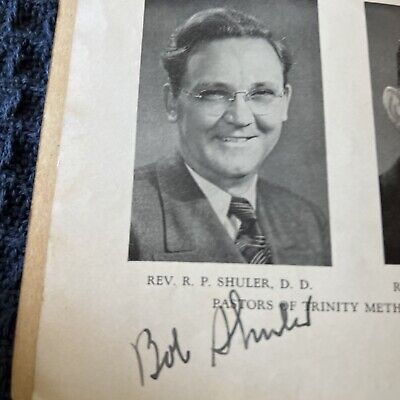

It was a surprise to find that my great-great grandmother in southwest Virginia mentored a famous early 20th century Methodist preacher radio broadcaster, R. P. “Fighting Bob” Shuler of Trinity Methodist Church in Los Angeles.
In the 1920s, Shuler competed with fellow radio preacher Aimee Semple McPherson, the flamboyant Pentecostal celebrity whom he often denounced. Shuler’s fame was such that in the 1920s, young Richard Nixon and his brothers were brought to his church by his Methodist father. (Nixon was raised Quaker by his mother.) In 1923, Shuler even spoke at Nixon’s Quaker church in Whittier, California.
“’Fighting Bob’ operates the most controversial religious radio station of all time,” wrote the disapproving Los Angeles Times. “Politicians fear him, criminals avoid him, newspapers deplore him, and many ministers criticize him.”
In a 1955 book Shuler wrote at age 75, he recalled as a young man in the 1890s that my great-great grandmother had become a sort of surrogate mother after his own mother’s death. My ancestor was, he recalled, the most active woman in the church that his father pastored. She encouraged him in his faith, and he continued to visit her in her later years. She lived until age 96, dying in 1953.
Shuler was born into poverty. His father yearned to be a minister and went to school when in his 30s, while young Shuler sold newspapers, and his mother sold meals. With the prayers of my ancestor, Shuler himself was licensed as a Methodist preacher at age 17. He later went to the same school as his father and became a feisty Methodist minister in southwest Virginia and east Tennessee. Later he moved to Texas. His rambunctious preaching won attention, but his outspoken opposition to all alcohol won him opposition.
Sometimes Shuler was physically attacked, to which he responded with vigorous self-defense. Many churches refused to accept him because of his stance against booze. He was unintimidated. His bishop, perhaps to dispose of him, sent him to a debt-ridden struggling church in Los Angeles.
This move, in 1920 to a large city, already a media center, whatever the intentions, made Shuler a star. He conquered the debt, and eventually he had several thousand regular worshippers. An admiring rich lady gifted him a radio station, which carried his preaching throughout the West. His hard-scrabble background and work ethic made him intolerant of graft, corruption, and moral turpitude. Los Angeles government and society were rife with all three, for which he excoriated the city. He gained headlines by attacking a prestigious country club for a tawdry party. He attacked decadent Hollywood.
Here’s one Shuler trumpet blast in 1922 against Hollywood and for regulating the film industry:
It is the same fight that stained America red with blood back in the sixties [the Civil War]. It is the same fight waged by womanhood and real men against the booze industry. It is the same fight that the sons and daughters of Christianity put up against white slavery. It is the fight for the preservation of society, the maintenance of right and justice, the saving of American ideals from the ravenous lust for revenues. The gate receipts have decreed that purity, that virtue, that cleanliness must give way before the clink of coin, and when the society resents this brutal rape of idealism, the yellow monarch marches forth to bribe, to buy, to intimidate; to win with the rattle of shekels, whether it be in a court, or a city council, an effort to bring a star to justice or an attempt to sucre freedom from filth for the eyes of little children, by appointment of a commission of censors.
Shuler likewise attacked anyone associated with liquor and gambling. Most of his arrows were aimed at what he deemed to be corrupt city officials and police, whom he alleged were tools of gangsters and bootleggers. This reforming zeal was very Methodist.
Shuler’s moral campaigns also earned him many enemies. In 1931 he lost his radio license, based on alleged defamations of individuals, along with his condemnation of Roman Catholicism, especially when opposing Al Smith, a Catholic, during the 1928 presidential campaign. He sometimes mentioned Jews in ways that regulators deemed were critical. His above reference to “shekels” could be so interpreted. Shuler litigated but the court ruled against him, declaring that his broadcasts were often “sensational rather than instructive.”
His sermons and speeches sometimes sadly reflected the prejudices and dangerous fads of his time. A 1922 Shuler speech, reported by The Los Angeles Times, compared the revived Ku Klux Klan to civic groups like the Odd Fellows and the Masons. He saw no reason anyone committed to “100 percent Americanism” should object to the Klan, reportedly provoking angry responses from a crowd of 500. In 1924 he announced his church would host a Klan meeting with a sermon called “The Fundamentals of American Manhood.” Many in the 1920s, including Shuler, saw the Klan as defender of Protestant morality.
Sometimes Shuler’s crusades were ridiculous. He urged California’s Board of Education to ban school textbook pictures of ancient Greek and Roman “undraped” deities that may, as one 1925 newspaper reported, “excite curiosity by students of tender years.”
Shuler unsuccessfully ran for the U.S. Senate in 1931 as the Prohibition Party candidate. And in 1942 he was the Republican nominee for Congress, running against Jerry Voorhis, whom Richard Nixon would defeat in 1946. In 1943, Shuler was forced off a radio station after the Federal Communications Commission investigated whether he was undermining the war effort. Voorhis defended his former opponent, who claimed he was targeted for his critique of Communism, the New Deal and labor unions.
Retiring in 1953, Shuler lived until 1965. Several of his descendants also went into the ministry. He was a beloved pastor at Trinity Methodist Church in Los Angeles for 33 years. Undoubtedly, he ministered to many thousands effectively and earnestly. He was also a man of his time and place, sharing in the phobias and prejudices all too common then. His targets often included Catholics and Hollywood, which were easy marks for early 20th century Protestant preachers. But he failed to see his own limited moral vision.
Shuler denounced theological progressives in Methodism. But too often his sermons, recorded in Los Angeles newspapers, were not about the Gospel but instead about arcane political topics. In the 1920s he absurdly preached sermon series about disputes within the Ku Klux Klan, with himself choosing sides.
In the scrappy hills of southwest Virginia, amid my ancestor’s prayers and encouragement, Shuler learned sacrifice, thrift, and faith. But his vision was still too often parochial. It’s a warning to all Christians. Our most important jeremiads should be aimed not outward but at ourselves and our own failings.



Comment by David on February 12, 2025 at 7:35 am
Attitudes prevalent in the 1920s-30s can be shocking today. Here is a quote from a Methodist preacher in New Jersey.
“We find, we have racial problems. The Jew, through thirty centuries, from ancient Egypt to modern America had been an international problem. We criticize Hitler, but we should go to Germany to find out first, certain facts if our criticism, is to have any basis of justice. Without a land of his own, the Jew has given to the world some of its noblest men and women, yet his peculiar genius, if given supremacy, would profoundly change, if not destroy the civilization of any nation in which he lives.
The Negro, brought here and enslaved, later liberated and clothed with the responsibilities of citizenship, was almost as unjustly treated in the second instance as in the first. He is essentially a child and to require him to discharge the responsibilities of manhood and womanhood as the white man does is unjust. With kindness. and patience, he must be guided.”
Comment by Gary Bebop on February 12, 2025 at 12:19 pm
The Shuler saga helps us understand why today’s politics and cultural trends are hard to unthread from the church. Shuler could not do it, but he made his life a campaign of it. There are other voices from Shuler’s time that crusaded for American revival. The postwar evangelical revival, which gave a platform to Billy Graham, should not be overlooked.
Comment by Wilson R. on February 12, 2025 at 12:30 pm
Unfortunately, the elder Shuler was not an outlier among Methodists of that era when it came to his Gospel-rejecting racism. In fact, that attitude was so pervasive in the 1920s that H.L. Mencken labeled the Methodist Church as “the political arm of the Ku Klux Klan.”
Comment by Gary Bebop on February 12, 2025 at 12:33 pm
Methodism now is allied with, what Rusty Reno terms, the Rainbow Reich. Shuler may have not been discerning of what was gospel and what was reactionary, but he wasn’t a theological revisionist, such as has now enthroned itself over the UMC.
Comment by Theodore J. Smith III, Esq. on February 17, 2025 at 8:33 pm
This is a reminder of why Methodism cannot unite along racial lines; why the AME and CME church denominations cannot find a “home” with the Global Methodist Church denomination. Imagine a church denomination filled with participating Christians of all races in America, seated on Sunday, side by side, praying and making the Gospel a real product in everyday life? Unfortunately, we are just reminded of hatred and differences without putting these words in the past where they should be studied, but in the past they should lie forever.
However, Shuler was correct in the 1920’s to clothe African Americans with citizenship yet not provide access to a formal education and entry into the trades for true integration into the American dream. WEB Dubois stated the same as many African American leaders of the day during the same time period. Now, too, this is in the past and it should be remembered, studied as history, but again, stay in the past. African Americans have access to an education and no inherent created system by a local, state or federal government to “hold them down”.
I want a Methodist faith of all races involved. I want to see this heaven on earth and I hope in reading about Pastor Shuler, this commitment is in the hearts of Methodist more than ever going forward in our present day into the future.
Comment by Richard Cizik on February 18, 2025 at 4:25 pm
Thanks Mark for this fascinating bit of history, with many lessons for today’s churches and denominations. We all have family histories, some more than others, that have shaped America’s religious landscape. It inspires me to continue my own family history of Scottish Presbyterians (from Ullapool and Perth, Scotland) who emigrated in the 1880’s to the Pacific Northwest, before Washington became a state.