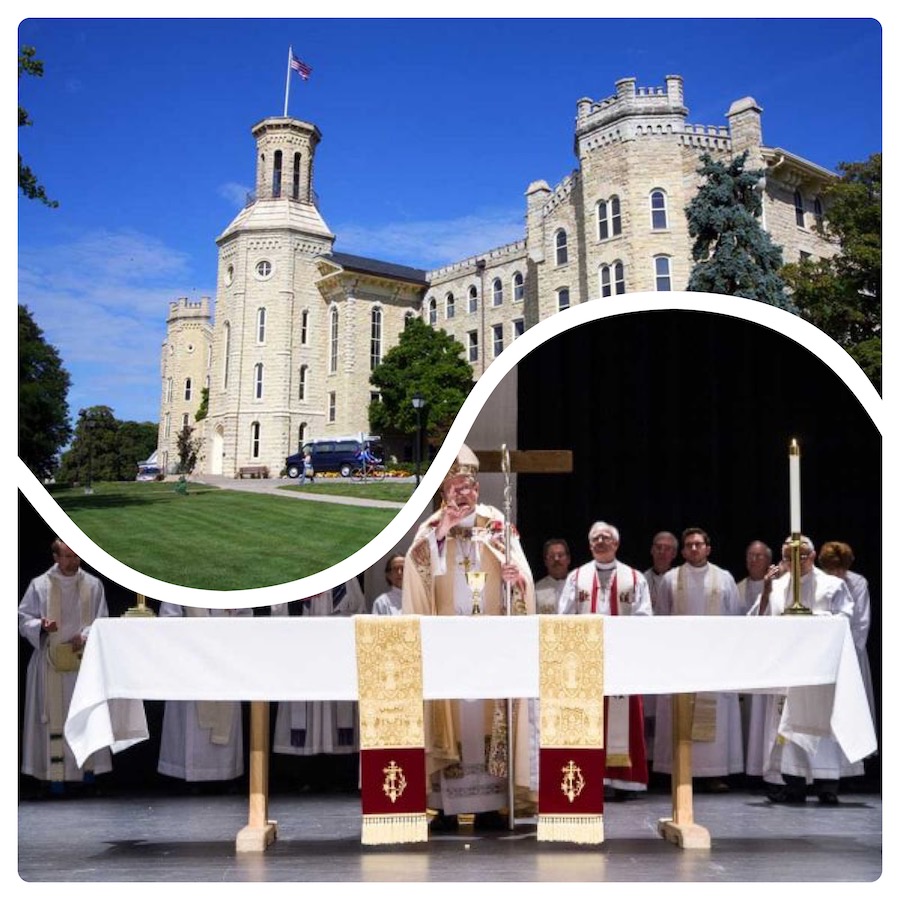
For many students, Wheaton College is their first introduction to liturgy.
Three days a week, all undergraduate students attend chapel – a required 45-minute Christian devotional service often including congregational worship songs, call and response, and a 20-minute guest lecture. It is within this service that many students participate in some formulation of traditional liturgy. Students respond to the Scripture reading with “Thanks be to God,” recite the Lord’s prayer by memory and participate in corporate confession.
This is a first for many students coming from an evangelical background and may be a foundational explanation in what is commonly known as the “Wheaton to Anglican Pipeline.”
This phrase refers to the peculiar phenomenon where students en masse enroll in Wheaton College and change their denominational affiliation to Anglicanism. This reality is so well known within the student body and by its professors, that those off campus have begun to take note. After hearing that I would be enrolling in Wheaton College, my Presbyterian pastor jokingly warned, “Do not become Anglican.”
An explanation for this phenomenon could be the liturgy of chapel, world-renowned Anglican professors in the Bible and Theology department, or the numerous Anglican churches in geographical proximity to the college, but I believe it points to a larger trend among young Christians in the United States.
As a person in my 20s, I have first-hand witness of growing trends among Christian young people. My time at Wheaton has made it clear: young people want tradition. These young people are in a pendulum swing away from the free-flowing worship or extemporaneous prayer that characterized much of late 20th century Evangelicalism. But every tradition has its liabilities. These young Christians are amidst a gradual gravitation toward traditional liturgy and established churches with historical continuity, traditional hymnody, church authority, etc.
American Evangelicals include a plethora of Protestant denominations in the United States, among them the Evangelical Free Church in America, the Southern Baptist Convention, some Presbyterian denominations, and many non-denominational churches. These churches, although diverse, often emphasize a personal (individual) relationship with Jesus, preaching of the Word, and sometimes lack liturgical structure. This compares to other classical Protestant traditions including Lutherans, Anglicans, Methodists, and some other Presbyterians, where the sacrament of the Lord’s Supper is the focal point of the service, there is corporate recitation of historic creeds and confessions, and a liturgical structure. Although I have noticed young Protestants migrating to the latter group of churches, I also see some depart Protestantism altogether for Rome or Constantinople.
Anglicanism both in the United States and globally is recorded to be growing in attendance and membership and I see my peers also increasingly attend traditionalist Lutheran congregations. I can name peer after peer, born into an evangelical Protestant household, who has changed religious affiliations to Roman Catholicism or Eastern Orthodoxy. Those I know born into Eastern Orthodoxy have been switching to Evangelicalism, while those born into Evangelicalism have become Eastern Orthodox.
Despite my pastor’s advice, I too have fallen into this growing trend among young Christians. Born and raised in the Presbyterian Church in America (PCA), I will attend an Anglican Church in North America (ACNA) parish for the next year.
It is not that my Presbyterian heritage lacks tradition; the Reformed are rich in tradition. From my childhood memorization of the Westminster Shorter Catechism, to owning Calvin’s Institutes of the Christian Religion during my teenage years, I know that the Reformed Presbyterian faith has the same characteristics of historical continuity and deep theology that many young people are looking for.
What led me to become interested in Anglicanism were its traditions outside the Puritan regulative principle of worship, and its upholding of beauty. I was fascinated by traditions including the procession of the cross, following of the liturgical calendar, and the unified liturgy across churches. I saw beauty within the church that enlightened a respect for art in the church as an outlet to glorify God. Useful tools like The Book of Common Prayer only added to my interest as I saw the Anglican tradition historically rooted, beautiful, and communal. Now, being a Fellow with The Falls Church Anglican Fellows, I have decided to commit myself to an ACNA church for the next year and serve within the youth ministry.
Although I may not be able to name all the reasons why I have witnessed this growing trend of young people becoming Anglican and affiliating with other historic, liturgical traditions, I can say that it is a pressing reality among Christian youth.
Even for Christians, young people want to be a part of something bigger. Young people want tradition.
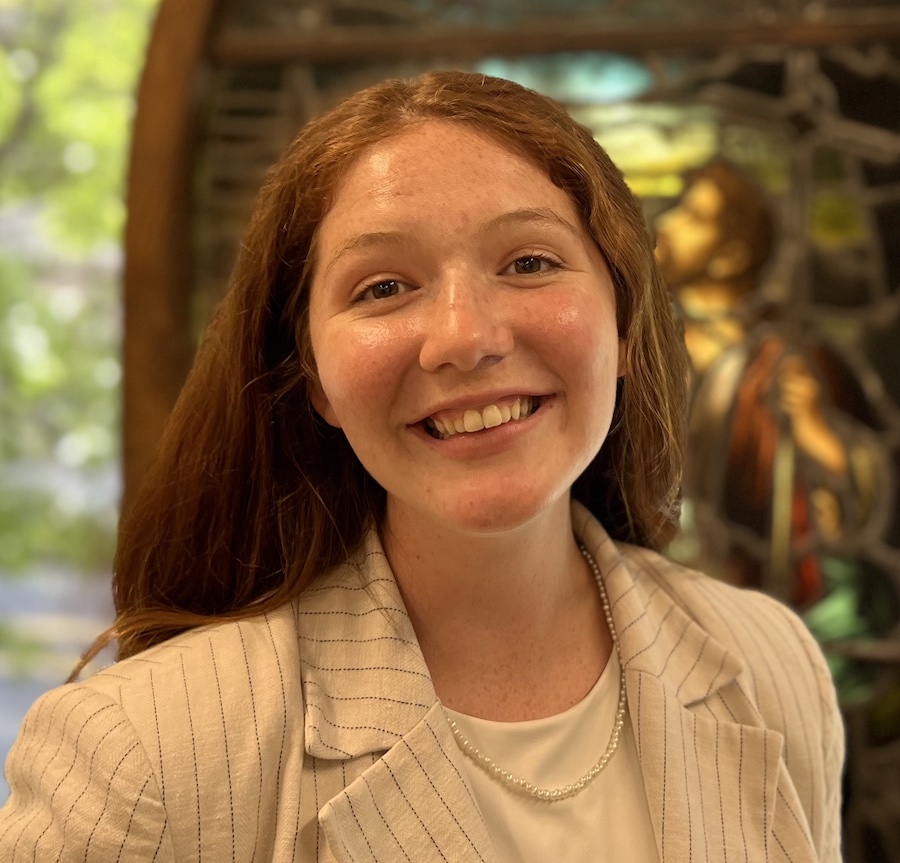
Sarah Carter is a participant in The Falls Church Anglican Fellows program and a recent graduate of Wheaton College in political science. She is most interested in Kuyperian political theology and the intersections of faith and public life in the United States. She has extensive experience in campus ministry, pro-life activism, and is an intern at the Institute on Religion & Democracy for the 2024-25 academic year.


Comment by Jakub Kohlmayer on September 26, 2024 at 4:09 am
So true. Thank you for shedding light on this.
Comment by Tim on September 26, 2024 at 6:22 am
The reason of the appeal of these “traditionalist” sects to conservatives is pretty obvious. In a very real sense, they’re a rejection of Luther’s point that Christians should be able to read and understand scripture. When one wants to ignore the social justice message of Jesus’s earthly ministry, it helps to read it in Shakespearean English (the KJV) or worse, maybe in one of the back to Latin churches that are surging on the Catholic side. Then you can replace God’s word with ritual chanting and feel very spiritual without having to actually listen TO Jesus.
Comment by Jeffrey Walton on September 26, 2024 at 11:16 am
The average Wheaton College student is likely more scripturally literate than the average U.S. Evangelical — it is known as “The Harvard of Christian Colleges” for a reason. Any student taking Old Testament and New Testament classes (common) will be required to read both in their entirety. There are probably several factors at play here, but Sarah’s comment that there is a generational pendulum swing here rings true. Older (Boomer) Evangelicals swung away from liturgical worship finding it rote and dry. They sought out expressive worship that they perceived as deeply personal and authentic (the Jesus Movement was part of this). Now, younger generations of Christians are finding liturgical structure and the rhythms of the church calendar to be (to them) new and refreshing — partly because they embrace it as an elective, rather than a requirement. Also, don’t underestimate the appeal of “high demand” faiths. Those churches that ask little of their congregants tend to whither away. Those that make big demands (Eastern Orthodoxy, Pietistic Lutheranism, Rad-Trad Catholicism) tend to attract a subset of the population that wants more, and the data shows growth in those communities through a combination of conversion/evangelism and procreation modeled by families in their churches. I don’t make a sweeping claim that everyone is doing this (in April I visited a booming multisite megachurch that was very young and not liturgical) but there is a pattern visible in the data.
Comment by Tim Mc on September 26, 2024 at 7:56 am
Tim, in my experience, no matter what church, people in the USA go to, very few have read the entire Bible.
And then there are many people like you today, who read the Bible, looking for scriptures that will encourage, what they perceive as the most important things in this life.
Many church goers, discard (no longer useful) scriptures they don’t agree with.
Comment by Corvus Corax on September 26, 2024 at 11:44 am
Tim, what a load of utter nonsense.
First of all Anglicans generally read the ESV or NRSV which are both plain enough for the modern reader to understand.
Second, by centralizing the eucharist and emphasizing the corporate nature of worship, traditional liturgy reinforces the self-giving sacrifice of Christ for all, and the communal nature of Christian life. Everyone, moving together, is part of the story.
Don’t slander devout people who choose to express their love of God with reverence. Just admit you prefer powerpoint slide decks and rock n’ roll Jesus like every other baby boomer.
Comment by Sigmagoose on September 26, 2024 at 1:15 pm
Nice article. As a middle aged person who still vividly remembers search for God in their 20s, I understand looking for more than what is in the American church. I didn’t get introduced to Anglicanism then, but I was introduce to the UCC back when you could still easily find an traditional church. The church I belonged was lead by a Presbyterian minister who followed Mercersburg Theology, which was originally of the Evangelical and Reformed Church. E & R theology was a mix of the best of Reformed and Anglicanism rolled into one and if it was properly developed, would have transformed the church. I will always remember the first Holy Communion in which had a moment of transcendence, that Christ was made know to me in the breading of bread and sharing of the cup.
Now that the UCC and the majority of the Mainline has forsaken the good news of Christ and have allowed other spiritualities to flourish and crowd out the Gospel message, I would be at an ANCA church in a heartbeat if one was close by.
Comment by Sarah Logan on September 26, 2024 at 1:23 pm
I can tell you why – it is not a spiritual reason, but a psychological one. “Familiarity breeds contempt” is commonly known and understood. Even in Jesus’ time, it was known that “a prophet is not without honor except in his own town.”
I have witnessed the switching of evangelicals to liturgical traditions (including Roman Catholic and Orthodox) and also those in liturgical traditions switching to evangelical free-style churches. Both experience something new, different, more accessible and perhaps more appealing when they go to a new church or church-type. There then is a need to interpret or explain what was experienced. The conclusion is sometimes: “this one is better” or “I feel God’s presence more here” or “Jesus’ presence is more real to me here”. The conclusion often becomes: based on this new and refreshing experience, God was not as present or as real in my last place.” No one would come out and say it just like that, but that is the gist of it. We might feel we missed out on something in our formative church years, that our starting place got it wrong or had a poor emphasis, ignored either long-standing tradition or ignored the emotive and spontaneous movements of the ‘Spirit’ (often poorly understood as an equal member of the Godhead and not some sentimental warm fuzzies).
God does indeed lead many on their journey of faith to find more fitting communion and community in a different tradition than that of their upbringing. It may be wise to switch and explore and find new growth opportunities.
This is just my observation and experience
Comment by April User on September 26, 2024 at 1:41 pm
My husband and I wish we would have discovered the Tradition about 30 years ago. We began in the evangelical church and he was ordained there. Then we moved over to the UMC and he was ordained there. We served in the Methodist Church for 20 years until it became too progressive. In our attempts to find a new church to worship in in a non-clerical role, we stumbled across an ACNA plant 10 years ago. (My husband pursued a PhD in liturgical studies so he was already in A liturgical mindset.) He was ordained an ACNA priest four years ago, started a church in our home, and now we have about 130 that call this parish,, St David’s, their church home. St David’s is full of evangelicals who have found a “deeper conversion” in the Liturgy, beauty of the hymns, excellent homilies rhythms of the daily office, and the list goes on.
Comment by John B. on September 26, 2024 at 5:33 pm
Hi Sarah, just a little correction here, “I also see some depart Protestantism altogether for Rome or Constantinople.” Unlike Roman Catholicism, not all Orthodox look to Constantinople. Each Jurisdiction is separate though, with the occasional Intra-Orthodox spat as with Ukraine, sharing the same Doctrine, Liturgy, Communion with one another. Thus the Russian Orthodoxy, the Georgian Orthodox Church, The Antiochian Orthodox Church, The Orthodox Church in America and so on. We do not all look to Constantinople for leadership, rather we look to our “local” bishops, our metropolitan, our synod of bishops, and the Seven Ecumenical Councils. As noted we have our squabbles, but A Russian Church Outside Russian Orthodox Christian can attend and receive communion in our OCA parish, likewise we can receive communion at say for instance an Antiochian parish.
Comment by David Jones on September 26, 2024 at 6:45 pm
Thank you. Church history, particularly reading of Thomas Cranmer and the roots of the Book of Common Prayer, you may find very helpful.
Comment by Tim on September 27, 2024 at 6:45 am
Wheaton isn’t the Harvard of anything. Harvard, and other legitimate universities, all share the common value of academic freedom. If a theology professor follows their research where it goes and acts in good faith and is honest, they are protected.
Contrast this to Wheaton, where you can get fired for becoming Catholic, or for pointing out that Jews, Christians, and Muslims all are people of the Book and worship the same God.
Wheaton’s admissions website basically says in its FAQs that if you don’t think like us, don’t come here. There’s no basis for attitudes like that in Scripture. Jesus made a point of ministering to people that weren’t like him. If one’s faith can’t defend itself against differing views without resorting to using power to crush them,one’s faith is worthless.
Comment by Different Steve on September 27, 2024 at 8:03 am
Harvard comes in dead last in nationwide free speech rankings
This is the second consecutive year that Harvard was found to be the worst college or university for free speech. Its climate of free speech was deemed to be “abysmal”.
https://www.boston.com/news/local-news/2024/09/05/harvard-comes-in-dead-last-in-nationwide-free-speech-rankings/
Comment by Different Steve on September 27, 2024 at 8:21 am
“Harvard President Resigns After Mounting Plagiarism Accusations
Claudine Gay faced backlash over the university’s response to antisemitism on campus, which led to increased scrutiny of her academic record.”
https://www.nytimes.com/2024/01/02/us/harvard-claudine-gay-resigns.html
Comment by Different Steve on September 27, 2024 at 8:29 am
“Why Harvard University Is Failing at Everything
A crushing cancel culture, accusations of plagiarism, protests on campus, lawsuits, Congressional investigations, and big-dollar donors running for the door. Inside the campus turmoil, where the emperor by the Charles has no clothes. …
Over the past few years alone, Harvard’s coveted image as the pinnacle of academic excellence has been taking a beating. Gradeflation is out of control: By 2021, 79 percent of students received A-range grades—compared to 60 percent a decade earlier.”
https://www.bostonmagazine.com/news/2024/02/27/harvard-failure-2024/
Comment by Rick Plasterer on October 1, 2024 at 9:07 pm
Tim,
To repost (approximately) what was inadvertently removed yesterday:
I really think that the King James Version is just as clear even to modern ears in reporting the words of Jesus as modern translations.
Neither “social justice” nor “liberation,” as those terms are commonly used today are the essence of the gospel. What people today want liberation from is the moral precepts of the Bible (the Ten Commandments and their extension in other Biblical commands pertaining to God and neighbor). Jesus clearly affirmed the moral law (Matt. 15:19, Mk. 7:20-22). His teachings stress faith in God, charity, humility, and obedience, quite the opposite of the “free to be me” philosophies of the last half century. He clearly excluded people who did not submit to his lordship (Lk. 14:26, as did Paul I. Cor. 5:13).
While the Bible doesn’t prescribe a form of worship for Christians, liturgical worship, and the holiness and love it expresses, is the only kind found in the Bible. Christian young people are naturally drawn to it.
Rick
Comment by SK Soon on October 3, 2024 at 10:01 pm
Wheaton College has indeed come a long way! I was studying for my MA at Wheaton College Graduate School as a young Anglican priest from Singapore on a scholarship from Wheaton from 1981-1983. Looking for fellow Anglicans then was quite futile and I found an Anglican Church in Glen Ellyn where I enjoyed a rich traditional liturgical worship on Sundays. I remember a couple of my professors, Dr Walter Elwell and Dr Robert Webber, who also worshipped in that church on Sundays but I cannot say if they were Anglicans or not. I daresay I will truly be at home at Wheaton today!
Comment by Sarah Puryear on November 20, 2024 at 3:39 pm
Thank you for this thoughtful reflection, Sarah! It prompted me to reflect on and write about my experience 20 years out as a Wheaton student who also discovered Anglicanism during my time there. It can be found on Covenant, the online journal of The Living Church. https://livingchurch.org/covenant/wheaton-to-anglican-pipeline-a-response/
Comment by Efrain Avila on May 20, 2025 at 11:42 pm
I saw this trend when I entered Wheaton in 1989. Coming from a Hispanic Pentecostal background, Anglican worship brought stability and depth to my spiritual experience. A good number of acquaintances entered Eastern Orthodoxy. For me, however, Anglican worship satisfied the spiritual thirst in my soul. Although I was confirmed into the Episcopal Church, eventually I became a United Methodist pastor, because Methodism seemed to better fit a Hispanic spiritual/religious ethos. Although I have left the UMC due to theological disagreements, I still value and hold Anglican elements in my ministry and theology.