
Christmas is reforming the world, as I was reminded on Christmas Eve walking around historic Old Town Alexandria.
Old Town, with centuries-old row houses and cobble stone streets, is always beautiful but especially at Christmas. It is now gentrified, refined and tranquil, with nice hotels and restaurants. Its streets are filled with strolling families, tourists, and shoppers.
But like all communities, it has darkness in its past.
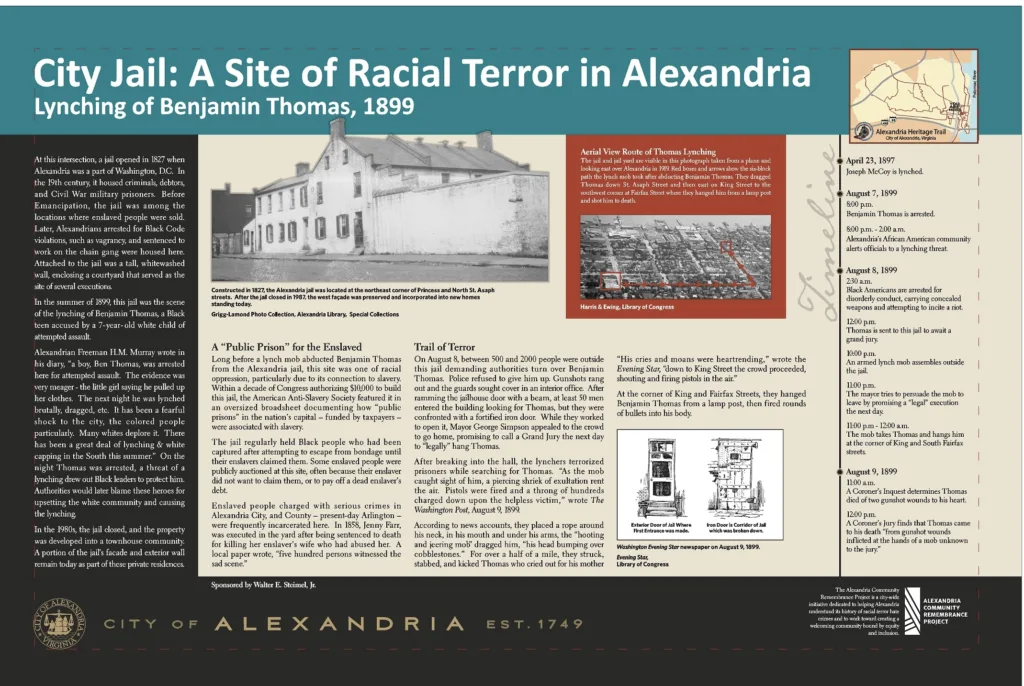
One dark episode is now commemorated by the new sign about Alexandria’s final lynching, which I discovered on a delightful street, outside the city’s old jail house. That jail house, which incarcerated escaped slaves before the Civil War, is now an expensive residence. But on August 8, 1899, it was surrounded by an armed and angry mob of up to 2000 men. Alexandria’s population was only 14,000. Assuming few women or children were in the mob (one account says 100 women were there), and that blacks were about one third of the population, then perhaps the mob included over half the city’s white men.
Inside the jail was a 16-year-old black boy, Benjamin Thomas, arrested because a neighoring 8-year-old white girl alleged he tried to assault her. The allegation was contradictory, and a trial presumably would have examined the evidence. A lynching in the city under similar circumstances just two years before prompted some Alexandria blacks to stand guard outside the jail. The police chased them away, and some were arrested. Later, they were blamed for provoking what followed.
The white mob mobilized in the evening. Five police officers and twenty deputized citizens tried to defend the jail. Having emptied the city’s gun and hardware stores, the armed mob surrounded the jail, pushing against its heavy doors. The city’s mayor implored the mob to disperse, declaring: “Fellow citizens, if you will disperse and go away quietly, I will promise you that a court will be convened today…. If this is not done, I will give you my word, as a man of honor, that I will personally lead a mob tomorrow night to lynch Thomas….” His plea was to no avail.
Apparently, the jail’s armed defenders declined to use lethal force, and the mob, with a “piercing shriek of exultation,” eventually found its target. The black teenager, with a noose around his neck, was pulled naked half a mile through the cobble stoned streets, while the mob, shooting guns into the air, howled and beat him with “bricks, iron, and stones, as he cried out for his mother,” as the sign reports. His “cries and moans” were “heartrending,” according to one newspaper. By the city hall and police station, he was “stabbed, kicked, shot, and hanged.” Reportedly the once loud mob went silent during the hanging from a lamppost, and then it surged forward to grab relics from his lifeless body.
A funeral at the Shiloh Baptist Church, where the victim was baptized two years earlier, attracted 600 mourners, where the pastor declared the victim to be an honest boy. A minister from the Israel Christian Methodist Church in Washington, D.C. visited Alexandria the day after the lynching to investigate for the National Organized Brotherhood of Afro- Americans. He reported: “It is now generally admitted that he was not guilty. The mother of the girl, I learn, told him when interviewed that the young man was not guilty and that she had known him from a youth to be a good boy.” The boy’s mother was too devastated to attend her son’s funeral.
None of the assailants who stormed the jail and murdered the victim were ever arrested, though the mayor had initially recognized “prominent” men. Several blacks who had tried to defend the jail were prosecuted for “disorderly contact.” Subsequent media reports were embarrassing to Alexandria, but apparently not sufficiently to prompt legal action. The white population just moved along. But at least it was Alexandria’s final lynching.
Nearly two decades later, several blocks away, there was additional unpleasant history in 1917, as noted by another sign I spotted on Christmas Eve. Twenty suffragists fighting for women’s voting rights were arrested outside the White House and jailed at a federal facility in nearby Occoquan, Virginia. Some of them, refusing to eat, were force fed, beaten, and shackled to the ceiling by their guards. In 1917 they appeared at the Alexandria courthouse, shocking onlookers by their condition, some of them lying on court benches because they could not sit up. They were granted parole, but some of them insisted on serving additional jail time in protest.
Women’s national voting rights were gained in 1920 with the Nineteenth Amendment, although Virginia did not ratify until 1952. Virginia approved an anti-lynching law in 1928, but no one was ever prosecuted under it, and a lynching occurred near Warrenton, Virginia in 1932.
The 1899 lynching of Benjamin Thomas was not very long ago. Witnesses to the lynching could have been alive through the 1980s. Yet it seems like a different universe. Nobody today can imagine thousands of people, some of them prominent citizens, openly storming a jail to lynch a prisoner. Nobody today can imagine racism so blatant that the crime is never prosecuted. Likewise, we cannot imagine a time when women cannot vote or lack legal equality, much less being tortured in federal jails for demanding their rights.
We blithely assume today that legal equality, regardless of race or gender, is the natural state, and exceptions are extraordinary. But for most of history, such assumptions were absent. For thousands of years, in every culture, some people were naturally privileged over others, which few disputed.
Yet, with Christmas, the coming into the world of God incarnate, the Gospel of good will and human dignity was proclaimed. It contravened the spirit of the whole world, where might typically makes right. Slowly that Gospel and its claims about human equality under God have advanced. There is still plenty of injustice, of course. But in few places do societies openly profess racial preferences or explicit official subjugation of women.
The streets of Alexandria, Virginia still resemble their appearance in 1917 and 1899. But our current times, however flawed, are infinitely preferable to the blatant violence and horror of several generations ago. More than a festive holiday, Christmas launched the gradual reform of the world, which is still redemptively unfolding.
This reminder amplified my Christmas spirit while walking the streets of Old Town Alexandria, Virginia.




Comment by David on December 29, 2023 at 9:12 am
Black men taking notice of white women was the ultimate offense in those days and was the provocation of many lynchings. The notorious Tulsa massacre was prompted by an incident in an elevator.
When my mother visited my father whose ship was docking in Biloxi, MI, in WWII, she was shocked that Blacks would step off the sidewalk and walk in the gutter until she passed. Before Rosa Parks, she sat unknowingly in the back section of the bus, which was empty as there were no seats in the front. The bus usher came charging back insisting that she stand in the front. Strangely, when she went to buy a bottle of milk, she was advised she could do so only by presenting a bottle. When she was swimming in the Gulf of Mexico, she found one and was able to get her milk.
Comment by George on December 29, 2023 at 11:42 pm
David, Biloxi is located in Mississippi, not Michigan. And let’s just keep on beating up the south over the Jim Crow era. I often wonder how things might have been different down south if it had been rebuilt the way we rebuilt Germany and Japan after war just eighty years later. Reconstruction was anything but. Wars leave scars. In my opinion, the evil we do unto each other today is spread pretty evenly across our country. I wish you were as concerned about the antisemitism that is filling our streets today as you are of wrongs of decades past. Happy new year.