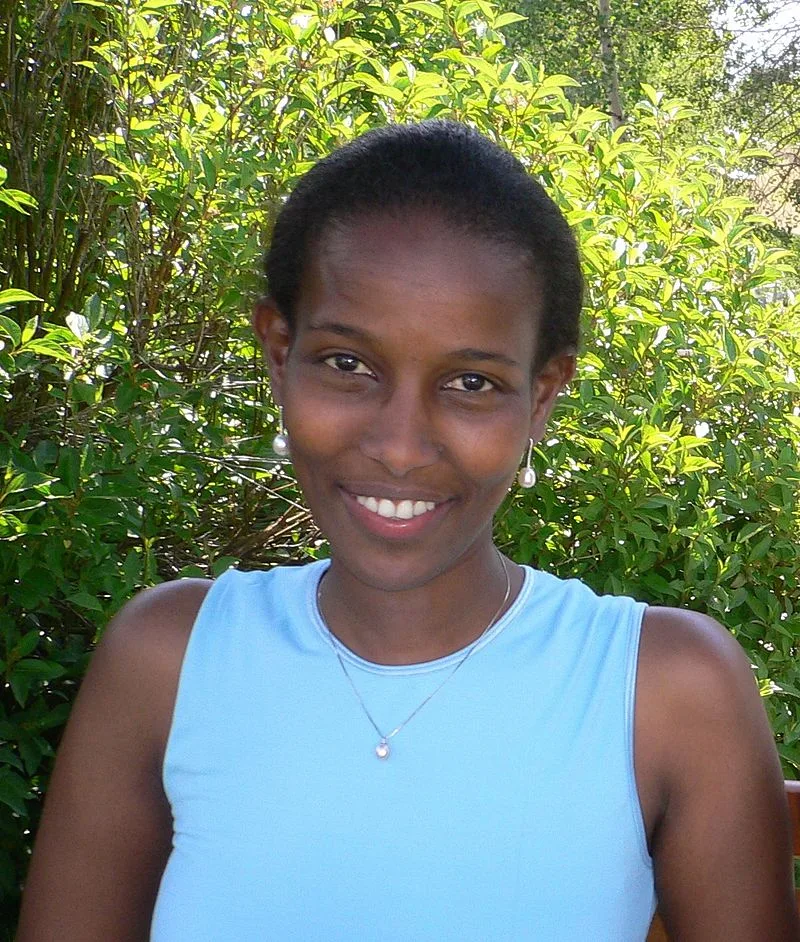
Some are questioning the depth of author Ayaan Hirsi Ali’s announced conversion to Christianity because she cites strengthening the West against its enemies as partly her justification.
Ali is the once Somali Muslim (and child victim of genital mutilation) who escaped an arranged marriage for refuge in the Netherlands, where she served in parliament, renounced Islam, and made a film whose co-creator was killed by an Islamist. She embraced atheism as a rational alternative and now lives in the U.S. with her husband, historian Niall Ferguson.
As someone who has long contended for freedom of speech, Ali explained in her column:
Freedom of conscience and speech is perhaps the greatest benefit of Western civilisation. It does not come naturally to man. It is the product of centuries of debate within Jewish and Christian communities. It was these debates that advanced science and reason, diminished cruelty, suppressed superstitions, and built institutions to order and protect life, while guaranteeing freedom to as many people as possible. Unlike Islam, Christianity outgrew its dogmatic stage. It became increasingly clear that Christ’s teaching implied not only a circumscribed role for religion as something separate from politics. It also implied compassion for the sinner and humility for the believer.
Countering China, Russia, and Islamism, along with domestic wokery, Ali wrote, requires more than atheism and secular liberalism. The available counterweight is the West’s Jewish and Christian legacy. She noted:
That legacy consists of an elaborate set of ideas and institutions designed to safeguard human life, freedom, and dignity — from the nation state and the rule of law to the institutions of science, health, and learning. As Tom Holland has shown in his marvellous book Dominion, all sorts of apparently secular freedoms — of the market, of conscience and of the press — find their roots in Christianity.
Ali’s conversion is not just political and cultural:
Yet I would not be truthful if I attributed my embrace of Christianity solely to the realisation that atheism is too weak and divisive a doctrine to fortify us against our menacing foes. I have also turned to Christianity because I ultimately found life without any spiritual solace unendurable — indeed very nearly self-destructive. Atheism failed to answer a simple question: what is the meaning and purpose of life?
So, Ali’s conversion is also personal. For all her activism and demands for truth-telling, she realized she lacked life purpose as an atheist. Her expectation for human equality only makes sense if the God of Jews and Christians actually exists. It sounds like she is church going but not does not describe herself as a confessional Christian. Maybe she is where the English journalist Malcolm Muggeridge was after his conversion from atheism (also like Ali disdaining British atheist Bertrand Russell), at which point he affirmed the idea but not the specific historicity of Christianity.
Ali’s conversion also somewhat recalls Whitaker Chambers, the mid-20th century journalist who had been a Communist and collaborator with Soviet intelligence who later turned to anti-communism, which led him to Christianity, as recorded in his famous memoir Witness. Also famously, as Soviet Communism seemed to advance, he thought he was joining the righteous but losing side.
There are of course many, many people who convert to Christianity not because of an intense personal spiritual crisis resulting in a cathartic acceptance of Jesus Christ but because of revulsion against the world’s distortions. For such converts, Christianity is at first an intellectual and aesthetic oasis to which they flee from an arid desert. Later they often in their spiritual journey become more theologically specific. Muggeridge, in his interview with William Buckley, said he did not care if Jesus Christ physically arose from the dead. Presumably later, upon joining the Catholic Church, he did in fact care.
Ali explained:
We can’t withstand China, Russia, and Iran if we can’t explain to our populations why it matters that we do. We can’t fight woke ideology if we can’t defend the civilisation that it is determined to destroy. And we can’t counter Islamism with purely secular tools. To win the hearts and minds of Muslims here in the West, we have to offer them something more than videos on TikTok.
Of course, Christianity’s chief purpose is not specifically to defend Western Civilization or politically counter its alternatives. It is to offer the living waters that flow from Christ, bringing life abundant and life eternal. Societies that turn to Christ, or are at least friendly to Him, typically esteem human dignity, freedom, and justice for all persons, at least approximately. It is right and good that people like Ali, who has been especially motivated by women’s rights, see and understand. Come whosoever will, as Christ said.
Christianity is not a geographically or politically Western faith. It has always been universal. But wherever it is heeded, there is greater opportunity for social uplift for all. Hopefully, Ali’s conversion will inspire others to also examine the roots of societal liberty and turn to the ultimate Source.




Comment by David on November 13, 2023 at 6:11 pm
Why does life require meaning and purpose? It is enough to accept that we are here for a time at least and have an opportunity to make the world a better place even in a small way. Attaching a great purpose to oneself borders on vanity.
Comment by Dan W on November 13, 2023 at 8:07 pm
David, you answered your own question, “an opportunity to make the world a better place…”
Imagine sharing the Good News, showing people there is a way out of darkness and despair…
Comment by John N Kenyon on November 15, 2023 at 5:41 pm
After a well written article by Mark Tooley about Ayaan Hirsi, a voice that needs a far wider audience, I repented from calling him the Beaver Cleaver of the UMC. Well done, Mark. Promoted to Wally, with great hopes you learn the meaning of a diphthong when parsing the Holy Trinity before you tank the Global Methodist Church.
Comment by Gordon Hackman on November 16, 2023 at 11:19 am
Seriously David? That’s your response to this article? Without meaning, where do you think the notion of “making the world a better place comes from”? And as for your claim about “attaching a great purpose to oneself” that is a strawman distortion of what she said.
For someone who clearly prides himself on his intellectual prowess, your comment displays none.
Comment by Gerard on November 17, 2023 at 8:10 am
Life per se does not require purpose or meaning if it happened to evolve by chance and lots of time. The very fact that humans get up each day with a sense of purpose and meaning only goes to support the idea of an inherent created and ordered universe in which man tries to find their place. This is just one of many foundations stones for my faith in the living Jesus Christ…..