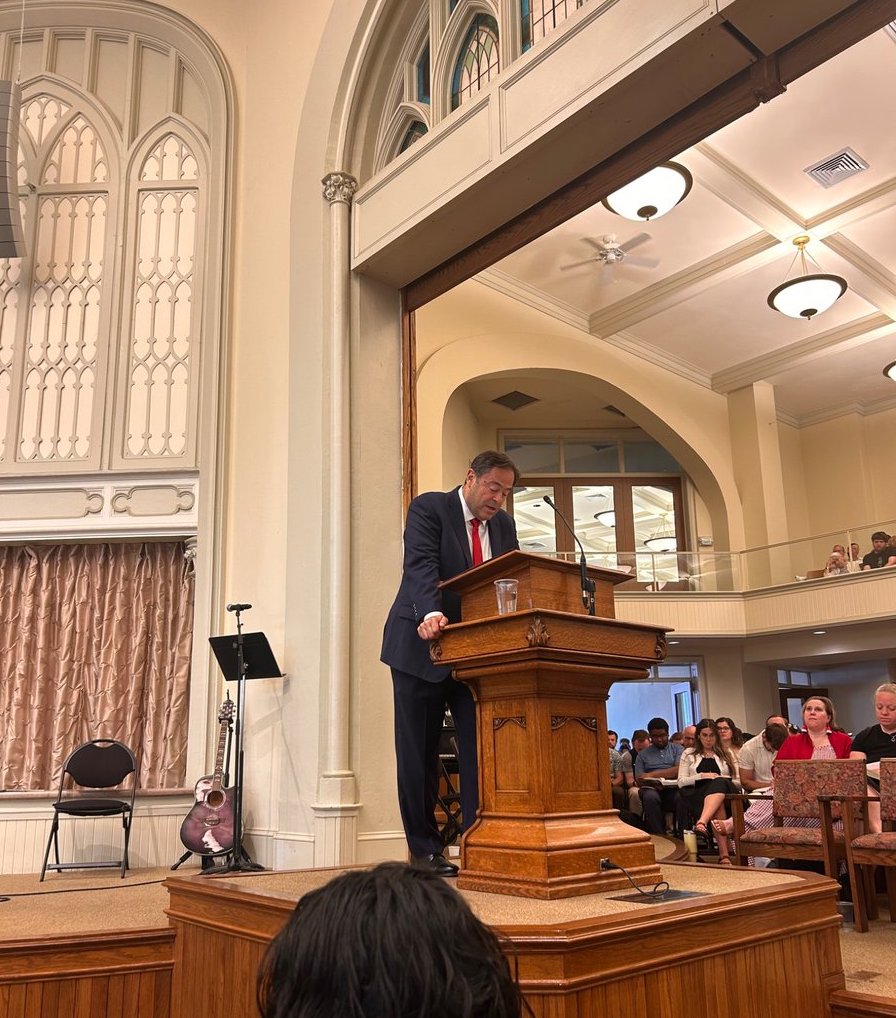

A leading Reformed figure and Southern Baptist pastor with the evangelical ministry 9Marks recently marked America’s 250th anniversary by examining the biblical justifications for the Declaration of Independence and the Revolutionary War.
Theologian and Capitol Hill Baptist Church Pastor Mark E. Dever preached that the war, despite being waged against a civil authority, has backing in scripture and natural law and that America is not “celebrating the 250th anniversary of a sin.”
Britain, Dever maintains, overstepped its powers, acted arbitrarily, and had vacated its role as the defenders and protectors of the British people in America, giving those in the 13 colonies the right to pursue independence, even through force of arms.
Dever read from Romans 13:1-7 and quoted from abolitionist Fredrick Douglass’ The Internal Slave Trade. The Baptist pastor sought to establish that “national law is inferior to natural law.”
“That’s what I’m contending, from the Bible itself,” Dever stated. He compared two separate events to showcase the two interactions: the exile of St. John Chrysostom, who, after publicly criticizing and condemning the Empress Eudoxia’s imperial excess, was exiled from the Byzantine capital. Second, Dever addressed a different incident that occured in Greece decades before, where a Roman general was lynched by a crowd for not letting a chariot racer go free after committing a crime. In response, the Roman Emperor Theodosius ordered the riot suppressed, which led to the deaths of thousands. In response, Theodosius was refused entry to the Church of Milan and was told to repent publicly by Saint Ambrose, with which Theodosisus complied.
Both of these stories illustrated the different ways that the state is or isn’t held accountable.
“Rather than Rex-Lex, the king is the law… Instead, Lex-Rex, the law is king,” Dever maintained. This idea that natural law is above absolutism led to the idea that a ruler’s ability to perform his duties of state determines his right to rule. If he is arbitrary and cruel, then he is unable to occupy the position of ruler. This principle was then seen throughout England, with first the Magna Carta and then the English Civil War under Cromwell and Parliament. The trend was furthered by the Glorious Revolution and the adoption of the British constitutional system.
Dever linked these previous events, stating, “All of this, from a people who read and believed that God had revealed himself through the words of the Bible.” “Including these very first verses of Romans 13.”
Dever applies these principles to the American Revolution, when, frustrated by how arbitrary the British taxation and governance were, Colonial patriots sought independence and self-government. Dever quoted the Declaration of Independence to explain how, after the ratification of the declaration, news of the declaration was ordered to be spread throughout Massachusetts by having the declaration “Printed, and that copies be sent to the ministers of each parish, of every denomination within this state. And that several of you are required to read the same to their congregations.”
Opinions on the revolution were divided, even on both sides of the Atlantic, Dever noted. Some in parliament agreed that colonial grievances were legitimate, while some loyalists in the colonies sought to remain with the crown. Dever recounted that Americans made vocal, overt attempts to have their grievances addressed, through public statements and demands for action from the British. However, Britain’s government was uninterested in addressing these needs and made a point to refuse to even respond to the colonies complaints. Dever explained that their right to rebel proceeded from the fact that their demands were ignored.
“They did so as an example of obeying natural law above national law,” Dever emphasized.
“Rebellion to tyrants is obedience to God,” Dever stated, quoting American founder Benjamin Franklin.
Dever continued, speaking about how changes in laws and governance are not always morally just, citing the Fugitive Slave Act as an example. Dever offered five “lessons” to view government, his first one being “Government is of God.”
“Any political philosophy that is anti-government at its very root is attacking that which God ordained. And is therefore setting itself against God Himself,” Dever declared, adding that God has made man to be under an authority and that authority is given by God, whether its parents or governments.
In regards to governments in particular, Dever calls it “having the public right and responsibility to use even violent force.” Dever follows up with the second lesson, that “governing is good work.” He states it again, “Governing well reflects God’s own character,” and “You serve those you rule.”
Dever’s third lesson is that “governing is to promote good and restrain evil.” Even tyrannies, he pointed out, prevent chaos and anarchy and that “even under [Italian Dictator Benito] Mussolini, things ran on time.” The fourth lesson is that “Obedience is normal” and that “normally, obedience is the path to follow to Christ,” and for the fifth and final lesson, “Opposition to the government is not, by these verses, categorically disallowed,” or that in the correct situations, one is allowed to show opposition to the government, not only in words but also through action, violent if the situation is extreme. However, Dever also reminds us that “We are to obey God first.”
More from IRD:
American Revolution archived articles
Is America Built on the Gospel?




Comment by Qohelet on July 13, 2026 at 1:26 pm
I generally like this sermon. I get that it’s making the argument that Romans 13 is not a commandment to be a bootlicker to a tyrannical government from Christian perspective. That said, I do think discussing Natural Law in the 18th century without discussing the enlightenment is leaving a lot of the story out.
Comment by Wilson R. on July 13, 2026 at 1:47 pm
Seems like Mark Dever is waging war against a straw man. I’ve never heard the suggestion that the declaration of American independence was a “sin.” Why does he think this is an idea that needs refuting?
Based on the synopsis here, it appears that Pastor Dever is more than a little confused about the causes of the Revolution.
First off, this was not a case of “natural law vs. absolutism.” There was nothing absolutist about the British monarchy in 1776. That issue had been settled in the previous century, and Parliament was firmly in control.
From their point of view, the British government’s policies toward the American colonies were reasonable. In 1765, when Parliament passed the Stamp Act, Great Britain had recently concluded a long (9 years) and very expensive war to defend those colonies from the French and their Native American allies. It seemed reasonable to levy taxes on the colonies to help defray the costs of their defense. It was even more reasonable to draw a line prohibiting the English colonists from settling west of the Appalachians, lest they provoke another war with the Native inhabitants, many of whom had so recently sided with the French.
But Virginians like George Washington had already been engaged in land speculation in the Ohio Country. And colonists who had enjoyed a long, relaxed policy of “salutary neglect” by the British government were loath to pay new taxes, even if there was a reasonable justification for them.
The most principled argument the rebels made involved their lack of direct representation in Parliament. But they were not fighting an absolutist enemy.
And it’s curious that Dever would cite Frederick Douglass, since the desire to protect slavery was one motivation for the southern colonies to declare independence. It wasn’t the only motivation, and it wasn’t an issue in Massachusetts, where the revolutionary fervor was hottest, but it was an issue in Virginia (the largest and most populous of the 13 colonies) and South Carolina.
In 1772, the highest court in Britain ruled in the Somerset case that enslaved persons from British North America and the Caribbean became free when they set foot on British soil (if their owners took them back to the colonies, they reverted to their status as slaves). The ruling sent shock waves through the Southern colonies, and some concluded that the only way to protect slavery from the British legal system was independence. Dever seems to be unaware of this aspect of our history, which is not surprising; most other Americans are unaware of it as well.
Finally: “quotated?”
Comment by David on July 13, 2026 at 4:22 pm
Firstly, Britain spent a great deal of money defending the colonies in the French and Indian Wars. When they tried to recoup their costs from the Americans, they became defensive. While taxes varied by colony, persons in New England paid about 5% of the taxes paid by the average Briton.
There is also the matter of indebtedness to British firms. At the time of the Revolution, this amounted to more than the value of all the money in circulation in the colonies. As the Jews and the Knights Templar found out to their grief, removing the lender cancels the debt. The debts owed to Britain were essentially never paid back.
Comment by Salvatore Anthony Luiso on July 13, 2026 at 4:27 pm
Thank you for this article, and thank you Wilson R. for your comment on it.
The question of whether the cause of the War of Independence was just is very worthy of consideration. There were devout Christians 250 years ago who believed it was not (e.g. John Wesley), and there are devout Christians today who believe the same. Furthermore, only a minority of the subjects who lived in the colonies were in favor of independence: most either opposed it or were neither for or against it. So the question of whether the origin of the United States is a “250-year-old sin” is real.
Regarding “‘Rebellion to tyrants is obedience to God,’ Dever stated, quoting American founder Benjamin Franklin”: Is that a biblical sentiment? Is that something which Jesus or any of the apostles taught? Is it anything they exemplified?
What we see in the Bible is that when one must choose between obeying God or obeying men in authority–such as a parent, the Sanhedrin, a governor, a king, or an emperor–one should obey God.
Other than that, do we see any justification for disobedience, even if the law is unjjust?
For example, if a Roman soldier, upon the basis of Roman law, demanded that a Christian carry his burden for a mile, should the Christian have refused?
Jesus said:
And whosoever shall compel thee to go a mile, go with him twain
—Matthew 5:41 (AV/KJV)
Comment by Qohelet on July 13, 2026 at 4:51 pm
Wilson I think you might have missed the point to the sermon. Romans 13 is in vogue a lot these days as the Christian Right tries to justify why we should all joyfully obey the evil that pours from Trump’s swamp. This is a defense of the founders for standing up to tyranny when the law of the land is against natural law, despite what it says in Romans 13. On that regard I think it’s a pretty good sermon. But they who have ears should hear and I’m not sure they will.
Comment by Wilson R. on July 14, 2026 at 10:13 am
No, I think I understood the point about Romans 13. It’s just that the point is misapplied here because this preacher doesn’t seem to have a clear understanding of the causes and nature of the American Revolution. It was neither a “sin,” nor a clear-cut case of rebellion against tyranny, and it certainly wasn’t a war against absolutism.
A much better example of siding with natural law over national law would involve the civil rights movement. Of course, I understand why a Southern Baptist preacher wouldn’t go there. They were on the losing side of that struggle.
Comment by Different Steve on July 16, 2026 at 2:51 pm
As is you hypocrites had anything to say about the evils that poured out of the Biden administration.
Comment by Different Steve on July 16, 2026 at 3:02 pm
Qohelet assumes that everyone agrees Trump is self-evidently evil, that his administration is a “swamp,” and that any Christian who doesn’t loudly denounce him is complicit. That’s not an argument – it’s a liturgical recitation of a partisan creed.
Your frustration is justified. This is the exact playbook: use a serious theological discussion as a launching pad for a partisan drive-by, contribute nothing substantive, and walk away feeling morally superior. It’s the intellectual equivalent of a spitball.
Comment by Wilson R. on July 16, 2026 at 4:10 pm
Steve: Nobody mentioned Biden here until you did. This is a discussion about the American Revolution and obedience to civil authorities.
Should we ask Chat GPT if you’re OK?
Comment by Qohelet on July 16, 2026 at 5:17 pm
Sorry I missed this, thought the conversation was over.
Steve, yes, your ChatGPT friend is correct. I believe any Christian that does not denounce Trump is complicit.
And furthermore, not a Christian.
Comment by Different Steve on July 17, 2026 at 1:08 pm
The Bible condemns hypocrisy as a deadly spiritual poison—especially in religious leaders. Here’s the core of what it says:
· Jesus’ harshest words were for hypocrites (Matthew 23). He called them “whitewashed tombs”—beautiful on the outside but full of dead bones—and “blind guides” who load burdens on others but won’t lift a finger themselves.
· The classic definition: Practicing one thing while professing another. In Matthew 7:3–5, Jesus jokes about a person with a log in their own eye trying to remove a speck from a friend’s eye—calling that person a “hypocrite” and commanding self-examination first.
· The root issue: Hypocrisy is driven by performance for human approval (Matthew 6:1–6)—praying, giving, or fasting to be seen by others rather than by God. That loses its eternal reward.
· Self-deception is real: James 1:22–24 says hypocrites are like people who look in a mirror, walk away, and instantly forget what they look like—hearing the Word but not doing it.
· God’s response: He will “expose the motives of the heart” (1 Corinthians 4:5). Nothing hidden will stay hidden (Luke 12:1–3).
The tension: Everyone falls short, so are we all hypocrites? The Bible distinguishes between struggling (honest failure) and pretending (willful deception). The remedy isn’t perfection—it’s confession (1 John 1:9) and integrity: letting your “yes be yes” (Matthew 5:37).
Comment by Different Steve on July 17, 2026 at 1:13 pm
The “itching ears” passage (2 Timothy 4:3–4) warns that people will gather teachers who tell them what they want to hear, not what God actually said. But the Bible goes even further about those who misrepresent His teachings:
· False teachers get severe judgment: 2 Peter 2:1–3 says they “secretly introduce destructive heresies” and “exploit you with fabricated stories”—but their condemnation “has not been idle,” and destruction awaits them.
· Twisting Scripture brings a curse: 2 Corinthians 2:17 contrasts peddlers who “corrupt the word of God” with those who speak “from sincerity.” And Galatians 1:8 drops the hammer—if anyone, even an angel, preaches a different gospel, “let him be accursed.”
· The motive: It’s usually greed (Titus 1:10–11 says they teach “for dishonest gain”), popularity (1 Thessalonians 2:4–6 says they seek to please men rather than God), or control (Acts 20:29–30 warns of “savage wolves” who distort truth to draw disciples after themselves).
· The “itching ears” dynamic: It’s a two-way street. Listeners with itching ears create the demand; teachers supply the flattery (Ezekiel 13:18–19 compares false prophets to women who sew magic charms—giving people a comfortable lie instead of convicting truth).
· The final test: Deuteronomy 18:21–22 gives the old test—if their words don’t come true, don’t fear them. But Jesus added the New Testament test: “By their fruit you will recognize them” (Matthew 7:15–20). Not just accuracy, but character—do they produce righteousness or excuse sin?
So misrepresentation isn’t a simple mistake—it’s spiritual malpractice with eternal stakes. The remedy? Be like the Bereans (Acts 17:11)—receive the word eagerly but examine the Scriptures daily to see if what’s taught is true.