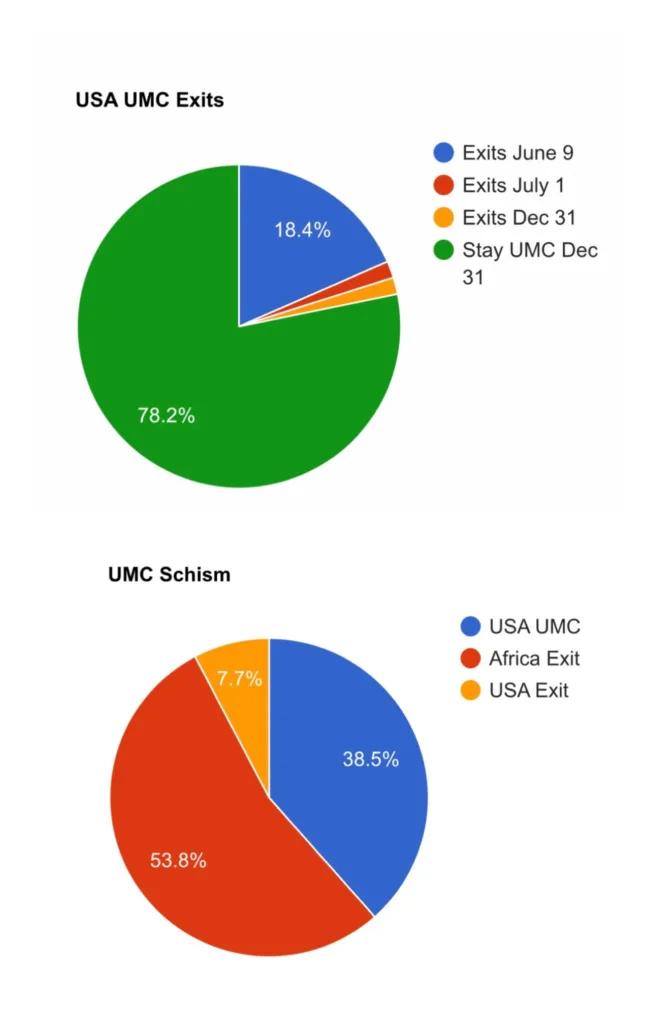

As of today there are 5,550 ratified church exits from U.S. United Methodism. At least 500 more exits are expected at the annual conferences meeting this month. And likely at least another 500 will be approved at the at least 19 special conferences meeting this summer and fall. So there will probably be at least 6,500 exiting churches this year before the deadline, or about 22 percent of the 29,598 U.S. United Methodist churches existing in 2020 before the pandemic and schism.
Of course, there could be more. In some conferences, deadlines have not yet passed for starting the exit process. Reaching 7,000 or more churches is not impossible. Even 6,000 churches exceeds most expectations. In a 2021 interview I had with large church pastor Adam Hamilton, he predicted 15 percent or at most 20 percent under the then still alive Protocol, which would have allowed easier exits, including by whole conferences. Under the Protocol, I thought as much as one third of the U.S. church could leave.
By end of next year, after United Methodism officially liberalizes its marriage and sex teaching, I expect at least 25 percent of U.S. churches will have exited. If the May 2024 General Conference approves a new exit ramp, which is unlikely, the number will be higher. But even with the current exit ramp ending this year, some churches will, with great difficulty, find ways to exit, through property purchase, litigation, or property abandonment.
There will also be exits by individuals. Many, perhaps most, traditionalists are not in exiting churches, which require a two-thirds majority. A 2019 United Methodist poll said 44 percent of United Methodist laity are traditionalists. Many will quit their United Methodist churches as they witness the impact of the denomination’s liberalization. In some cases, congregations have already divided, especially when congregational majorities failed to reach the two thirds needed for exit.
Where will Methodists ultimately land? I expect total U.S. exited churches will include about one million members. United Methodism had nearly 6.3 million U.S. members in 2020. The possibly incomplete 2021 stats say 5.7 million. It’s likely that United Methodism now has fewer than 5 million U.S. members. By the end of 2024 it could be 4.5 million. The church was losing 200,000 members annually before the pandemic. That number likely will double.
Most United Methodists are in Africa, which at last count had 7 million members. They are overwhelmingly strongly traditionalist. Some U.S. United Methodist institutionalists think that excluding Africa from new liberal marriage and sexuality standards will persuade them to stay. Maybe, but I doubt it. Africa in the past has already rejected similar proposals. Many bishops in Africa, whose salaries are U.S.-paid, want to stay United Methodist. But they will unlikely persuade many Africans after United Methodism fully liberalizes next year.
Africans will wonder why they, a growing 7 million, should remain subordinate to policies dictated by a shrinking U.S. church of fewer than 5 million. And many U.S. progressives are not anxious to accommodate Africans whose views they deem reactionary. If delegates at General Conference were apportioned fairly, Africa would already have a majority. U.S. progressives who think ahead will not want repeatedly to contend with growing numbers of Africans whose views are so opposed to their own.
Sadly, as Africa ultimately departs United Methodism it will likely fracture. Some will join Global Methodism. Some will become autonomous, which might better facilitate funding from all sides in the U.S. Others might align with British originated Methodism in Africa. Tribal and political divisions will emerge. They’re maybe fiefdoms under strong personalities. Africa to stay together needed for United Methodism to remain at least officially orthodox. Liberalized United Methodism cannot lead or unite Africa. And as it shrinks, so too will its funding for Africa.
Amid division, hopefully many Methodists will rediscover who they are. United Methodism, founded in 1968, was never known for strong doctrinal reflection. In finally having to make choices about alignment, there can possibly be a rediscovery by many of Methodism’s distinctions, centered in the grace and holiness of God available to all people. For this outcome we can hope and pray.



Comment by Tom on June 12, 2023 at 5:30 pm
“United Methodism, founded in 1968, was never known for strong doctrinal reflection”
Granted I am a Presbyterian (PCA) and that we are stronger on doctrine than most; but might that just be the problem? It is obviously most important to know Who you believe. But what you believe is right next to it, followed closely by why you believe it.
Comment by GinVA on June 12, 2023 at 5:53 pm
I am curious how liberal US Methodists will try to sell a plan where its same sex marriage policies would not apply to conferences in Africa. Guessing they can’t pitch it as a “separate but equal” policy….. US liberal will also have to contend with their argument that any opposition to LGBT inclusion is akin to violence.
Comment by John on June 13, 2023 at 6:03 am
In Australia in 1977 the Methodist Church merged with parts of the Presbyterian and Congregational denominations to form the Uniting Church In Australia the Methodist property was all owned by the State Conferences whereas the Presbyterian and Congregational churches owned their property at a local level. After spending several years reflecting on the Uniting Church position since it first started to go liberal in 1997, I believe that the Uniting Church did not have a strong doctrinal position. By 2006 when we moved 300 km the question was not which U.C. service to go to but which church between Presbyterian, Baptist and Assemblies of God (Pentecostal) as I wanted a church which showed my young son it is normal for men of all ages to worship God After a number of years and major physical moves of locations I have settled on the Presbyterians primarily because of sound expository preaching and being willing to tackle hard questions. When the Uniting Church began debating allowing practising homosexuals, I said to my parents I was happy for their to be a debate, but it needed to come to the right answer
Comment by Lawrence Kreh on June 14, 2023 at 12:37 pm
The UMC, unlike many denominations, never had a Catechism that defined basic doctrines of Christian faith and Wesleyan distinctions. I am extremely pleased that the GMC has a provisional Catechism (available by order). It is very encouraging to read and strengthens my optimism about the future of Methodism.
Comment by April user on June 19, 2023 at 2:35 pm
These statistics only tell part of the story. I would be interested in knowing how many people are represented in those 5500 churches. I would think that some of the larger, more conservative churches would be leaving, and that small churches have a little chance of withstanding restrictions that their conference requires to leave.
Comment by Terry Vanderslice on June 19, 2023 at 9:08 pm
I am also curious about the people.in the congregations. It seems that there is good information about various “churches” disaffiliating. But we are not hearing about the number of members that are disaffiliating. Our congregation has both gained and lost members as the choices were made. Maybe the dust will have to settle before we know how the members made their choices. I am reminded of the children’s hand game …(Hands are folded together with the fingers on the outside) “here is the church, here is the steeple, open the doors…and where are the people?”
Comment by David Gingrich on June 20, 2023 at 6:23 am
“There will also be exits by individuals.” Like me, ten years ago. Plus millions of others.
I have come to the sad conclusion that no denomination with an overwhelming bureaucracy chooses serving God over Mammon.
Comment by John on June 20, 2023 at 2:57 pm
I’m a Traditional United Methodist living in Wisconsin. I know Asbury left. Are there any other Wisconsin churches leaving? It would be nice if someone would publish a list of churches from each state. Some of us are looking for churches to go to.
Thanks
Comment by Al on June 21, 2023 at 2:54 pm
Answer to John from Wisconsin. The list of disaffiliating Wisconsin Churches (43) is
here: https://www.wisconsinumc.org/files/documents/disaffiliation/approved+churches+for+disaffiliation.pdf.