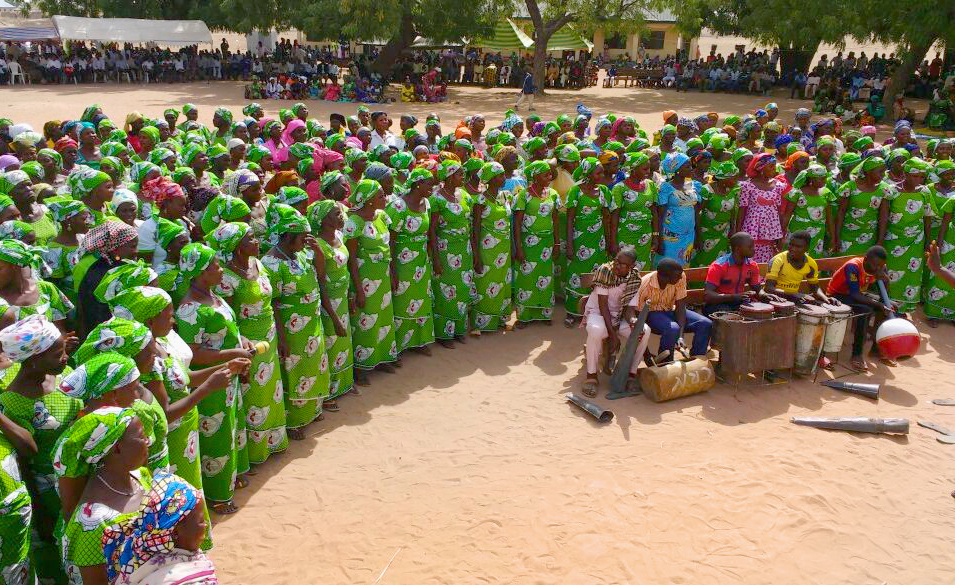
Meeting in mid-February, leaders from the United Methodist Church’s four annual conferences in the West African nation of Nigeria released a remarkable statement on our denomination’s current crisis. The Nigerian United Methodist leaders’ statement strongly supports the “Protocol” proposal for the separation of our denomination into at least two new ones, and rejects the perspective of the more liberal “African Voices of Unity” group. Entitled “Re-Statement of Church Unity from United Methodists in Africa,” it is signed by over 60 district superintendents, regional lay leaders, and other conference leaders and is broadly addressed “To Our Bishops in Africa.” This statement was noted earlier by the United Methodist News Service. (A notation about this meeting taking place in January rather than February was reportedly a typo.)
The Nigerian UMC leaders declare, “we are traditionalists rooted in the Biblical Christianity,” “strongly believing that homosexuality is incompatible with Christian teaching.”
As for our denomination’s future, these Nigerian United Methodist leaders express deep appreciation for the late Bishop John Yambasu of the nearby Sierra Leone Conference and “continue to celebrate his brilliant idea of Protocol for reconciliation & Grace through Separation.” They note how “through the leadership of the Holy Spirit, sixteen leaders representing centrists, progressives, traditionalists, and bishops were carefully invited and participated in crafting the Protocol for Reconciliation and Grace through Separation document,” with these representatives with very different perspectives meeting over the course of several months until “after significant compromises from all sides, they arrived [at a] unanimous decision on the protocol.”
In supporting the Protocol, these Nigerian United Methodists describe themselves as standing with the Africa Initiative as well as U.S.-based United Methodist renewal groups, specifically naming IRD/UMAction, Good News, the Confessing Movement, and the Wesleyan Covenant Association (WCA).
The Nigerian leaders’ statement makes clear that they felt prompted to make their own declaration in response to the attention paid to the “Africa Voice of Unity” group that has recently been promoted by some liberal Americans. This “unity” group’s main agendas appear to be categorically “reject[ing] any dissolution of, or separation within, our denomination in Africa,” supporting the “Christmas Covenant” proposal which would let each global region unilaterally decide its own ordination standards (i.e., allow American and likely some European United Methodists to ordain partnered gay clergy, and perhaps be more doctrinally loose on other matters as well), and harsh personal demonizing of theologically traditionalist United Methodist leaders, especially those associated with the Africa Initiative.
The “Africa Voice of Unity” appears to be a small group of just ten more liberal African individuals, at least two of whom now live in North America. But it includes one current and one former Nigerian General Conference delegate. The latter spoke at a February 2019 rally urging adoption of the so-called “One Church Plan” to liberalize the denomination’s sexuality standards and definition of marriage.
There is probably no region in which United Methodists are a complete theological monolith, however much some heavy-handed liberal bishops have done to push out orthodox believers. Some individuals in our denomination’s generally most theologically traditionalist regions hold more theologically liberal views, and vice-versa.
Sometimes American liberals seem to go out of their ways to cherry-pick and heavily promote the voices of only those non-American United Methodists who they find useful for their own agendas, while refusing to listen to more representative voices from the central conferences into which non-American United Methodism is organized. One very prominent example of the latter is the arrogant refusal of many liberal American United Methodists to respect the proper authority of non-American General Conference delegates in the adoption of the Traditional Plan. It is easy to criticize this as hypocritical and even neo-colonialist. But the reality is that Bishop Yambasu was the only African in the Mediation Team that negotiated the Protocol, and that since his untimely death, there have been many questions about where African United Methodist leaders stand. The relative dearth of readily available public statements from African leaders over the past several months has naturally provoked a hunger to hear more. And so in a way, the “Africa Voice of Unity” group was effectively stepping into a bit of a communications vacuum.
For their part, the dozens of Nigerian United Methodist leaders pointedly “disassociate” themselves from the Africa Voice of Unity’s own earlier manifesto and make clear that this “unity” group does not represent the four-conference Nigeria Episcopal Area of the UMC.
Furthermore, the larger group of Nigerian leaders challenges those in the “Africa Voice of Unity” to “embrace the teaching of Jesus as according to Gospel of Matthew 5:14-16 which encourages believers to stay away from act[s] that will destroy the unity of The United Methodist Church in Africa….”
Both groups celebrate rapid UMC growth in Africa, while warning that the other’s agenda poses a threat to this growth.
The Nigerian leaders’ statement did include one confusing and somewhat ambiguously worded line about how they “would uphold [Bishop Yambasu’s] Separation plan with amendment to regionalization of the Book of Discipline.” However, I have been assured by multiple sources close to the situation that this line was not intended as an endorsement of the sort of “regionalization” as in the Christmas Covenant, of letting different global regions have separate, mutually contradictory moral or doctrinal standards.
The Nigerian United Methodist leaders’ statement was released shortly before the announcement of another rescheduling of General Conference. But it remains an important declaration from a large group of representative African leaders.
The four Nigerian annual conferences have a combined membership of 520,212. This should make the voices of Nigerian leaders at least as worthy of attention as those of leaders in the extremely liberal, externally subsidized U.S. Western Jurisdiction, which has only 286,385 members. Yet as a clear matter of systemic racism in the United Methodist Church, the all-black Nigeria area has twice as many members but has been allowed only one bishop, while the predominantly white Western Jurisdiction is allotted five.
Given how now roughly half of all United Methodists live in Africa, American United Methodists must be especially willing to share or even surrender leadership as we listen to a range of representative United Methodist voices from other countries.
The full statement can be read here.

Comment by David on March 18, 2021 at 10:33 am
It would be interesting to ask the Nigerian leaders about their position on witchcraft and its punishment in their country. The reports are rather appalling.
Comment by Steve on March 19, 2021 at 11:11 am
I don’t know about witchcraft, but going off topic to invoke racist stereotypes is definitely appalling.
Comment by Douglas on March 19, 2021 at 12:19 pm
There is Islamic genocide going on against Nigerian Christian brothers.
Comment by David on March 19, 2021 at 3:08 pm
Here is one report:
https://www.bbc.com/news/world-africa-50742414
Comment by Gary Bebop on March 19, 2021 at 3:59 pm
There are trolls out there. They are among us. Pay them no heed. Their chariot wheels are stuck in quicksand.
Comment by David on March 19, 2021 at 4:34 pm
My point in mentioning this topic is to point out the cultural differences between the US and Nigeria and how difficult it would be to have one big happy family. Here is perhaps even a worse report:
https://borgenproject.org/child-witch-hunts-in-nigeria/
Comment by Thomas Brown on March 19, 2021 at 10:47 pm
The post about witchcraft is appalling. It has nothing to do with the article, and one wonders about the motivation behind it.