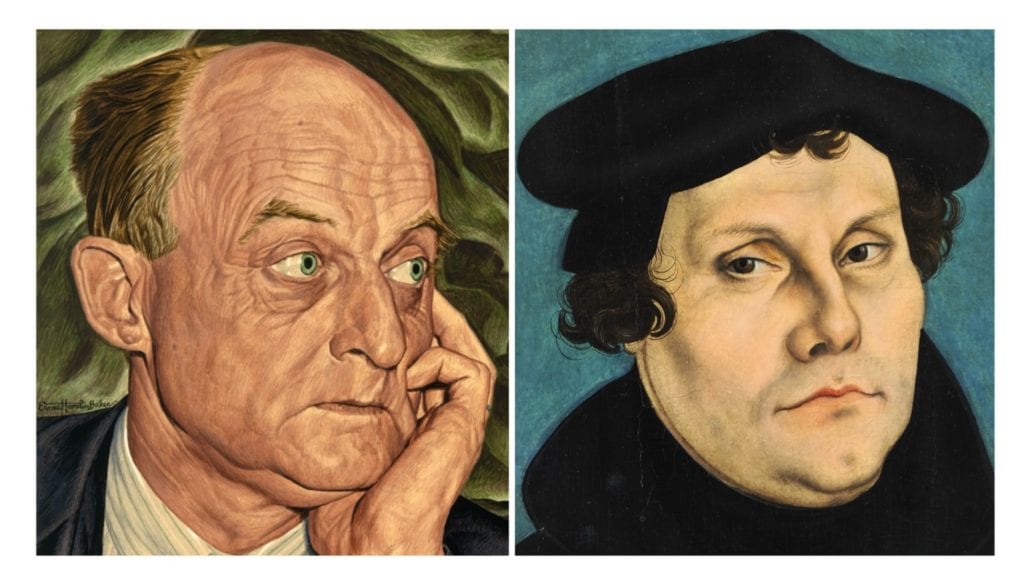

Reinhold Niebuhr visited Europe in 1947 and observed how Lutheran political theology had dramatically different impacts on Germany, which had just been deloused from Nazism, and reliably democratic Scandinavia:
No political position is so dogmantically held that party tension destroys the nation’s sense of community. This is how nations should grow and adjust their political institutions to the new requirements of a technical age. The constitutional monarchy is the symbol of the national life and the will of the people in its continuity and its transcendence over fluctuations of party politics. The political achievements of Sweden are interesting from a religious standpoint because the political ineptitude of Germany has frequently been ascribed to the Lutheran faith. The argument, which Dean Inge made during the war for instance, was that Luther’s complete separation between the individual life which was governed by “grace” and the collective life of man, which was governed by “law and force,” had the effect of removing politics from the realm of morals and faith and therefore allowing it to sink to the level of a cynical power politics. As regards Germany the criticism is not without some foundation. The political ineptitude of the Germans cannot be denied; and the separation of “the two realms” individual and social, as German Protestantism conceived it, must bear some responsibility for this ineptitude. But one should not draw too hasty conclusions when assessing historical causes and effects. It is well to study Lutheran Scandinavia on this particular issue. These Scandinavian countries are more completely Lutheran than Germany ever was. They are, in fact, the most homogeneous nations, religiously and ethnically in the whole world. But they have the sense of community which Germany lacked. In both their political and religious thought there is a restraint and a sense of measure which the Germans never attained. Furthermore Scandinavia never cultivated that uncritical attitude toward government, that religious sense of awe before the power of government, so dangerous to the development of the democratic spirit, which characterized German religious and political thought. Scandinavian democracy owes something to a medieval heritage. Even before the Reformation the Scandinavian monasteries had developed democratic forms, unknown in the rest of Europe. This historical foundation was a great resource. But to it must be added virtues of tolerance and restraint which developed in recent countries. It is a pity that language difficulties make it so hard for the outside world to learn from these small nations. They would have much to teach us if we had the linguistic instruments to tap the treasures of their history and their thought.
Martin Luther advocated a Two Kingdoms perspective that some, as Niebuhr noted, interpreted as confining morality to the church while leaving government outside its purview.Yet overwhelmingly Lutheran Scandinavia became egalitarian and lawful, while Germany at its worst became genocidal.
There were of course pre-Reformation influences that shaped Germany and Scandinavia. But there were also within Lutheranism seeds for different understandings and emphases. The stress on priesthood for all believers and salvation by faith alone obviously encouraged egalitarian and democratic impulses. It also could spawn anarchic antinomian misunderstandings. The Two Kingdoms proposal aims to recognize government works under common grace, mainly to seek public order. Government’s not instituted specifically and narrowly to incarnate the Sermon on the Mount or to evangelize the Gospel, which is the church’s task. But government, as Luther understood, with all major Christian traditions, should seek justice for all persons as equal image bearers of God.
Any form of Christianity can derail disastrously by narrowly stressing certain teachings to the radical exclusion of others. Politically, Christianity betrays its purpose if it totalizes or sacralizes politics or government. IRD’s founding statement was penned in 1981 by then Lutheran cleric Richard Neuhaus who warned:
To mistake any existing or proposed social order for the Kingdom of God is the great crime against humanity. We readily acknowledge that democratic governance is unsatisfactory. Everything short of the consummation of the rule of Christ is unsatisfactory. For Christians, it is precisely the merit of democracy that it reminds us of this truth and sustains the possibility of humane government in a necessarily unsatisfactory world.
In short, democracy is preferable to alternatives because its expectations of politics and government are limited. God has purposes for both, but neither in a fallen world can replicate fully His Kingdom. Neuhaus quoted Niebuhr’s famed adage: “Man’s capacity for justice makes democracy possible, but man’s inclination to injustice makes democracy necessary.”
Neuhaus also wrote:
Democratic governance is based upon a morality of respect and fairness for all. It is responsive to the diverse moral judgments and meanings affirmed by individuals and institutions within society. It not only tolerates but rigorously protects those spheres within which people find meaning for their lives and share that meaning with others.
And: “We do not know whether democracy is the wave of the future. We do know that the future will be darker if the democratic idea is extinguished.“
Neuhaus wrote during the Cold War whose outcome then seemed uncertain. Our times are comparatively less dire, but democracy is always threatened and needs persistent nurturing. Christians are called in their political duties, as Niebuhr said of Scandinavia, to foster in society a wider “sense of community” and encourage “restraint and a sense of measure which the German never attained.”
Loud, zealous and impatient voices get more attention. But Christian political witness should seek, in contrast to insistent fanaticisms, restraint and measure.




Comment by William Heath on December 12, 2020 at 7:11 am
Appreciate your articles. The insight and heart of the topic make sense for the reasoning mind.
Comment by Search4Truth on December 12, 2020 at 7:58 am
A wonderfully articulate message and reminder for today. Wonder if anyone is listening?
Comment by Michael Riddle on December 12, 2020 at 11:21 am
As long time reader of Richard John Neuhaus, I found myself identifying with much of your article. It reminded me of Neuhaus’ book American Babylon: Notes of a Christian Exile, which I highly recommend. Christians are indeed out of place in civic life, but they are not unaware.