
Those convinced that teenagers today shun the church, lack motivation, and spurn meaningful social involvement should probably reconsider. Barna Group challenges “The Myth of the Lazy Teen” with data from a newly published survey. The report, released on September 2, showed American teens pursue more than just so-called social media “slacktivism,” thanks in large part to the church, their parents, and youth pastors.
“There’s been plenty of debate about teens and their social justice ‘slacktivism,’” the report began by stating, “but how much truth is there to the claim that young people are only taking action with 140 characters or less?” Not much, Barna concluded, since “teens are actively engaged in service and volunteer projects and youth ministry is a primary channel through which they serve.”
Indeed, most volunteer regularly. Serving the needs of their community through their local churches remains a central element of their lifestyle. Barna noted they are actually “flocking to the local church when they feel the urge to volunteer.”
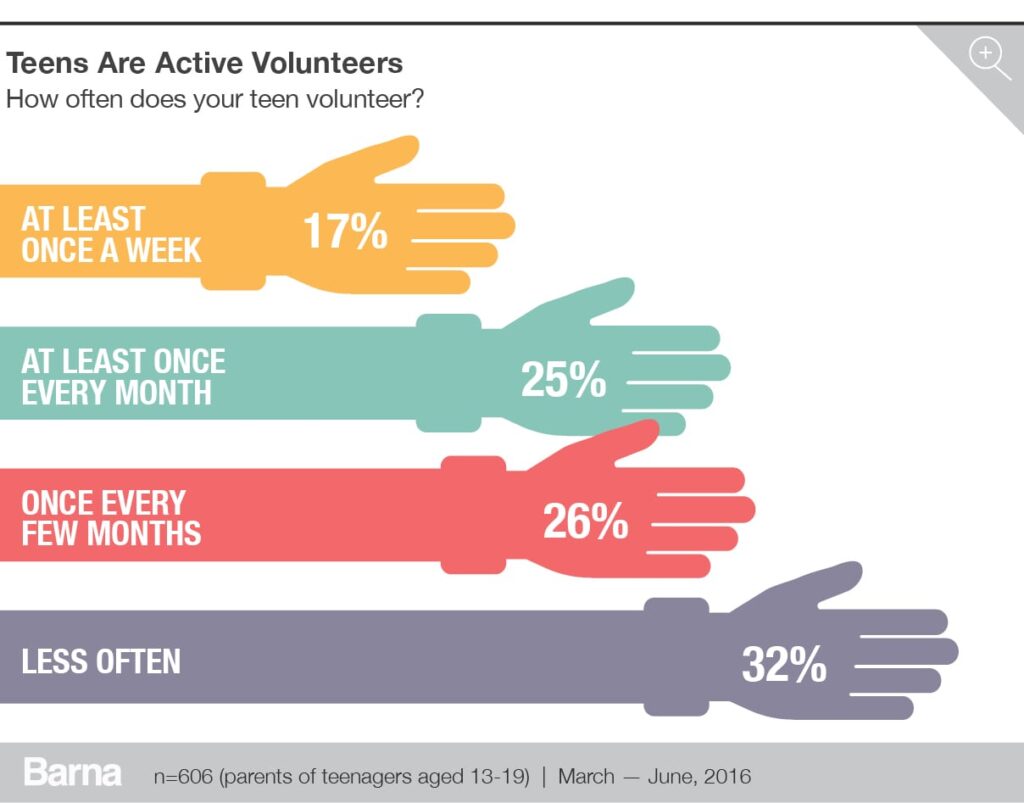
The survey found that 68 percent of teens, more than two thirds, volunteer on a regular basis. Most parents, who responded on behalf of their teens, said their children volunteered at least weekly (17 percent), monthly (25 percent), or every few months (26 percent).
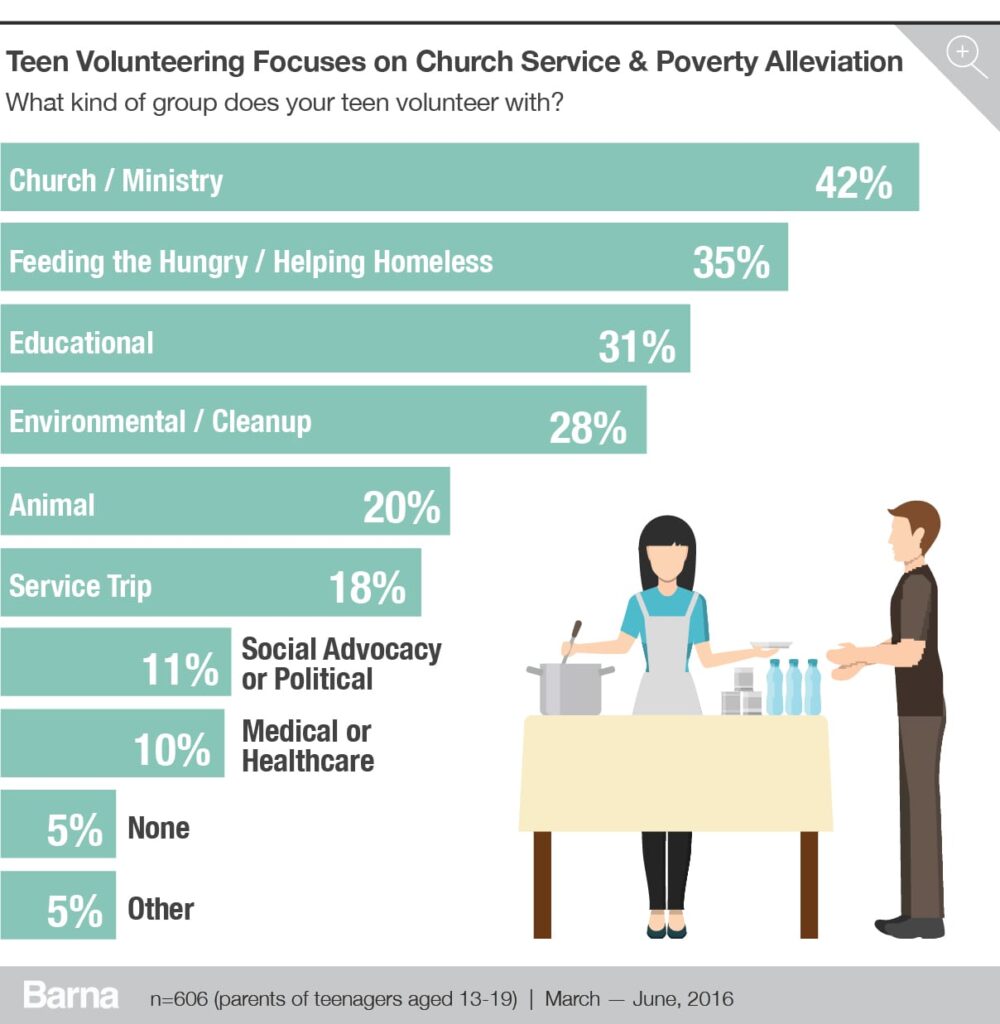
Interestingly, the ways teens volunteered were remarkably practical, rather than oriented toward activism. Only 11 percent of teens participated in political or social advocacy. More often their efforts focused on church ministry (42 percent), feeding the homeless (35 percent), education (31 percent), cleanup and environmentalism (28 percent), and care for animals (20 percent). Just less frequently than activism, 10 percent of teens engaged in providing healthcare.
Whether teens attended church with their parents proved to be a strong predictor for volunteerism – 60 percent for those who did versus 16 percent for those who didn’t. Sixty-two percent of teens who went to youth group regularly also participated in a project with their church. Most of these projects were church service days (52 percent) and/or service days in their hometown (48 percent). A much smaller portion said they travelled more than a day (19 percent) or outside the U.S. (8 percent) in order to serve with their church.
However, when teens were able to travel on extended service trips, it almost always made a “lasting impression” on them. Parents overwhelmingly said it “definitely” (74 percent) or “probably” (24 percent) did so. Barna highlighted how a youth pastor following up after a service trip could help cement takeaway lessons.
What’s clear is that although teenagers may have a reputation for slacktivism, they are actually quite active through their churches. Involvement from parents and youth pastors reinforces this commitment.
“The church, and youth groups in particular, have a unique opportunity to stand out as an authentic example of love through service by being the hands and feet of Jesus to those in need,” said Barna Vice President of Research Brooke Hempell.
So while it may be tempting to berate teens for slipping into mere slacktivism, it’s clearly more effective to encourage them and equip them for ministry. Provided with the right opportunity and an example of Christian love, the evidence shows they are ready to serve.



Comment by Jaden on December 3, 2018 at 9:57 am
What the heck, this article is so stupid! Teens that are not into christ can be teen activists too! In this article you stated that most of all the teens that are activists are involved with christ. This article can be racism to religion and could be taken down by the law. That is why you should not state that teen activists that are with christ are mostly the ones that do something, just because your with christ yourself doesn’t mean you should only include stuff about christ. Please take down this article because it is racism to religion.