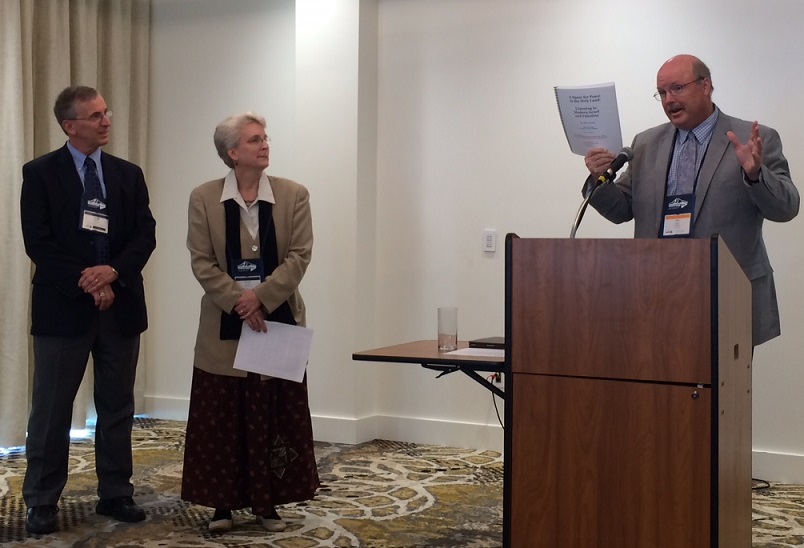
Proposals to divest United Methodist Church (UMC) pensions from companies that do business with Israel are counter-productive and will not foster a narrative leading to Middle East peace, according to a group working against divestment at the denomination’s top legislative gathering.
“Divestment is often cloaked as an answer that comes with assumptions about Israel that are dangerous,” cautioned Alex Joyner, a District Superintendent from the Virginia Annual Conference and a speaker at a May 10 press conference sponsored by United Methodists for Constructive Peacemaking in Israel and Palestine. “I don’t think divestment has proven to be effective on the ground.”
Delegates from across the 12.1 million-member United Methodist Church are gathered this month in Portland, Oregon for their quadrennial General Conference, a gathering which will consider several competing proposals for and against a policy of anti-Israel divestment.
Speakers at the press conference emphasized that the Israeli-Palestinian conflict is not analogous to 1980s apartheid-era South Africa or the 1960s civil rights movement in the United States, although those comparisons are regularly made by divestment advocates.
“Solidarity with the oppressed is a Jesus things to do, and it emerges from our best impulses,” Joyner declared, but the Methodist clergyman qualified that problems quickly emerge “when we see righteousness in one party only … and don’t seek a new shared narrative that will allow for peace.”
The reserve delegate from the Virginia Annual Conference stated that divestment operates on a misguided belief that placing economic pressure on Israel will bring about a lasting peace.
“It is a punitive and violent measure,” Joyner assessed, stating that Israel is not capable of ending the occupation on its own — and that the Jewish state has “legitimate concerns about security” and “cannot just unilaterally withdraw” without an arrangement with Palestinian authorities.
“Peace will not come by trying to tear down the militarily stronger party,” Joyner announced. “It [conflict] will only come to an end when there is enough trust to make a space for peace to happen.”
Joyner introduced three petitions, “Investment Ethics,” “Diplomacy and Investments in Palestine,” and “Saying No to Violence in Middle East Conflict.”
“We have to realize that this conflict is more than about just an unwanted Israeli occupation,” assessed Dan Bryant, a District Superintendent from the East Ohio Annual Conference.
Bryant warned that divestment “will only increase the Israeli sense of isolation” and won’t encourage Israelis to take risks for peace.
The speakers proposed a series of resolutions setting up non-exclusionary investment screens “that reward companies who invest in ways that encourage peace”.
“Let’s reward good peace and good peacemaking behavior instead of trying to punish one side,” Bryant suggested. “Without a strong economy, there will be no viable Palestinian state once it comes into being.”
Bonnie Marden , an elected lay delegate from the New England Annual Conference, pointed out that both Israelis and Palestinians “have been victims of the others’ violence” and charged that “violent actions like divestment shame, isolate.”
Marden expressed hope that rather than being divisive, United Methodists will be able to bring something that will make a positive difference in the region.
The United Methodist Church has considered and rejected numerous proposals to divest the church’s financial holdings from companies that sell non-lethal products and services to the Israeli military, including Caterpillar tractor, Hewlett-Packard and Motorola Solutions. At the denomination’s 2012 gathering in Tampa, Florida, an anti-Israel divestment proposal was rejected by a 2-1 margin.
Joyner argued that withdrawing funds from companies that do business with Israel advances a narrative in which Israel is seen as the sole problem in preventing a final status outcome and a lasting peace.
“It [divestment] is a diversion from the other issues that need to be addressed in order to bring about a final status agreement,” Joyner alleged.
Marden added that it was important to move “away from the idea that one action is going to change everything” and to carefully consider unintended consequences to well-meaning actions.
“We’re living in this world where anything we do or say is going to get reinterpreted over and over again,” Marden cautioned.
The press conference came one day after Democratic Presidential Frontrunner and lifelong United Methodist Hillary Clinton issued a letter stating that the Boycott, Divestment, and Sanctions (BDS) movement against Israel was “not the path to peace.”



Comment by Eternity Matters on May 11, 2016 at 7:59 am
These “Christian” Lefts don’t believe the Gospel, but they do all this grandstanding because someone might have a slight investment in Israel? Do they protest companies doing business with Muslim countries? Do they seriously think Israel is a greater risk than ISIS?
They don’t even believe their words about the poor, or they’d sell these investments and help them.
Comment by Alan Hoffman on May 13, 2016 at 9:54 am
I totally agree. I think these “Christian” leftists should at least be consistent and give up buying gasoline and oil products based on Middle Eastern oil.
Comment by JaydeeHanson on May 18, 2016 at 3:19 pm
Please support the effort to divest of these oil companies in our board of pensions portfolio.
Comment by apriluser on May 11, 2016 at 9:16 am
Once again the UMC is dancing around the real issue of a declining church membership, aging congregations, and loss of influence in the larger culture. Not sure what real connection this issue has with “making disciples for the transformation of the world”. The Titantic is sinking but the band plays on.
Comment by Skipper on May 11, 2016 at 12:12 pm
Israel took the rest of Judea and Samaria in a war started by the Arabs. To give it back would unsettle the area as Israel could be left on 18 miles wide in the middle. That would tempt an attack by their enemies. Why can’t these “divesture” people be peaceful?
I wouldn’t have mentioned Hillary Clinton. Didn’t she and the Administration support overthrowing the two most peaceful dictators in the Muslim world – in Egypt and Syria? After Egypt’s “peaceful” dictator was overthrown a real tyrant came to power (later toppled by their military). Syria is still torn by war, a war that should not have been encouraged.
Comment by Alan Hoffman on May 13, 2016 at 9:55 am
Small point, but Jews are from Judea (modern day West Bank) and Arabs are from Arabia. I cannot make it simpler than that.
Comment by Alan Hoffman on May 12, 2016 at 9:21 am
The article is balanced in that it educates people that there are 2 sides to the story. Security is not delivered by, advanced or encouraged by punishing the Israelis with any kind of economic sanctions. It requires Palestinians to choose a real peace rather than the Islamic “hudna” (temporary cessation of hostilities to be resumed when advantageous). The Church is not educated on the Arab (Islamic) idea of Dar-al-Islam (previously conquered territory once lost is still Islamic) and Dar-al-Harab (the rest of the world untouched by Islam is ripe for war and Islamic imperialism). Ignoring that cultural imperative from the Islamic “other” is willful blindness of the realities in the Middle East. A suggestion would be to invest in companies, like SodaStream, that foster co-existence by employing both Arabs and Jews. That is inclusive and non-punitive and more likely to foster mutual dependency in a positive way.
Comment by Wayne D. Worsham on May 12, 2016 at 1:43 pm
Israel has an UNCONDITIONAL ownership of the land in which they currently live, plus more land than they are currently living. If you want to know modern day judgement on the two state solution, read “Eye to Eye: Facing The Consequences of Dividing Israel” by William Koenig. Don’t think that churches will not be judged as well for trying to divide Israel. Also, when Yeshua returns to set up His Kingdom in East Jerusalem, shall the UMC threaten to boycott Jesus, a Jew, from His “occupation” of “Palestinian” territory? According to the BDS movement, Jesus has no right occupying East Jerusalem upon His Second Coming since he is Jewish.