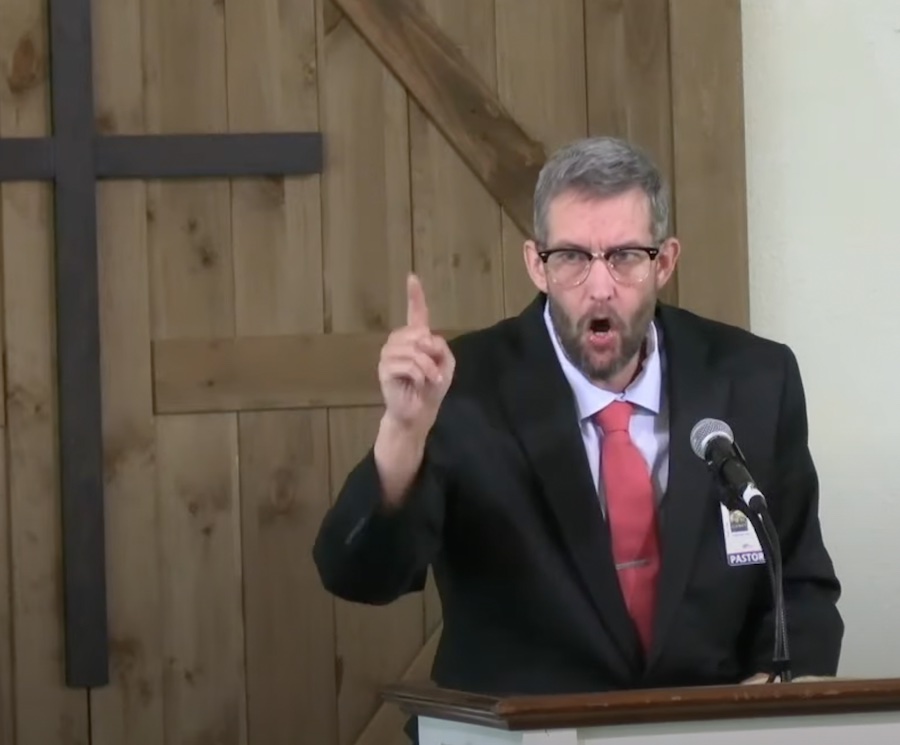

Tucker Carlson, independent journalist and ex-FOX News host, recently released an interview with Christian Commentator and Former Pastor J.D. Hall of polemical website Pulpit & Pen, now known as Protestia, discussing their disagreements with Christian Zionism. While the interview began with theological critique of dispensationalism, it quickly moved into a fervent anti-Zionist appeal, a bizarre defense of the Ottoman Empire, and concluded with the dismissed pastor claiming Israel and Jews are a “war cult” using warfare as a form of blood sacrifice.
Hall, a high profile pastor dismissed after a public falling out with his Reformed Baptist congregation in Montana, is the latest in a string of guests offered a sympathetic platform on Carlson’s popular video podcast with views that are anti-Israeli and, in the case of far-right influencer Nick Fuentes, outright anti-semitic.
Dispensationalism is a theological framework that divides human history into distinct, divinely appointed eras. Popularized in the 20th century and briefly reaching mass appeal in 1990s evangelicalism through the Left Behind series of novels and film adaptations portraying an imminent end times scenario, dispensationalists hold that the Jews, as well as Christians, are God’s chosen people and receive his blessings, with separate paths for salvation. That framework has receded from evangelical scholarship and is not instructed in most large evangelical seminaries, but critics note that its key tenets – a literal rapture and period of global tribulation necessary before the Second Coming of Christ – are regularly assumed, if not expressly named, in nondenominational evangelicalism and Pentecostalism. This is distinct from covenant theology, which holds that Christians alone are the inheritors of the New Covenant and the Old Covenant has been fulfilled in Christ.
Hall explained to Carlson how Genesis 12:3, “I will bless those who bless you, and him who dishonors you I will curse, and in you all the families of the earth shall be blessed,” is a basis of this idea of God’s blessings in covenant theology. The Christian commentator insists that this passage is misrepresented as “Those who bless Israel will be blessed” and subsequently extrapolated into support for the creation and preservation of a Jewish state in the Middle East.
Hall explained his own beliefs on the relationship between the Old Testament and the New Testament, namely that the rituals and symbols of the Old Covenant were meant to allow the Jews to recognize their messiah when he arrived. Carlson then mentioned how there are moments even in the Old Testament where it’s claimed that the whole world will be saved. Hall agreed, citing Isaiah chapter 19, “The Egyptians and the Assyrians will be redeemed by God in the end days.”
Hall criticized dispensationalism claiming that, in this theological approach, the Church loses its exclusive claim to God’s blessing. The former pastor characterized dispensationalists as viewing the church as “a parenthesis.”
“Instead of being the bride of Christ, the church is more like a summer fling,” Hall described, claiming it is a “very Jewish way of looking at scripture, where Jews and Judaism and Jewish people are always at the center of the scripture as opposed to Jesus.”
Hall pivoted to Jesus’ crucifixion. He acknowledged that the Romans physically carried out the execution, but he then quickly pointed to how Roman Governor Pontius Pilate and the Roman centurions were pagans who either did not want the execution, or had come to see Jesus as the Christ. The Roman Empire would eventually convert, Christianity becoming the state religion. Hall recalled the stoning of St. Stephen the Martyr, noting his statement to the religious leaders in Acts 7:52, paraphrasing “You’ve always killed God’s prophets, and you’ve killed Christ.”
Hall then began calling into question the origins of the Scofield Reference Bible, using terms like “allegedly” to describe whether American Bible student Cyrus I. Scofield was the theologian who wrote the margin notes. Hall noted that Oxford University Press owns the publishing rights to the Bible translation and stated that it was the “hotbed of political Zionism.” Hall then went on to say that, at the time of publication early in the 20th century, many Baptist and congregationalist pastors would possess little formal scholarly training and would usually only have a Bible. He furthered this by saying the Scofield Bible, with its margin notes, was a rare scholarly resource for these pastors. These margin notes in the Scofield Bible were based on dispensationalist theology and were then, over time, adopted by churches that used the Scofield Bible. Following this, he brought forth the idea that British political Zionists funded the translation as a way to drum up support for the creation of Israel among Christians by influencing theology. He also mentioned how, within a year of the British Government’s publication of the Balfour Declaration that announced support for the establishment of a “national home for the Jewish people” in Ottoman-controlled Palestine, Oxford University Press would publish the Scofield Bible.
Later, Hall addressed the Israeli right of return, law permitting any Jew in the world to have the right of travel to, and to become a citizen of, Israel.
“If you’re a Jew who believes in Jesus, you’re not welcome back,” Hall insisted, explaining that the right of return is nullified if a Jewish person “joined another religion.”
“You can be a Satanist as long as it’s not organized Satanism,” Hall insisted on who could be allowed immigration to Israel. He also talked about how (Messianic) Jews in Israel who believe in Jesus will phrase it as “believing in Jesus” and not as being a Christian, because the latter, according to him, may be grounds for deportation by the Israeli government.
Hall then segued into defending the Ottoman Empire, saying, “The Ottomans didn’t make churches pay tax,” as a point against an Israeli requirement for churches to pay a property tax levied by their local municipality. Hall failed to mention the institutionalized tax levied on “people of the book” by Muslim authorities, the Jizyah, which ranged from low, flat tax rates to high percentages of income, depending upon the ruler. In addition, the Ottomans carried out brutal repressions on clergy and laity alike, engaging in extreme brutality and cruelty while doing so. This is to say nothing about the Janissary system, in which thousands of Christian children were enslaved, forcibly converted to Islam, and made to serve as soldiers and bureaucrats in the Ottoman army. So while it is true that during the Ottoman Empire, there were, as a rule, no direct taxes on churches (there were confiscations of Church properties), it is disingenuous to frame the Ottomans as more accommodating of Christians than the state of Israel and to claim that they were “very kind” to Christians.
Following this, both Carlson and Hall commented on the Israel Defense Forces (IDF) and the conduct of its soldiers, particularly in regards to the war in Gaza following the October 7th attacks. Carlson termed the IDF “the most brutal military in the world, which is globally renowned for murdering innocents at scale.” Hall followed up later, again, claiming legitimacy as the successors to Abraham and referring to the Jews as a whole, “The Christian Church, which is chock-full of gentiles… We’re the chosen nation, they’re (the Jews) a desert war cult, who’s murdering a lot of innocent people.”
Hall went on to make an incredibly concerning comment, saying,
“The bloodshed of the Old Covenant religion, of Moses, is what symbolizes the forgiveness of sins. It allowed them to see and understand the Messiah and what Jesus would do on the cross, and by his blood we’re actually forgiven. But after the temple fell in 70 AD with no altar, no temple, with no priesthood to make those sacrifices, and with no blood being shed, where does the blood come from in Rabbinic Judaism? And I think it comes from their fixation on war. I think that they view it almost as an actual real atonement. That they are accomplishing something of actual spiritual value when they go to war and kill gentiles.”
Hall’s claim is particularly alarming, that the state of Israel and the religion of Judaism use war as a form of mass blood sacrifice, either directly or indirectly as a blood offering. His previous statements about the theology of dispensationalism and the history of Zionism, while controversial for many, are far less vitriolic than making such an inflammatory accusation and laying it at the feet of the religion of Judaism as a whole.
More from IRD:
Theobros Radicalizing Young Christians




Comment by Wilson R. on July 9, 2026 at 11:49 am
J.D. Hall is basically repeating the old blood libel in a new and different form. And he seems to be nuts.
But instead of spending so much time debunking obvious cranks, why not devote more space to a serious discussion about how the meaning of Zionism has evolved and the kinds of questions many people are wrestling with, such as whether it is still possible to support the state of Israel as a Jewish homeland without also supporting the apartheid policies of the current Israeli government.
Rahm Emanuel, an American politician who was born in Israel, went there yesterday and delivered a major speech about how he believed the current US-Israeli relationship was unsustainable. Seems like that would be a better basis for a real theological discussion than what some Tucker Carlson/Nick Fuentes wackjob is spouting.
Comment by David on July 9, 2026 at 2:49 pm
What we have seen in Israel from day one was not a “blood sacrifice,” but ethnic cleansing. As early as 1937, before the “Final Solution” was even formulated, David Ben Gurion wrote privately about the necessity of the removal of the native population to create a Jewish majority. This has continued to create “living space” for the increasing Jewish population.
This is not unlike what was practiced in the US against Native Americans in the 19th century. The Palestinians, however, did not so easily die of smallpox and other introduced diseases from Europe.
States that do not involve themselves with religion are the most tolerant. Jews actually have more religious freedom in the US and Europe than in Israel. Before this statement is dismissed, consider the marriage laws and status of Reform Judaism in Israel.
Comment by Gary Bebop on July 9, 2026 at 3:19 pm
These anti-Zionist or anti-Israeli comments being posted at this site should not go unchallenged. I would ask Mark Tooley and IRD to note how this site is being used to promote antisemitism in anti-Zionist drag. Israel has robust internal debates about the defense of Israel. Let’s give space for that conversation, not the debate highjack we see in this comment section. Antisemitism is a malignancy. It feeds on big lies, small lies, disinformation, and fools. cranks, and collaborators.
Comment by Gary Bebop on July 10, 2026 at 1:21 am
The sickness of antisemitism is showing its face here. There’s no mistaking it. Mark Tooley and IRD and Wesley Institute staff must pay attention. Watch what happens rhetorically. The virulence of it is astonishing.
Comment by Wilson R. on July 10, 2026 at 9:47 am
Gary, if criticizing the leadership of Israel is anti-semitic, then Isaiah, Jeremiah, Amos, Micah, and Hosea were all rabid anti-semites.
Comment by Jeffrey Walton on July 10, 2026 at 11:35 am
A brief reminder that, while this blog provides expansive latitude for readers’ comments, there are limits. Please critique ideas, but do not make personal attacks on others. Comments in violation of this policy have been and will be removed. Thank you.
Comment by Qohelet on July 10, 2026 at 4:11 pm
The Carlson /Hall discussion is clearly antisemitic, and it is a useful example of what is and is not antisemitism.
Criticizing Israel ‘s behavior is no more antisemitism than criticizing any other government. There’s nothing wrong with pointing out that Israel under Netanyahu is doing horrific and evil things.
Where the line is crossed is when they claim that spilling blood is a part of Rabbinic Judaism. In other words, they say Israel is violent because of the Jewish religion. That’s antisemitism for sure.
“Israel is violent and cruel because of this thing it did:” legitimate political opinion
“Israel is violent and cruel because they are Jewish:” absolute antisemitic vitriol
Comment by Alf on July 13, 2026 at 7:55 am
Hall and Carlson are troubled men. Hall has been dogged by controversy while Carlson is obsessed with Israel though he constantly denies it. The interview has been broken down by several commentators. Not only was Hall fact-challenged regarding the Ottomans, he also spouted the same simplistic Covenant Theology explanation of Gen 12:3. That it is not about the church, but about Israel, is clarified further in Gen 27:29 and Num 24:5-9. It couldn’t be clearer unless one’s interpretation is driven by presupposition.
Comment by Randy McWilson on July 14, 2026 at 12:20 pm
Thank you for drawing attention to the deeply troubling rhetoric in this interview.
J. D. Hall’s description of Jews as a “desert war cult,” along with his speculation that warfare functions as a substitute blood sacrifice in Judaism, goes far beyond legitimate criticism of Israeli policies or theological disagreement with Christian Zionism. It assigns a sinister religious motive to an entire people without evidence.
One related part of Hall’s argument also deserves closer historical scrutiny: his insinuations concerning C. I. Scofield and the Scofield Reference Bible. Christians are certainly free to criticize dispensational theology, but Oxford University Press owning the publishing rights—and the presence of Zionist sympathies among some people associated with Oxford—does not demonstrate that political Zionists secretly authored, financed, or directed Scofield’s notes.
No contemporary contract, letter, financial record, diary, or eyewitness testimony has been produced showing that Samuel Untermyer (Untermeyer), the Rothschild family, Jacob Schiff, Bernard Baruch, or other Jewish financiers funded or controlled Scofield’s work. By contrast, contemporary and near-contemporary sources identify the Christian businessmen who supported the project, including Alwyn Ball, John T. Pirie, John B. Buss, Francis E. Fitch, and Lyman Stewart.
The surviving Lotos Club records are also significant. They show that Scofield’s membership was proposed by Horatio Fraser and seconded by John Elderkin—not by Samuel Untermyer. No known correspondence from Scofield mentions Untermyer, and no known writing from Untermyer mentions Scofield.
None of this requires anyone to accept Scofield’s theology or endorse every action of the modern State of Israel. It simply means that serious historical accusations should be based on contemporary documentation rather than guilt by association and later repetition.
I have assembled the relevant primary sources, funding records, Lotos Club documentation, and history of how the allegation developed here:
https://scofield-files.com/who-funded-the-scofield-reference-bible/