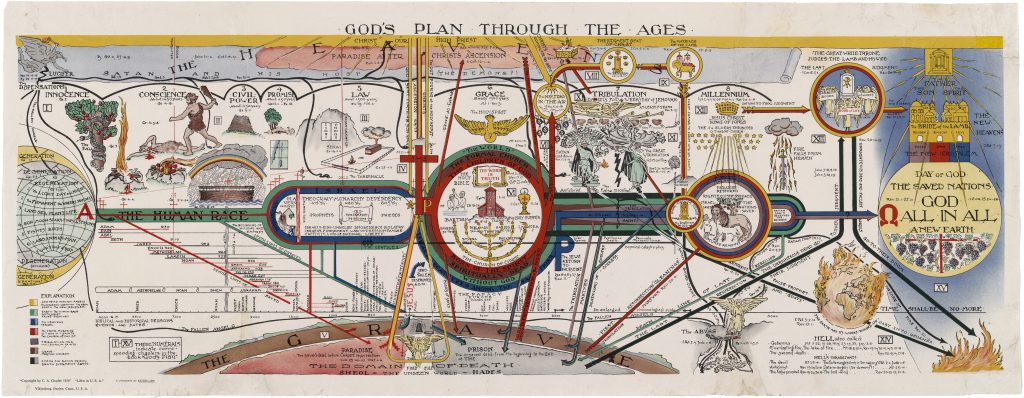

The decline of Dispensationalism’s influence does not signal an evangelical retreat from the public square, but rather a fundamental reorientation of it. By removing the prophetic necessity that once mandated specific alliances, the collapse of this framework is accelerating the expansion of the culture war web of mutual antagonism, exposing deep-seated social and cultural frictions that were previously shielded by the grip of dispensationalism on Protestant public engagement.
For much of the second half of the 20th century, American Protestantism was defined by a radical theological innovation: Dispensationalism. As Mainline denominations receded, a new evangelical vanguard—powered by the Assemblies of God, the Southern Baptist Convention, and the reach of satellite television ministries like the 700 Club and the Trinity Broadcasting Network—redefined the public witness of American Protestantism.
The dispensationalist framework spread within those networks, popularized by works from Hal Lindsey and John Hagee, and by fiction from authors like Tim LaHaye and Jerry Jenkins who wrote the Left Behind series, and the comic book style tracts of Jack T. Chick. Together, they instilled a hermeneutic of suspicion toward global institutions and a dual passive-protective posture toward Israel and Jewish Americans.
Dispensationalism began with the British 19th century Plymouth Brethren leader John Nelson Darby, who developed a complex timeline dividing human history into distinct eras, or “dispensations,” each governed by a specific set of divine rules. What made this influential on public life was that it went beyond theology to provide an almost prescriptive method for interpreting current events.
When this framework came to the United States, it found fertile ground in the burgeoning Bible Institute movement through James H. Brookes and D. L. Moody. The definitive turning point was the 1909 publication of the Scofield Reference Bible. By embedding Darby’s complex eschatology directly into the margins of the biblical text, Cyrus Scofield effectively imposed an ahistorical and not-traditional interpretation on the Bible, an irony given that the work has appeal to nuda scriptura Christians who see the Bible alone as authoritative and exclude tradition.
The adoption of the Scofield framework by 20th-century megachurches and television ministries did more than change Sunday morning liturgy; it radically altered evangelical political witness amid Mainline Protestant decline and Cold War anxieties. This was heightened by dispensationalism’s focus on the end time conflict known as the Tribulation when a literal embodied Antichrist would lead a global government. Fear of signs of the antichrist baked this anxiety into the American religious psyche.
This hermeneutic of suspicion viewed any move toward international cooperation, such as the formation of the United Nations or the European Union, not as diplomatic progress, but as a chilling prerequisite for the Great Tribulation.
After the 1979 Iranian Islamic Revolution and reigniting of Cold War competition during the Reagan Administration, American dispensationalists viewed geopolitical tensions with Iran, Russia, or China not through the lens of secular realism, but as the fulfillment of “tidings from the East” mentioned in the book of Daniel or the coming of a Gog and Magog war.
For the dispensationalist, the state was never neutral; it was a potential vessel for the ultimate deception, a belief that cemented a populist, anti-globalist streak in American Protestantism. Institutions like the International Monetary Fund and the World Bank were not judged according to their efficacy or principles of realism but seen as the mechanism for imposing a global one-currency tyranny that would prevent anyone from engaging in trade unless they submitted to Satan’s chosen false-messiah.
Dispensationalism also promoted a dual passive-protective posture toward Israel and Jewish Americans, viewing them as central actors in a divine eschatological drama. On the positive side, it formed a firewall against antisemitism. On the less positive side, it romanticized and arguably objectified Jewish people and Israel. It created a widespread impression that Christian support for Israel was entirely based on dispensationalism and biblical prophecies. This assumption is playing out today as some postliberal Catholics are attacking Zionism as a supposedly Protestant heresy at odds with Catholic teaching, ignoring that many Catholics, and others, are Zionists without any reliance on dispensationalism.
The dominance of dispensationalism is currently being hollowed out by a dual-front migration. First, some younger evangelicals are abandoning the religious innovations of the 20th century in favor of older, more rooted forms of Christian worship. Central to this is a burgeoning interest in Anglicanism, framed not as a liberal departure, but as a return to a foundational, traditionalist, and robust Anglo-American Protestant tradition. Similarly, the move toward Eastern Orthodoxy and Roman Catholicism represents a rejection of the “rapture culture” in favor of a sacramental worldview that is fundamentally non-dispensational.
Also, many evangelicals of all ages have moved beyond dispensationalism. There were no successors to Pat Robertson, Hal Lindsey, and Tim LaHaye. Dallas Theological Seminary, once a headquarters of dispensationalist theology, has largely moved on. And Christian commentators are no longer anxious to relate contemporary events to biblical prophecy. But it is notable that the dispensationalist mindset, however, has gained some ground among many segments of Black America and Latino American Protestants.
Additionally, the second and perhaps more significant migration, is the rapid secularization of White American formerly Christian households. A vast swath of formerly Christian White America has transitioned into a Secular White America, for whom the biblical hermeneutics of the 1970s and 80s are viewed as relics of a paranoid past rather than a roadmap for the future.
The most significant consequence of the dispensationalist decline is the collapse of the theological firewall that historically shielded the relationship between conservative Protestants, Jewish Americans, and Israel. Viewing Jewish political sovereignty in the Holy Land as an essential gear in the clock ticking toward the Second Coming of Jesus Christ; for the dispensationalist, this was not a normal political alliance but a prophetic requirement. Absent that prophetic confidence, American evangelicals, especially if younger, are no longer passionately pro-Israel. They now require alternative arguments.
So too for dealing with the rise of the anti-Jewish online groyper movement, which appeals to some Christian young men, many of whom lack the theological and moral tools to rebut it absent dispensationalism.
As dispensationalism’s theological shield dissolves, antisemitism, hostility to Israel, and overall confusion about how Christianity relates to Judaism abound. In our current postliberal and tribal moment, appeals to universal human dignity and brotherhood are less persuasive. The result is a more volatile and expansive front of cultural conflict, where a once-stable pillar of the American religious right faces a framework dissolution, turning culture war into a web of antagonisms rather than a clear arena.
Without strong dispensationalism, American evangelicalism needs not only a new explanation for friendship with Jewish fellow citizens and with Israel, but also to undergird its overall political framework for addressing the world.
Dr. Albert Thompson is a historian of American political development, culture, religion, and conflict. He is a lay leader in the Anglican Church in North America and serves on the Board of the Institute on Religion & Democracy.
More from IRD:
Hal Lindsey’s ‘The Late Great Planet Earth’




Comment by Salvatore Anthony Luiso on February 23, 2026 at 4:02 am
Thank you for this article. I generally agree with it.
However, regarding “And Christian commentators are no longer anxious to relate contemporary events to biblical prophecy”: There are plenty of Christian commentators who still do this. For example, when Trump moved the American embassy in Israel from Tel Aviv to Jerusalem, some said it was the fulfillment of prophecy. (Which prophecy, I don’t know.)
I agree that “The dominance of dispensationalism is currently being hollowed out by a dual-front migration”. It’s unclear to me whether the author thinks dispensationalism itself and excesses related to it are motives for that migration.
I find it remarkable that less than a generation ago, dispensationalism seemed to be at its height in popularity and influence. How and why did its popularity and influence fall so far so fast?
I see five reasons other than facts which are mentioned in this article (e.g. its ahistoricity):
1. Years of false interpretations of current events which became obsolete (e.g. false interpretations of prophecy which involved the Soviet Union, which were obviously false after the collapse of the Soviet Union)
2. Bad books and movies which made it seem ridiculous (e.g. bad movies about the Rapture)
3. American failures in the Iraq War
4. American failures in the War in Afghanistan
5. Drastic changes in the relationships between Israel and its neighbors. From the 1940s to the 1970s, it was a tiny nation surrounded and beleaguered by enemies, whose very existence seemed miraculous. Since the 1970s, it has become the most prosperous and powerful country in its region by far. it has established peaceful relations with Egypt, Jordan, and other neighbors, and its existence doesn’t seem so miraculous. Besides that, its treatment of Palestinians in the West Bank and Gaza has become increasingly difficult to ignore and excuse (which is not to say there aren’t still plenty of people in America–especially among fundamentalist and evangelical Christians–who ignore and excuse it).
Comment by Philip Massey on February 23, 2026 at 11:27 am
This article perpetuates the myth that Dispensationalism was Darby’s invention. As Charles Ryrie’s seminal work on the subject ably documented, the early framework of Dispensationalism can be traced back to the church fathers in the fourth century, and Isaac Watts had a 6-point framework that is nearly identical to the 7-point Darby-Scofield framework. Except that Isaac Watts lived a century before Darby! There is also an excellent book called “Dispensationalism Before Darby” by William Watson. Therefore, the assertion that “Scofield effectively imposed an ahistorical and not-traditional interpretation on the Bible” is just wrong. The interpretive framework was the culmination of MANY centuries of development. If one wants to argue that most of church history did not believe in a future for Israel and instead believed that the OT promises are spiritually fulfilled in the Church, the obvious response is that for 19 centuries, there was no nation of Israel in existence. Therefore, for 19 centuries, theologians could not possibly have anticipated that God really did intend to fulfill the Old Testament restoration promises in a literal sense.
Comment by Gary Bebop on February 23, 2026 at 12:45 pm
This article is intriguing for several reasons, not least for its missteps of interpretation. Another commentator has rightly noted that trust in the return of Jesus Christ is one of the three pillars of Christian proclamation (“Christ has died; Christ is risen; Christ will come again”). The New Testament writers framed their message within this anticipated Final Revelation (and God’s irrevocable covenant with Israel). There are too many examples of this to be doubted. The Protestant mainline continues to obscure or neglect the historical nature of this anticipation. I’m not sure why this is so. Perhaps it’s implicit confidence and optimism about modern progress, as though the paradigm is eternal. More conservative Christians are skeptical of this as mere hubris.
Comment by Qohelet on February 24, 2026 at 9:52 am
Thank you for this article, which I generally enjoyed.
Regarding Israel’s relationship with all branches of Christianity- I fear it will be damaged until Israel decides to act justly, love mercy, and walk humbly with their God. Are there antisemites out there? Sure. But for most of us, we’re just simply aghast at the Gaza death toll and settler behavior in the West Bank. We will always call out on behalf Jewish people when they are attacked for their faith. But bulldozing a Palestinian family’s home and taking their land illegally isn’t part of the Jewish faith.
Comment by Marc on February 24, 2026 at 4:07 pm
Biblical promises to Israel will be fulfilled only through the Church, i.e. only Jews that believe in the Messiah will see fulfillment of those promises. Sorry, but the Church is the new Israel. This has been orthodox Christian teaching for 2000 years!
Comment by Wilson R. on February 25, 2026 at 4:08 pm
That this teaching has been orthodox for 2,000 years doesn’t make it right. For nearly all of that time, Christians also have also engaged in persecution and murder of Jews based on the blood libel that they were responsible for killing Jesus.