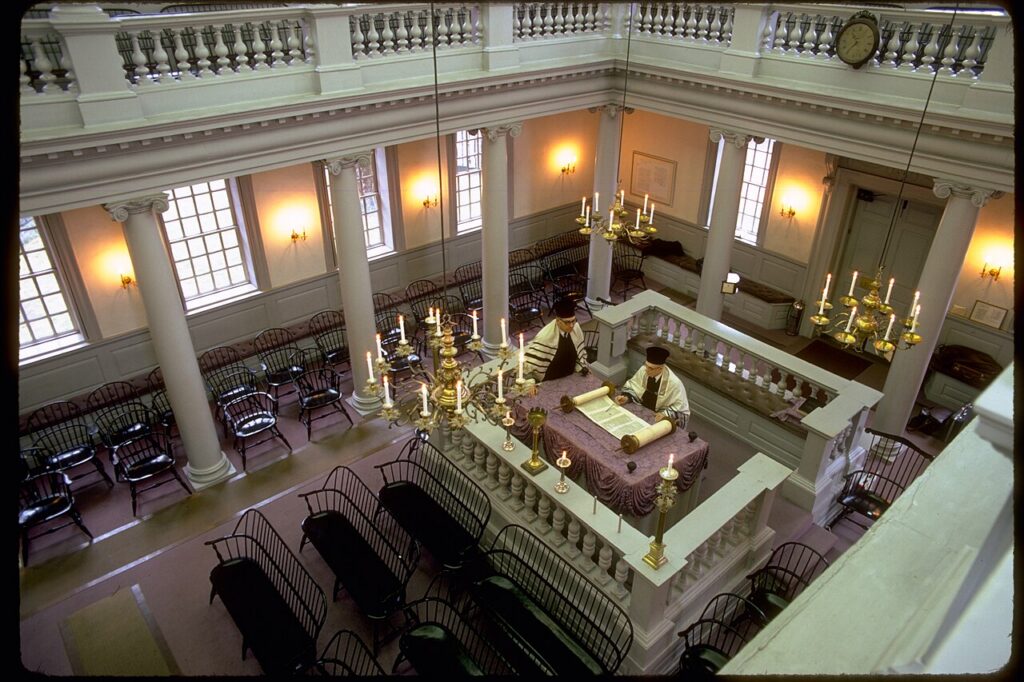

As America prepares to celebrate its 250th birthday, there is one place every American should visit: Touro Synagogue in Newport, Rhode Island.
Completed in 1763, Touro Synagogue is the oldest surviving synagogue building in the United States and one of the great symbols of the American experiment. It was here that President George Washington responded to the Newport Hebrew Congregation with words that have echoed through American history: the new nation, he wrote, would give “to bigotry no sanction, to persecution no assistance.”
Washington’s letter was revolutionary. In much of the world, Jews had long lived by the permission of rulers. In America, they would live as equal citizens. The promise was not simply freedom from persecution, but the opportunity to flourish together under a shared constitutional order.
That vision deserves renewed attention today.
For too long, Jewish-Christian relations have been defined primarily by dialogue about the past. Those conversations remain essential. But our present moment calls us to something more: enduring friendships rooted in a shared commitment to the future of America. As our nation approaches its semiquincentennial, renewing America will require more than better policies. It will require recovering the moral and spiritual inheritance that made ordered liberty possible in the first place.
The Newport Fellowship, a new initiative of Tikvah, seeks to cultivate exactly these kinds of friendships. Bringing together emerging Jewish and Christian leaders in education and public policy, the fellowship invites participants to study the Jewish and Western traditions, build lasting relationships, and strengthen the future of Jewish-Christian relations. Through monthly online seminars and an immersive Shabbat retreat in Newport, fellows will encounter the ideas, texts, and institutions that have shaped both biblical faith and the American experiment.
The choice of Newport is no accident.
Perhaps it is time for Touro Synagogue to become something like an American pilgrimage site.
Not because it belongs only to the Jewish people, but because it tells an American story that belongs to all of us. Within its walls, visitors stand where the Founding generation worshipped and reflected on the meaning of liberty. Washington’s famous 1790 letter transformed the relationship between the Jewish people and the American republic, affirming not mere tolerance but equal citizenship. Its twelve columns symbolize the twelve tribes of Israel, its sanctuary faces Jerusalem, and every detail reminds visitors that America’s commitment to religious liberty was nurtured not in spite of biblical faith, but alongside it.
For Protestants, Catholics, and Jews alike, Newport reminds us that the American experiment depended not upon religious uniformity, but upon a shared moral vision rooted in Scripture, the dignity of the human person, and the freedom to worship God according to conscience.
Faithful Jews and Christians will never agree on every theological question, nor should they. But we do share the Hebrew Scriptures, belief in the God of Abraham, a commitment to the sanctity of the human person, and a profound concern for the future of our civilization. Those shared convictions make genuine friendship—and meaningful collaboration—not only possible, but necessary.
In many ways, Newport reminds us that this partnership is not new. It reaches back to the very beginning of the American story.
As our nation enters its next 250 years, there may be no better place to remember who we are—or who we hope to become—than the quiet sanctuary on Touro Street, where Americans are reminded that people of different faiths can stand shoulder to shoulder in freedom, pursuing the common good together.
Applications for the inaugural Newport Fellowship are now open. Emerging Jewish and Christian leaders in education and public policy who are committed to the biblical renewal of America are encouraged to apply. Fellows will participate in online seminars throughout the fall before gathering for a Shabbat retreat at historic Touro Synagogue in Newport, Rhode Island. There is no cost to participate, and fellows receive a stipend upon successful completion of the program. Learn more and apply at: https://tikvah.org/newport-fellowship/



Comment by Wilson R. on June 29, 2026 at 3:40 pm
Newport should also be celebrated for another reason: More than 150 years before George Washington wrote his famous letter, Rhode Island was the place where religious freedom in America actually began.
The story that people originally came to America for religious freedom is a myth. The Puritans cared about religious freedom only for themselves. To be a Quaker in Massachusetts was punishable by hanging.
The religious freedom that Roger Williams authored in Rhode Island is a rebuke to those who threaten religious freedom today. And the biggest threat comes not from secularists but from Christian Nationalists who try to impose their particular religion, which is hostile to the Way of Jesus, on everyone else, including actual Christians.
Comment by David on June 29, 2026 at 5:07 pm
“In 1776, the British forces took possession of New York City. Many of Shearith Israel’s congregants fled the city, with a significant number of the men joining the military of the American patriots. Several British soldiers desecrated two of Shearith Israel’s Torah scrolls; the [Newport] Congregation maintains these scrolls as historical memorials of the Revolutionary War period. The soldiers who desecrated the Torah scrolls were severely punished by the British military authorities.”
Comment by Wilson R. on June 29, 2026 at 5:37 pm
We like to point to Washington’s letter, and it was indeed a milestone. But the reality is much more complicated. In the early years after the Revolutionary, many states barred Jews from voting, holding public office, or serving on juries. Even after Washington’s letter, getting rid of discrimination by states was a piecemeal effort. For example, North Carolina did not end its ban on Jews holding office until after the Civil War.
Comment by Davie on June 29, 2026 at 9:41 pm
Following in the footsteps of the 1645 Charter of what is now Flushing, Queens, which granted freedom of conscience, the New York State Constitution of 1777 allowed Jews and persons of any religion to vote and hold office, provided they met the usual requirement of property ownership, etc. However, all clergy were prohibited from holding office.
Comment by Wilson R. on June 30, 2026 at 11:15 am
We also owe a debt to the Dutch tradition in New York for America’s legacy of religious freedom. In 1645 New York was still under Dutch control. They weren’t perfect, but they were much more tolerant than the colonies settled by the English. Worth remembering that, when Spain expelled Jews in 1492, they were allowed to relocate to the Netherlands (the philosopher Baruch Spinoza, and one branch of my own family, were Spanish Jews who found a home in the Netherlands).
Comment by Thomas on June 30, 2026 at 12:27 pm
In fact, the Jews escaped from Spain to Portugal in 1492. However, king Manuel I also expelled them in 1497. The Jews from the Iberian Peninsula were often called Sephardi Jews or Spanish and Portuguese Jews. Baruch Spinoza was actually from a Portuguese not Spanish family, and his first language was Portuguese. The Touro Synagogue was started by Portuguese Jews. Thats why the name “Touro” (in Spanish would be “Toro”).
Comment by Thomas on June 30, 2026 at 12:45 pm
A very good article. Its important for Christians to partner these days with Orthodox Jews for the reasons the article shares.
Comment by Wilson R. on June 30, 2026 at 2:01 pm
Just Orthodox Jews? Why not Conservative and Reform Jews as well?
Comment by Thomas on June 30, 2026 at 4:39 pm
Conservative (with some exceptions) and Reform Jews, unfortunately, are very far from original Judaism, to the point of looking often like a new religion. Reform Judaism is very similar to Liberal Protestantism.
Comment by David on June 30, 2026 at 7:17 pm
Reform and Conservative Judaism date from the 19th century, some time after the historical period in question. Peter Stuyvesant attempted to ban Jews from New Amsterdam, but was rebuked by the governing Dutch West India Company, some of whose stockholders were Jewish.
Comment by Wilson R. on July 1, 2026 at 11:53 am
Ah, Thomas, thanks for explaining it to me. I understand the concept. I see the same thing you’re describing in Christian Nationalists, who have invented a new religion that is very far from the religion of Jesus–so much so, as to be hostile to it.