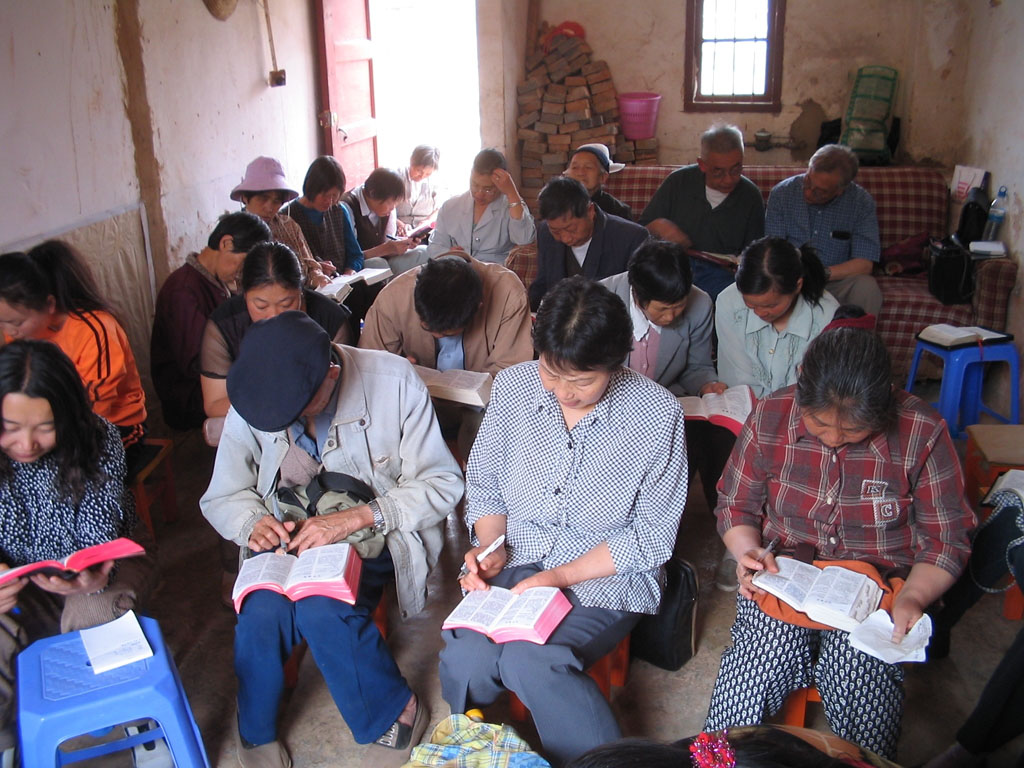
It was August 1998, a year of multiplying expansion for the shadowy Chinese Christian “house church” movement, which I penetrated as a reporter for The Oregonian, a newspaper in Portland.
With President Donald Trump in China this week, an examination of China’s treatment of Chinese Protestant house churches shows no progress since 1998. On the contrary, it reveals a lasting crackdown on religious freedom, the ongoing suffering of leaders who refuse to edit the Bible for promotion of the state and a government that punishes any religious leader with the audacity to place God above the Communist Party.
The U.S. Commission on International Religious Freedom, a bipartisan federal watchdog, has designated China a “Country of Particular Concern” every year since 1999. In an April 2026 news release, the Commission’s vice chair, Asif Mahmood, was blunt: “Under Xi Jinping, religious freedom has worsened to a horrific degree.”
Reporting on the ground in 1998 with the guidance of journalist and author David Aikman, a friend who later wrote Jesus in Beijing, we arranged a landmark meeting in a secret location near Zhengzhou with a dozen Chinese house-church leaders representing an estimated 15 million believers.
For the first time, leaders of the house-church movement gathered in one place, agreeing to be interviewed and photographed by Western media, with their real names used. During a lunch break, the 12 leaders wrote a document outlining their points to the Chinese government, marking the first time house church leaders had issued a joint public statement.
They asked me to publish an article in The Oregonian for Americans first, then deliver their document to Communist officials in China, which I did via FAX and email. What follows is a summary of house-church requests and a sobering assessment of whether things have worsened, improved, or stayed the same.
[Editor’s Note: The author used AI tools to assist with research.]
House Church Requests in 1998
1: Legal Recognition of House Churches Without State Control. Verdict: Worsened.
The 2018 Regulations on Religious Affairs require all religious organizations, clergy, and even online religious activity to be registered with and approved by the state. The Communist Party’s United Front Work Department, which manages relationships between the party and groups it considers potential threats, now directly supervises all religious affairs. State-approved churches must incorporate Communist Party ideology into their worship. Independent churches that refuse to register face closure, property confiscation, fines, and the imprisonment of their leaders.
2: Release of House Church Christians from Labor Camps. Verdict: Worsened.
In 2024, China had the highest number of individuals detained for religion of any country on earth, 810 confirmed cases, according to ChinaAid. The mechanisms of imprisonment have evolved: where the government once relied on labor camps, it now uses criminal prosecution and flexible charges that criminalize ordinary religious activity. Tithing to an unregistered church, participating in an online Bible study, or receiving theological training abroad can each constitute an illegal act.
3: Define ‘Cult’ in a Way That Does Not Include House Churches. Verdict: Worsened.
The government has responded not by clarifying the definition of “cult” but by expanding its tools of criminalization. Under Xi Jinping, “fraud” charges have emerged as a flexible new instrument for prosecuting house church leaders. Because the government does not recognize unregistered pastors as legitimate clergy, it can characterize donations to congregations as funds obtained fraudulently.
4: Open Dialogue Between the House Church Movement and the Government. Verdict: Worsened.
The Chinese government never formally responded to the 1998 statement. No dialogue between the government and house church representatives has occurred in the nearly three decades since. Under Xi, the very concept of negotiation between the state and independent religious organizations has been abolished. The government’s position is no longer that house churches are misunderstood. Independent religious organizations are, by definition, threats to national security.
5: Recognition That House Church Christians Are Mainstream, Not Foreign Agents. Verdict: Worsened.
The 1998 statement explicitly argued that house church believers are part of “mainstream Christianity in China.” This fact, the signers noted, is “recognized internationally.” Xi Jinping’s Sinicization campaign (his policy of subordinating all religious practice to Communist Party ideology) is premised on the opposite assertion. Christianity is characterized by the government as a foreign religion, and any expression of it not subordinated to the party is treated as Western cultural infiltration.
On the surface, the deterioration of religious freedom for Chinese Protestant house churches is discouraging. However, in Beijing, Allan Yuan, considered one of the patriarchs of the Chinese house-church movement, shared a paradox with me.
“All throughout history, Christianity has grown by persecution,” he said.”It’s like a spring. You try to push it down, and it recoils.”
Mark O’Keefe is a journalist and nonprofit communications executive whose reporting from five countries in 1997 and 1998 chronicled the persecution of Christians and was nominated for the Pulitzer Prize. He and his family are active members of The Falls Church Anglican in Falls Church, Virginia.
More from IRD:
Intensifying Religious Persecution in China
The Worsening Situation in China and Vietnam
Christianity in China: An Open Secret, But Often a Dangerous One



Comment by Salvatore Anthony Luiso on May 15, 2026 at 1:09 am
Thank you for this article–I’ve told other people about it and provided them with a link to it.
In the last several months Christians in America have given much more attention than usual to violent attacks on Christians in Nigeria.
That’s good, but they should also give more attention than usual to the persecution of Christians in China.
On the 2026 World Watch List of Open Doors, Nigeria ranks 7th and China 17th. (One can learn more about this list at the websites of Open Doors, such as that of Open Doors US.)
Comment by David on May 15, 2026 at 7:02 am
Unfortunately, places where people are subject to religious persecution are places where the US has little influence.
Comment by Different Steve on May 15, 2026 at 8:49 am
Article is about China, not “places”. Considering all the business we do with China, and judging by the pomp and circumstance surrounding Trump’s visits, and the deals that have been and are yet to be announced, and the fact that the dollar is the world’s default currency and the world’s most formidable military, and dominance in tech, and thermonuclear weapons, I would say we have more than a little influence in China. And most other “places”.
Comment by David Gingrich on May 21, 2026 at 7:31 am
The Chinese Communist Party is the enemy of free people everywhere.