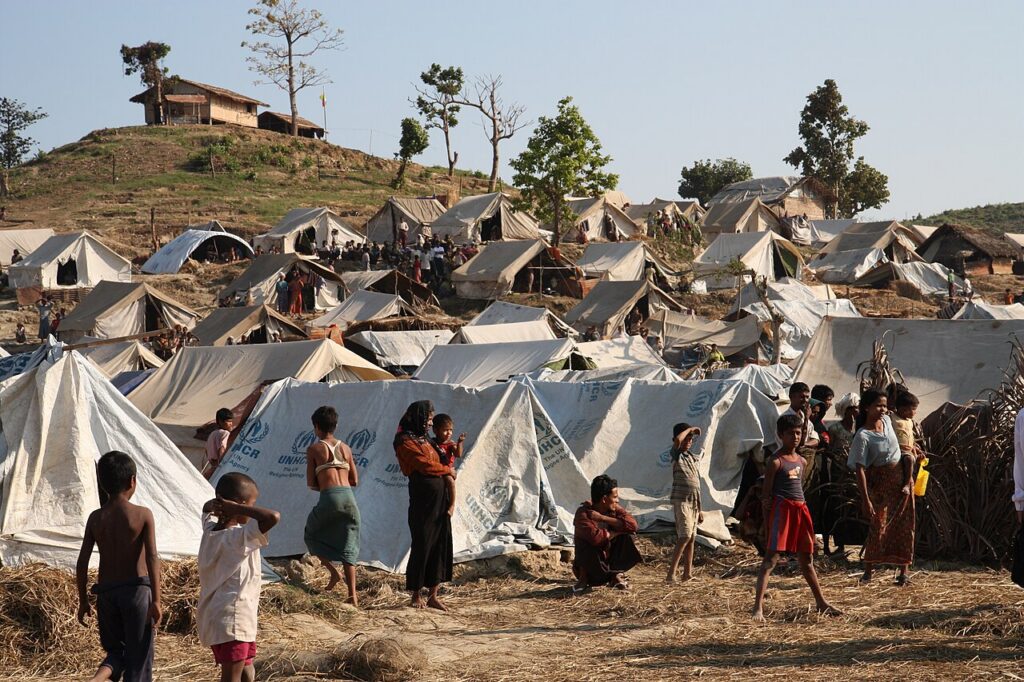

Late last month, Malaysian Prime Minister Anwar Ibrahim announced that Myanmar (Burma) had agreed to take back an initial group of about 5,000 Rohingya refugees living in Malaysia.
A Muslim minority from Myanmar’s Rakhine State, the Rohingya have long been denied citizenship there and faced severe persecution, including a military campaign in 2017 that the U.S. government called a genocide. Many fled to neighboring countries, including Malaysia and Bangladesh. Malaysian authorities began screening people for possible return, but later said they would not send anyone back if their lives would be at risk.
Return remains highly dangerous. Myanmar does not recognize the Rohingya as citizens and large parts of Rakhine State are unstable. A Rohingya advocacy group in Malaysia has said the community hopes to go home one day, but only if there is real safety, stability, and dignity. Rights groups warn that forcing people back under current conditions would put them at serious risk and violate the international rule against sending people to places where they face persecution.
The U.S. Commission on International Religious Freedom (USCIRF) responded on August 14. Vice Chair CeCe Heil warned that forcing survivors back would expose them to armed conflict, forced conscription, and ongoing humanitarian crisis.
Commissioner Gunisha Kaur stated: “The U.S. government has supported the needs of Rohingya fleeing persecution through the World Food Program; now is the time for the State Department to re-double the message directly with Malaysia that its help for these desperate families is both vital and appreciated. Pushing Rohingya into the hands of their persecutors would contribute to perpetuating ten years of atrocities that have impacted many of Burma’s vulnerable religious groups.”
Who are the Rohingya?
The Rohingya are an Indo-Aryan-speaking, predominantly Sunni Muslim people from Rakhine State in western Myanmar. Their ethnic status and citizenship remain politically contested. Myanmar’s government does not recognize them as one of its 135 official national races. It labels them “Bengalis,” denies them citizenship under a 1982 law, and has subjected them to repeated campaigns of violence. The United States government has determined that the 2017 military operations against them constituted genocide.
Joint Government of Bangladesh–UNHCR registration data recorded 1,202,034 Rohingya refugees in Bangladesh as of July 31, 2026. In Malaysia, approximately 126,000 were registered with UNHCR in early 2026, the largest single refugee group there, with additional unregistered individuals present. Estimates of those remaining inside Myanmar range from 500,000 to 600,000, concentrated in Rakhine State. Pre-2017 estimates placed about one million inside Myanmar. Worldwide totals, including diaspora communities, are commonly estimated between 2.5 and 3.5 million. Approximately 12,000 to 13,000 Rohingya live in the United States. An NPR report in 2025 described a “some 12,000-strong” population, while PeopleGroups.org lists about 13,000. Local concentrations exist in places such as Milwaukee.
The largest concentration remains in Bangladesh. After the 2017 military campaign, more than 700,000 fled across the border. Most settled in Ukhia and neighboring Teknaf in Cox’s Bazar District. As of July 2026 the joint registration figure for the camps stood at about 1.2 million.
Settlements sit on steep, deforested hillsides with dense bamboo-and-tarpaulin shelters. The situation is a long-term crisis with recurring dangers. Monsoon landslides regularly collapse hillsides. In July 2026 multiple landslides killed at least eight people in one incident at Camp 5, including seven children when a wall and earth buried a girls’ madrasa. Between 2021 and mid-2026 landslides killed at least 28 people according to UNHCR. Funding shortages have reduced slope-stabilization work. Periodic large fires destroy hundreds of shelters. Shootings linked to rival armed groups, occasional attacks near the camps, and drug trafficking continue. The camps remain overcrowded, with limited livelihoods, restricted movement, and pressure for repatriation under conditions many refugees and rights groups still call unsafe.
Malaysia is a Muslim-majority country whose population is predominantly Sunni Malay. The Rohingya share the same broad religious identity. In principle, Islamic teaching calls for care of the stranger. In practice that ideal collides with local politics, economics, numbers, and nationalism. More than 126,000 registered Rohingya form the largest refugee population in Malaysia. Their presence produces informal settlements, competition for low-wage work, and pressure on local resources. Shared faith has not prevented hostility.
In Malaysia mid-2026 online campaigns of hate speech, fabricated claims, and petitions demanding their “removal” surged. At least nine community schools closed after threats and social-media complaints. A twelve-year-old girl stopped attending class after two men threatened to beat her and asked whether she intended to take over the country. Activist Sharifah Shakirah reported that children were afraid to leave their homes. In late July more than one hundred Rohingya, including women and children, were driven from an informal settlement in Penang. They traveled to the UNHCR office in Kuala Lumpur seeking protection and were detained by police before later release.
The situation remains a political and moral deadlock. More than 1.2 million Rohingya live in Bangladesh camps. Roughly 126,000 are registered in Malaysia. About 12,000 to 13,000 have been resettled in the United States. Several hundred thousand remain inside Myanmar under contested conditions. The Rohingya cannot safely return. Malaysia does not want them to remain indefinitely. The principle of non-refoulement forbids sending people back to places of persecution. Scripture commands care for the stranger: “Thou shalt neither vex a stranger, nor oppress him: for ye were strangers in the land of Egypt” (Exodus 22:21, KJV). Civil authority bears a duty not to deliver the vulnerable into the hands of those who have already targeted them.
The USCIRF is an independent advisory commission. It monitors religious freedom, publishes reports, and makes recommendations to the President, Secretary of State, and Congress. It has no operational authority. It cannot order action, allocate funds, impose sanctions, or compel Malaysia to change course. Any practical effect depends on whether the State Department elevates the issue.
Alex Littlefield, PhD, is a former Assistant Professor of International Trade in Taiwan and Teaching Fellow in China. His research areas include international trade and regional security. His most recent publication is a book chapter on China’s nuclear forces in Learning to Love the Bomb: Understanding the American Nuclear Arsenal (Cambria Press, 2026). He lives in Washington, DC, and serves as an independent scholar and Fellow with the National Institute for Deterrence Studies.
Further Resources:
Malaysian government position (Fahmi Fadzil, post-Cabinet press conference, 5 August 2026) via New Straits Times (closest official record)
USCIRF official statement (14 August 2026)
Reuters: Rohingya schools closed amid online hate (July 2026)
Rohingya population and dispersion
More from IRD:
Karen Christians Rally for Recognition of Burma’s Genocide
Spotlight on Malaysia’s Religious Freedom Restrictions
No comments yet




Leave a Reply