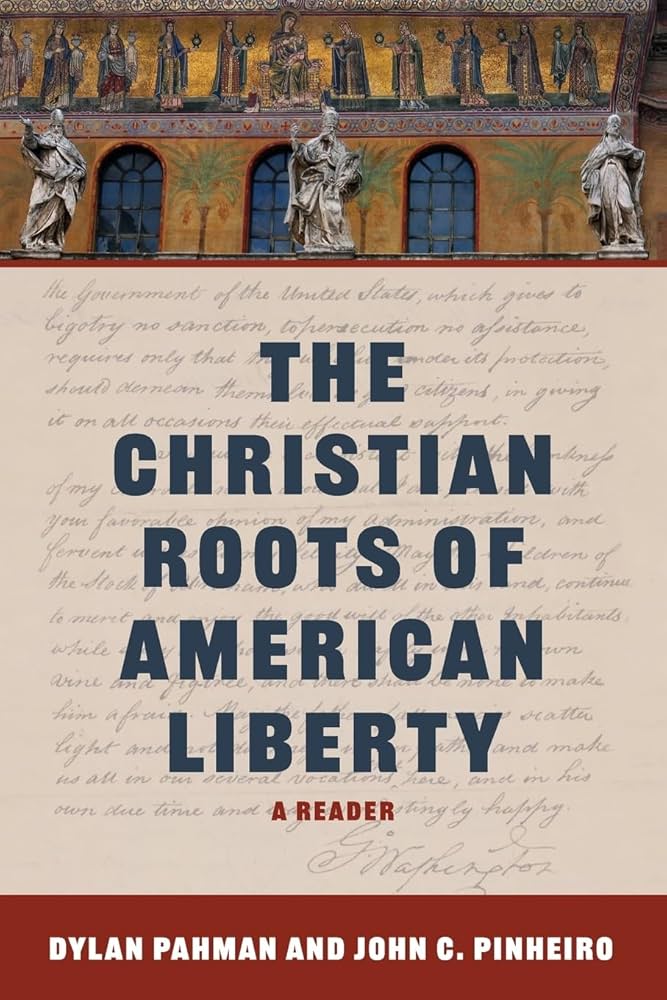

Centuries of Christian ideas shaped the American founding, even as today new movements on the Right are dismissing the founding as hopelessly secular.
This week I spoke with authors Dylan Pahman and John C. Pinheiro to discuss their new book The Christian Roots of American Liberty: A Reader.
I hope that you enjoy our conversation viewable on the IRD YouTube channel below or downloadable as podcast audio on our SoundCloud account.
More from IRD:
The Bible’s Significance for the American Founders
How Anglo-American Christianity Advanced Ordered Liberty
Independence Day and Christian Liberty




Comment by David on May 4, 2026 at 3:31 pm
There are a few clunkers in this talk. Firstly, the only form of government to come out of Christianity was divine right monarchy. “Fear God, honor the king/emperor” (1 Pet. 2:17). The First Commandment is not an especially tolerant declaration and is actually “un-American.”. It was the rejection of religion that led to religious freedom. Jefferson and Franklin would not be considered Christians today. Franklin and Washington’s views on religious freedom can be traced to Freemasonry. While members are required to believe in a “higher power,” of the member’s choice, religion cannot be discussed at Masonic meetings.
Voting for officials goes back to the ancient Greek democracy and the Roman Republic, not the Dominicans.
Some states had established denominations, and others did not. The last to disappear was in the land of the Puritans in 1833. There was a goodly number of refugees from this area to more liberal regions as New York, which was founded by the Dutch solely for trade and not religion. “You may therefore shut your eyes, at least not force people’s consciences, but allow everyone to have his own belief, as long as he behaves quietly and legally, gives no offence to his neighbors and does not oppose the government.”—The Dutch West India Company to Peter Stuyvesant (1663). Early visitors to Pennsylvania were astonished by the diversity of belief and non-belief found there.
Nowhere do I see “limited government” in the Constitution. Instead, I see, “promote the general Welfare” [a state of prosperity, health, and happiness]. This can include many things.
Comment by Wilson R. on May 5, 2026 at 9:45 am
To add to what David writes, the Christian roots of religious intolerance are just as deep as those promoting religious liberty. The idea that the Puritans came here for religious liberty is mostly a myth, since they denied religious freedom for everyone but themselves. Quakers in Puritan Massachusetts were subject to hanging. The true advocates of religious liberty in Massachusetts, like Roger Williams, were driven out.
The founding principle that all men are created equal is certainly religious in nature and, arguably, the most important of America’s founding ideals. But to call it a Christian idea ignores that it is rooted in Judaism.