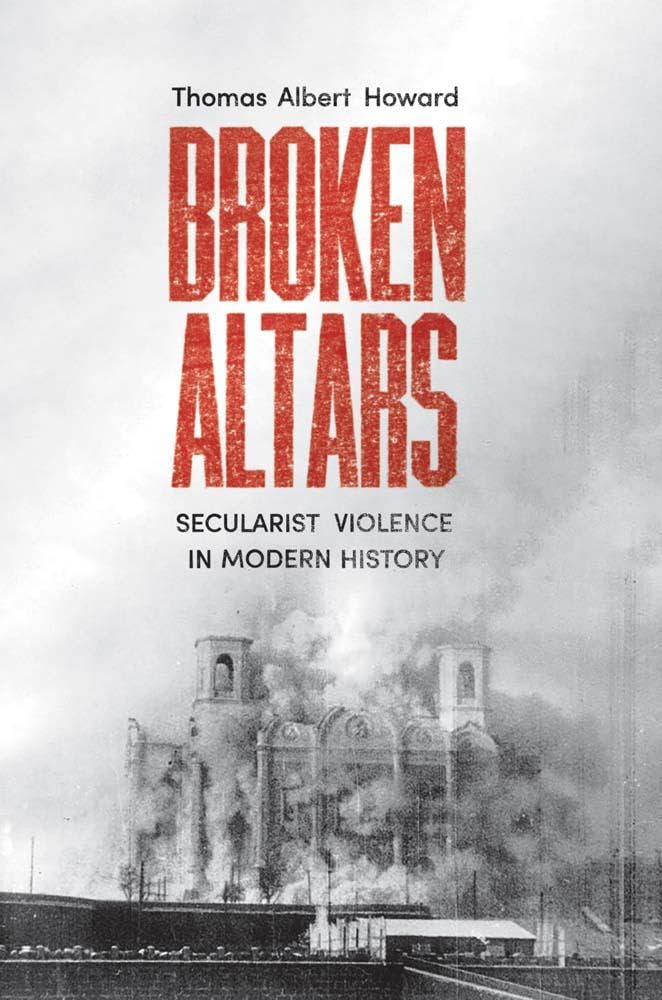
Here Tal Howard of Valparaiso University discusses his recent book Broken Altars: Secularist Violence in Modern History (Yale University Press, 2025). Enjoy!

Here Tal Howard of Valparaiso University discusses his recent book Broken Altars: Secularist Violence in Modern History (Yale University Press, 2025). Enjoy!




Comment by Wilson R. on April 9, 2026 at 12:21 pm
Here’s a blurb from Google about the book:
“Howard categorizes secularism into passive, combative, and eliminationist types, focusing on the latter two, and uses case studies from the Soviet Union, China, Mexico, and Turkey, among others, to show how state-sponsored atheism and anti-religious ideologies led to persecution, imprisonment, and mass death. The book contends that Westerners often fail to recognize this violence because they mistake passive secularism (where religion is separate but tolerated) for secularism as a whole.”
While this contention may be true, so far as it goes, I think the reverse is also often true: Conservative Christians often fail to recognize that much of the secularism they rail against is the passive variety that is tolerant or even respectful of Christian religious beliefs but insists on a clear line between church and state. For example, banning Christian prayers forced upon school students every morning via the PA system is not persecution, but merely an insistence that prayer be voluntary.
A problem with the author’s argument is that it doesn’t seem to provide much context for what made some of the “secular” regimes he profiles to be hostile to Christianity. Marx thought communist revolutions would happen in industrial nations like Britain and Germany rather than more backward places like Russia. Yet it’s hardly surprising that the Bolsheviks were anti-Christian because, in Russia, the church had been so closely identified with the oppressive czarist regime.
Had Howard widened his focus beyond modern secularist regimes, he might have found a useful parallel to Russia in revolutionary France. The Jacobin government was almost as anti-religious as the Bolsheviks, even renaming the months of the Christian calendar and beheading “refractory” priests. Yet, again, their persecution of the church was not surprising given that the Catholic Church in 1789 France was second only to the crown as a feudal landowner (and oppressor of peasants. The Church was so identified with the ancien regime that it was actually the First Estate–and many of the high officials in the French church were from noble families.
In such regimes as France and czarist Russia, you can’t rebel against a tyrannical regime without rebelling against the Church, because the Church has been a partner in oppression. Combative/eliminationist secularism are two possible byproducts of that unholy partnership between church and state; in Latin America, Liberation Theology was a different type of byproduct. Mainstream Christians in the US may dislike all of those byproducts, but they seldom stop to consider that they all have been reactions against un-Christian things the Church did in those countries.
Comment by Different Steve on April 10, 2026 at 5:52 pm
Wilson R.’s comment does indeed appear to be based almost entirely on the Google Books blurb he quotes at the beginning, not on Howard’s own discussion in the video interview that Tooley posted.
Here’s why that’s a significant flaw in his critique:
1. He critiques a summary, not the argument presented in the video
Tooley’s article says, “Here Tal Howard discusses his recent book… Enjoy!” — implying the video is the main event. Wilson jumps straight to the Google blurb, never referencing anything Howard actually says in the interview. A good-faith critique would watch/listen first, then engage with Howard’s own framing, examples, or qualifications.
2. The blurb may flatten or simplify Howard’s actual thesis
Howard’s video discussion likely provides nuance about what he means by “secularist violence,” how he defines the three types of secularism, and whether he acknowledges the church-state partnership problem. Wilson assumes the blurb is sufficient, but book blurbs are marketing copy — they compress arguments into provocative claims. Critiquing a blurb is like reviewing a film from its poster.
3. Wilson’s “reverse is also often true” point might already be addressed in the video
Howard may well agree that conservative Christians mislabel passive secularism as persecution. He might even say so in the interview. Wilson doesn’t know — because he didn’t watch. His comment thus risks being a straw man: refuting a version of the argument he imagines from 150 Google-summarized words.
4. The historical parallels (France, Russia) might be covered or contextualized by Howard
Howard could discuss revolutionary France in the video, or explain why he starts with “modern” secularist regimes (post-1917). Wilson doesn’t engage with whether Howard actually missed France — he just assumes he did. That’s a critique based on absence of evidence, not evidence of absence.
5. The comment functions as performance, not engagement
Wilson seems more interested in registering his own (reasonable) point about church-state entanglement than in actually testing whether Howard’s book withstands scrutiny. He uses the blurb as a launching pad for his own mini-essay, not as something to be seriously examined.
Bottom line:
Wilson’s comment is thoughtful in isolation, but as a response to Tooley’s post featuring Howard’s video, it’s superficial. It critiques what a Google algorithm summarized, not what the author actually argued on the record. A responsible comment would at minimum acknowledge, “I haven’t watched the video, but based on the blurb…” — or better, watch first.