The Trump administration’s decision to launch an attack on Iran on Saturday has met with division among prominent Christian voices. Some evangelicals shaped by premillennial dispensationalism view the war through a lens of Revelation’s apocalyptic prophecy about the final day of judgment, while others support or oppose the attack for varying reasons.
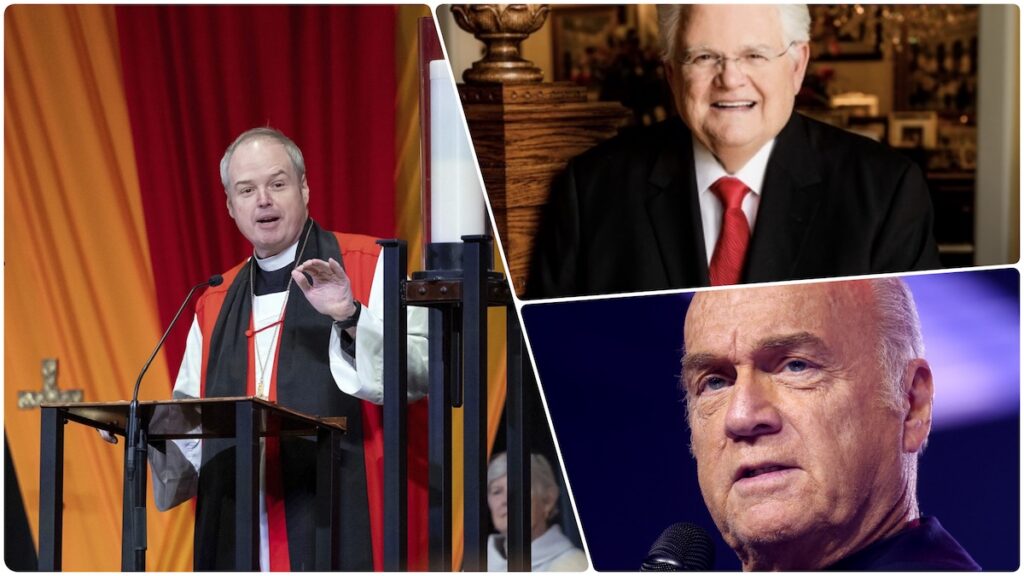
Christians preaching end-times rhetoric include Harvest Christian Fellowship Senior Pastor Greg Laurie and televangelist John Hagee. Laurie connected modern day Russia to “Magog,” from the book of Ezekiel chapter 38 which prophesies that Magog will attack Israel and be destroyed by God in recompense.
“One of the allies of Magog is Persia,” Laurie determined, “now known as Iran.” Although he does not believe Magog has yet attacked Israel, he calls for Christians to be prepared for the Rapture to come after.
Hagee, founder and chairman of the Christian Zionist organization Christians United for Israel, furthers this connection between Russia and Magog. In his Sunday, March 1 sermon, titled “God’s Coming…Operation ‘Epic Fury,’” Hagee claimed that Russia would invade Israel with “what’s left of” Iran, Turkey, and other “Islamic groups.” God would then destroy a third of these forces, as detailed in Ezekiel.
Among other Christian voices supportive of the war are Babylon Bee satirist Seth Dillon and conservative radio show host and Family Research Council President Tony Perkins. Dillon posted on X saying, “God bless President Trump and the United States of America.” Perkins described himself as “grateful” for Trump’s actions, declaring the attack “necessary and justified,” and called for believers to take care of the spiritual battle.
Christians including Trump spiritual advisor Paula White-Cain and New York Times bestselling author Allie Beth Stuckey declined to make political or theological statements on the war, instead asking for prayers.
However, the war also has its fair share of Christian detractors, both conservative and liberal. Right-wing commentator Matt Walsh vehemently opposes the war, stating that “the freedom of Iranians is not our responsibility” and describing the administration’s messaging on the issue as “confused.” Catholic pro-life activist Lila Rose reposted a statement by Pope Leo XIV expressing concern over the diplomatic breakdown and has since posted about the missile strike on a school that Iranian sources claim killed over 150 people. In another post, Rose declared, “Children and civilians must NEVER be targeted in war.”
The New York Times columnist and religion writer David French, who identifies as Christian, opposes the war on the grounds of Congressional war powers. To an X clip of Secretary of State Marco Rubio explaining why the administration attacked Iran, French replied, “This was the case that should have been taken to Congress. There was zero reason not to take [it] to Congress.”
American Catholic philosopher and Pasadena City College Professor Edward Feser argued against the war based on just war doctrine, claiming that “No Catholic can support” a war without a “concrete and realistic plan to make sure what follows is not even worse.” Doing so would be just as bad as supporting abortion or euthanasia, he stated.
Episcopal Church Presiding Bishop Sean Rowe authored a letter to church members expressing concern over the attack. He admitted to watching the “escalating response of the U.S. government” with “alarm” and called on Christ as the Prince of Peace. Similarly, Evangelical Lutheran Church in America (ELCA) Presiding Bishop Yehiel Curry was “distressed” that “congressional authorization did not occur prior to…this war.”
The unfolding war in Iran shows American Christians divided not only politically, but philosophically and theologically as well. While some premillennial dispensationalist Christians interpret the war as a sign of apocalyptic prophecy, others make no theological claim, only grief for the suffering and the dead. Some argue for or against the war on the basis of just war doctrine, while others cite isolationism or Zionism.
More from IRD:
Post-Dispensationalist America


Comment by John on March 5, 2026 at 2:01 am
Every US commander who told their troops over the weekend that we going to help bring about Armageddon and the Second Coming by fighting Iran should be removed immediately. All this panic on the right about Sharia Law when we should have been worried about Dooms Day Christians in the Pentagon with the fingers on the missile switches. God save us from ourselves!
Comment by Salvatore Anthony Luiso on March 5, 2026 at 2:41 am
Thank you for this article.
Regarding “David French, who identifies as Christian”: French is an evangelical Christian, and has been one since his childhood (unless one considers him to have been a fundamentalist until he became an evangelical as a young adult).
Unlike Laurie, Hagee, Dillon, Perkins, and others who approve of Trump’s war, French is also a constitutionalist. Which is to say: he believes that a president who swore an oath to “preserve, protect and defend the Constitution of the United States” should keep that oath. Likewise with members of Congress who swear an oath to “support and defend the Constitution of the United States against all enemies, foreign and domestic” and “bear true faith and allegiance to the same”.
Regarding this war and prophecy: I have long known about what premillennial dispensationalists say will happen with respect to Iran, e.g. that Russia, Iran, and other nations will attempt to conquer Israel but God will protect and deliver Israel by devastating them. I have NEVER heard a premillennial dispensationalist say that the Bible says the United States and Israel will start a war against Iran for the purposes Trump and Netanyahu say they have.
Note: I am well aware that both the United States and Iran have been hostile toward each other and in conflict with each other for many years. However, there’s no comparison between that and the open warfare Trump has started. What we had before was either a cold war or, at most, a tepid war: not the hot war we have now. Likewise with Israel and Iran. Engagement in a cold war or a tepid war does not justify starting a hot war.
Comment by Wilson R. on March 5, 2026 at 9:37 am
Yes, it’s very interesting that the author here feels a need to say that David French “identifies as a Christian” but makes no such qualification for right-wingers like Matt Walsh, Tony Perkins, and the notorious Allie Beth Stuckey. She appears to accept their Christianity at face value, but French gets no such treatment–perhaps because he doesn’t march in lockstep with Magangelicalism? French writes consistently and openly about his Christian faith, and his pro-life positions have earned him attacks from liberals. Meanwhile, Stuckey has shown herself to be an opponent of the Gospel of Jesus.
Sad.
Comment by Miranda on March 5, 2026 at 9:56 am
Y’all, I was simply trying to guess which people were known to be Christian by most, and I figured Matt Walsh, whose X bio says he’s a “theocratic fascist” and Allie Beth Stuckey are more well-known as Christian than someone whose bio describes himself as an NYT columnist…I was attempting to bridge any possible knowledge gap. Apparently not well, but it is what it is.
I get making the worst possible assumptions about everyone is popular on the internet, but it’s really not necessary. For the record, I am far more sympathetic to French than to pretty much anyone else I covered in this article.
Comment by Wilson R. on March 5, 2026 at 10:19 am
The label “theocratic fascist” could apply just as easily to an Iranian mullah or a Taliban leader. Why would anyone assume that such self-identification means “Christian?” It creates the strong impression that Matt Walsh gets the benefit of the doubt because he’s part of the right political tribe, and being in the right tribe these days counts for more in some places than being right with the gospel (as the casual acceptance of Allie Beth Stuckey as a “Christian” voice makes clear.)
Comment by Gary Bebop on March 5, 2026 at 11:05 am
I appreciate Miranda Mobley’s coverage of a situation that is fluid and careering unpredictably. No one commenting here is in charge of the future, and their comments should be regarded in light of their revealed antipathies or clairvoyant powers. Do they have prophetic powers?
Comment by John on March 5, 2026 at 11:33 am
Miranda,
Wouldn’t the mere inclusion of French in an article about different Christian opinions establish the fact that he identifies as Christian without the need for clarification. I don’t doubt your intentions, but it generally good form not to try and second-guess your readers at all or their familiarity with certain names or figures compared to others. Instead you should introduce all of them the same way. I, for instance, had never heard of Greg Laurie at all, but am very familiar with David French and his support for the Benedict Option. I remember Hagee from his hateful rhetoric toward Jews and Catholics in the past, but for some reason I thought he had passed away years ago.
Comment by Salvatore Anthony Luiso on March 5, 2026 at 12:48 pm
Miranda:
Thank you for your explanation. In return, I think I should explain why I was concerned that you said David French “identifies as a Christian”.
Firstly, I didn’t assume the worst about you–but I was concerned.
Second, I expect almost everyone who knows about French knows he identifies as a Christian, because he’s written about his beliefs and experiences as a Christian so often in his opinion pieces, both before and after he became a columnist for *The New York Times*.
Thirdly, because, despite this, there are Christians who accuse him of apostasy, deny that he ever was a Christian, and even call him anti-Christian. Based upon what I’ve seen, the foremost reason for this is because he is a Never Trump conservative, and he is critical of evangelicals and others who support Trump. Which is absurd and extremely sad, but such is the state of Christianity in America today.
Note that French is also a Senior Fellow of The Trinity Forum, which is a Christian organization, and he’s a co-creator of The After Party, which is published by Good Faith. The website of Good Faith says the following about it:
The After Party is a collection of resources designed by the non-profit Redeeming Babel to help you move towards better Christian politics. Our video course, book, and worship music were designed for pastors & people who know there’s a better way to “do politics.” As you engage with our materials, you’ll be equipped & encouraged to do the hard work of engaging across differences, reframe your political identity in light of the Gospel’s promises, and focusing your heart & mind on the “how” of relating to each other before the “what” of political opinions.
Comment by David on March 10, 2026 at 10:55 am
The predictions of the premillennial rapture preachers should be taken with a grain of salt, because they’re simply adding to the pile of failed predictions that have been made over the last two centuries by John Nelson Darby’s successors all bearing their Scofield Reference Bibles. Scratching the itching ears of those who seek signs is their bread and butter. So too should be ignored the selective indignation of cloistered and semi-cloistered clerics. Most are notoriously left-wing pundits who are silent in the face of Islamic tyranny and terror, except of course when it’s one of their preferred left-wing statist Presidents doing the bombing. The main thing to note is that those who shout their support or criticism of governmental policies from pulpits are simply men and women spouting their own opinions, and they often misuse scripture in support of them. The Church Universal would be much better served by clergy who are focused on striving first for the Kingdom of God and helping their parishioners to do the same. Let them ponder these words from a letter of John Wesley to Frances Asbury: “. . . I am afraid that both he [Dr. Thomas Coke] and you differ from me. I study–desire, plan, design–to be little; you study to be great. I creep; you strut along. O, beware; do not seek to be something! Let me be nothing, and ‘Christ be all in all!’ . . . Let others do what they please; but let us know our calling better.”