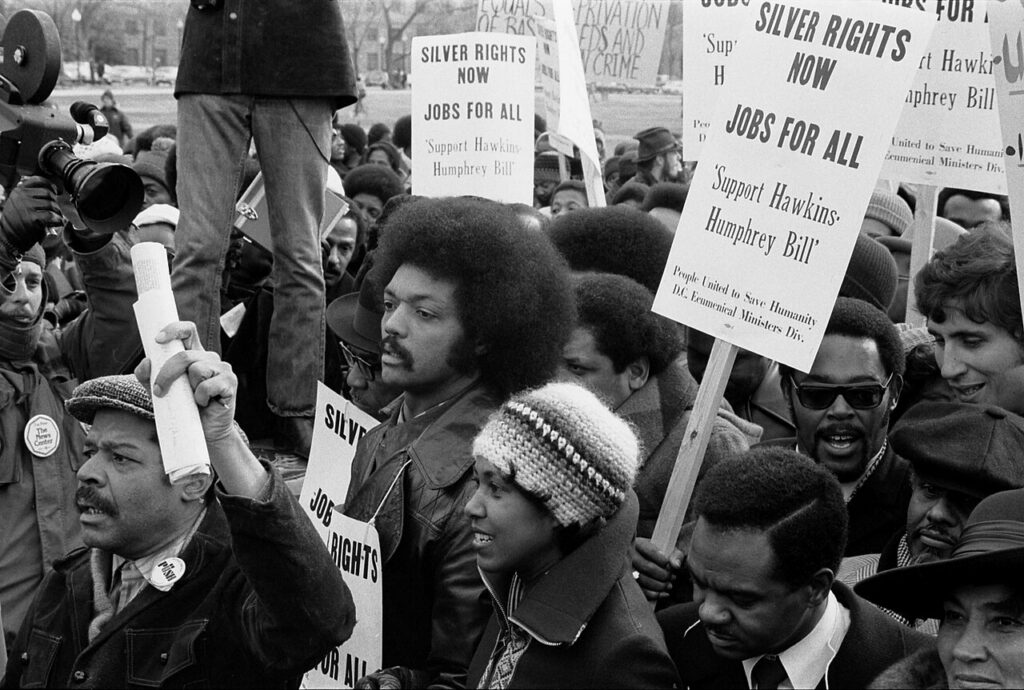

Jesse Jackson’s death represents perhaps the end of two eras. He was an icon of the Religious Left and of the historic black church, both of which have receded from public life, the former almost into oblivion. Jackson was the last great figure of that type.
Jackson was one of the last close associates of Martin Luther King, Jr, having been present at the 1968 assassination. In the 1970s he became a star in his own right, founding Operation Push. A masterful organizer and speaker, he was renowned for his motivational speeches for self-empowerment. He invited young black audiences to chant with him “I am somebody.”
Always ambitious, Jackson was always convinced he was somebody, despite his original poverty and illegitimate birth. He excelled in school and athletics, and a letter of introduction got him a meeting with legendary Chicago Mayor Richard Daley, who offered him a job as toll booth collector. Jackson, with bigger dreams, politely declined. He attended seminary and was ordained a Baptist, although he never pastored a church.
Jackson’s 1970s celebrity elevated him to political influence. He founded the Rainbow PUSH Coalition, shifted left socially, from pro-life to pro-choice, and he ran for the Democratic presidential nomination in 1984 and 1988. His lock on the black vote in Democratic primaries garnered more votes than most expected and enhanced his power. Jackson’s speeches at Democratic conventions were unforgettable barnburners, with only New York Governor Mario Cuomo as oratorical competitor.
In the 1980s, with his new prestige, Jackson focused on foreign affairs. In 1984 he successfully negotiated with Syrian dictator Hafez al-Assad for the release of a downed U.S. airman. President Reagan greeted them both in a White House ceremony. Jackson capitalized on his diplomatic prowess to gain similar hostage releases from dictators in Cuba, Serbia, and Iraq.
Jackson’s stance towards anti-American dictators was at best uncritical. He withheld criticism of Assad, Fidel Castro, Saddam Hussein, Slobodan Milosevic, Robert Mugabe, and others with much blood on their hands. Beyond just retaining his diplomatic equities, he often seemed to sympathize with anti-American tyrants as part of his own global liberationist agenda. In 1986 Jackson hosted Nicaraguan Marxist dictator Daniel Ortega (still in power!) at Jackson’s Chicago headquarters.
Ortega’s Sandinistas were a Religious Left favorite of the 1980s. Although Jackson never pastored a church or led a specifically religious group, he was always “Reverend” and spoke in the cadence of a preacher. He was in the 1980s and 1990s perhaps the highest profile Religious Left figure. His politics were conventionally progressive on nearly all topics but laced with religious rhetoric. At the 1992 Democratic Convention, he called then Vice President Dan Quayle the “Herod of his day” for supposedly, by opposing unwed motherhood, dehumanizing the Virgin Mary. The comment prompted one biblically illiterate network anchor to ask: “Who’s Herod?”
At the height of his influence, the Religious Left was still strong although ebbing. Jackson offered the charisma and oratory that the mostly white Religious Left could never match. He was their beau ideal. Jackson obviously also represented the black church, which is traditionally political and left, although often socially conservative. Black churches gladly supported Jackson during his presidential runs as one of their own.
That was a very different era. The Religious Left now barely exists as an institutional or political force. The historic black church still exists but is declining. Black young people like white young people are far less tied to churches. And young black church goers like young white church goers are more prone to attend non-denominational churches that are likelier multiracial and not tied to old traditions. The historic black church of today could not churn out voters as it did for Jackson in the 1980s and for other candidates.
For decades, much of the historic black church was very political because blacks had been effectively barred from other political institutions. Today the historic black church no longer is as essential to black political organizing, influence, and power. And both politics and religion have shifted from institutions to online influencers. Jackson was masterful behind the pulpit and the rostrum. Could he have been as successful as a podcaster and substacker?
(In 1998 my predecessor as IRD president Diane Knippers was interviewed on television alongside Jackson, and she reported he was, even as an opponent, full of warmth and charm, bantering with her after the interview.)
Jackson streaked through the American political and religious firmament across several decades like a spectacular comet. He never held public office, but he was more influential than most office holders. It’s hard to describe his specific legacy. He was simply a cultural force. And the world he represented is fast fading away if not already gone.
More from IRD:
Churches, Minneapolis, Protests & Riots




Comment by Dan W on February 17, 2026 at 6:44 pm
Herod the Great, whom Jackson compared Dan Quayle to, was responsible for the Massacre of the Innocents (Matthew 2:16-18.) Ironically Reverend Jackson was the one who supported abortion.
Comment by Qohelet on February 17, 2026 at 9:31 pm
The Christian Left might be about to turn Texas blue. The horrors of Christian Nationalism have reminded a lot of believers that sometimes their faith requires standing up to evil.
Comment by David Miller on February 18, 2026 at 11:25 am
The religious left hasn’t disappeared it has become the mainline churches.
Comment by Wilson R. on February 18, 2026 at 11:47 am
I hold no brief for Jesse Jackson. I never cast a vote for him. Never thought he’d have made a good president (MLK wouldn’t have, either.) Didn’t agree with all of his stances. I thought things reached a point where it was often more harmful than helpful when he showed up in a city on behalf of some cause.
Nevertheless, this assessment by Mark Tooley is breathtakingly slanted and reduces a complex person to one dimension that Tooley finds convenient to attack. In that sense, this piece is intellectually dishonest. And even in the age of Trump, intellectual dishonesty is unworthy of someone who claims intellectual credentials.
Here, perhaps, is Tooley’s most revealing sentence: “His politics were conventionally progressive on nearly all topics but laced with religious rhetoric.”
Notice the “but.” Not “and” but “but.” The strong implication is that there is something inherently contradictory between Christian religion and holding progressive views on public policy.
In Mr. Tooley’s shuttered mind, that may be true. But given this obvious blind spot, it’s no wonder he can declare that the “Religious Left” (whenever you want to present something as a monolith, use capital letters, as Tooley does here) is all but dead. Rev. William Barber says hey. James Talarico says hey. Prof. Kristen du Mez and Diana Butler Bass say hey. Kentucky governor Andy Beshear apparently has a new book about how his Christian faith drives his politics; he’d like to say hey, too.
Just as Mark Tooley claims that people aren’t being labeled as anti-semitic because they criticize Israel’s government, he is apparently oblivious here, too, to the millions upon millions of Americans whom he would now label as “Religious Left” because they oppose White Christian Nationalism. Whether this obliviousness is willful or simply naive I will leave others to judge.
In any event, this reductio ad absurdam assessment of Jesse Jackson’s life was dishonest, and honesty is supposed to be a Christian virtue.
Comment by Wilson R. on February 18, 2026 at 3:26 pm
One more comment about Tooley’s telling sentence: Saying that his politics were “laced with religious rhetoric” suggests that Jackson’s views were not sincerely held, that religion for him was merely a rhetorical device, especially since he takes pains to point out that Jackson never pastored a church.
Well.
You people are just sad.
Comment by Different Steve on February 22, 2026 at 8:26 am
What Wilson R. Does Well
He identifies a real interpretive issue
Wilson zeroes in on Mark Tooley’s sentence:
“His politics were conventionally progressive on nearly all topics but laced with religious rhetoric.”
Wilson argues that the word “but” implies a contradiction between Christianity and progressive politics. That’s a fair linguistic observation. “But” often signals tension or incompatibility. So he’s not inventing something out of thin air — he’s picking up on rhetorical framing.
He challenges the “Religious Left is dead” claim
Wilson disputes the claim that the Religious Left is fading by citing contemporary figures:
William Barber II
James Talarico
Kristin Kobes Du Mez
Diana Butler Bass
Andy Beshear
That’s a concrete rebuttal strategy — offering counterexamples rather than simply asserting disagreement.
He defends sincerity
In his second comment, Wilson objects to the phrase “laced with religious rhetoric,” arguing that it implies insincerity — that Jackson used religion as a tool rather than as conviction. That’s a reasonable concern; “laced with” can carry a dismissive undertone.
Where Wilson’s Argument Weakens
He substitutes accusation for argument
Wilson calls the article:
“breathtakingly slanted”
“intellectually dishonest”
“shuttered mind”
“You people are just sad”
These are ad hominem attacks. They don’t demonstrate dishonesty; they assert it. Once the tone shifts to moral condemnation, the argument becomes less persuasive and more reactive.
If his claim is that Tooley misrepresents Jackson, he needed specific counter-evidence (e.g., policies, sermons, organizing impact) rather than rhetorical escalation.
He over-interprets motive
Wilson claims Tooley implies:
there is something inherently contradictory between Christian religion and holding progressive views
But that conclusion depends on reading intent into one conjunction (“but”). Tooley might simply mean that Jackson combined progressive politics with explicitly religious language — not necessarily that the two are incompatible.
Wilson treats ambiguity as proof of bad faith.
His counterexamples don’t fully address the claim
Tooley’s argument is not just that religious progressives exist — it’s that the institutional Religious Left of the 1980s (as a mobilized political force tied to black churches and denominational structures) has declined.
Listing contemporary progressive Christians does not necessarily refute the institutional decline argument. Wilson counters a straw version (“no religious progressives exist”) rather than the more specific structural claim.
Emotional escalation undermines credibility
His final line:
“You people are just sad.”
This abandons argument entirely. It signals frustration rather than confidence. For a reader on the fence, that weakens his position.
Strongest Point Wilson Makes
His best critique is this:
Saying Jackson’s politics were “laced with religious rhetoric” can imply religion was ornamental rather than substantive.
That’s the most defensible and intellectually serious objection he raises.
If he had stopped there — calmly — his comment would have been much stronger.
Where Both Sides Simplify
Tooley simplifies Jackson by emphasizing:
association with dictators
progressive stances
decline of institutional Religious Left
Wilson simplifies Tooley by assuming:
hostility to progressive Christianity per se
blindness to modern religious activism
bad faith
Both reduce the other’s position somewhat.
Overall Assessment of Wilson R.’s Comments
Strengths:
Identifies rhetorical framing issues
Defends sincerity of faith-based politics
Offers contemporary counterexamples
Weaknesses:
Overstates dishonesty without proving it
Attacks motives rather than arguments
Emotional tone dilutes credibility
Doesn’t directly refute the institutional-decline thesis
Comment by Thomas on February 23, 2026 at 10:09 pm
Jesse Jackson held strong pro-life beliefs as late as in 1977. You can read about it if you Google them. The fact that he changed his mind isn`t that surprising. The most surprising is that he never explained why he did so. Could he have run for President on a pro-life plataform in 1984 and 1988? Its doubtful. Anyway, the Democratic Party in the 1980s was far from radical or extreme on abortion back then. The Democratic Party supported the legality of abortion in the first weeks of pregnancy and the legal protection of the unborn after that. There were 15 Democratic senators who supported overruling Roe vs. Wade in 1983. Jackson from my understanding had been totally silent on the radical pro-abortion stance now taken by the Democratic Party who states human life before birth is meaningless and want to push women to abortion, taking them the right to decide between life and abortion, by closing pregnancy crisis centers.
Comment by CG on February 25, 2026 at 8:14 pm
I grew up in the 80s and supported Reagan. While 40 plus years ago, Jackson represented the left. Everything he advocated was black centrist. Keep in mind this was 20 years after ’65 after Johnson’s “Great Society” and everyone who voted for that in Congress. I was bussed across town as were many in the 70s, both black and white students, and the great experiment( at the expense of many) has not yielded the desired outcome. Renaming streets, bridges, and schools, and tearing down statues causes us all to question why. Cross town bussing sucked. I’m still hearing there is not enough money for education despite state lotteries going on after nearly 40 years in Virginia. I substituted, was an Instructional Assistant, and taught as a Teacher. The system is broken and glad I left. Going through the system as a student, trying as an older adult- it is worse than when I was there. Jackson did not help